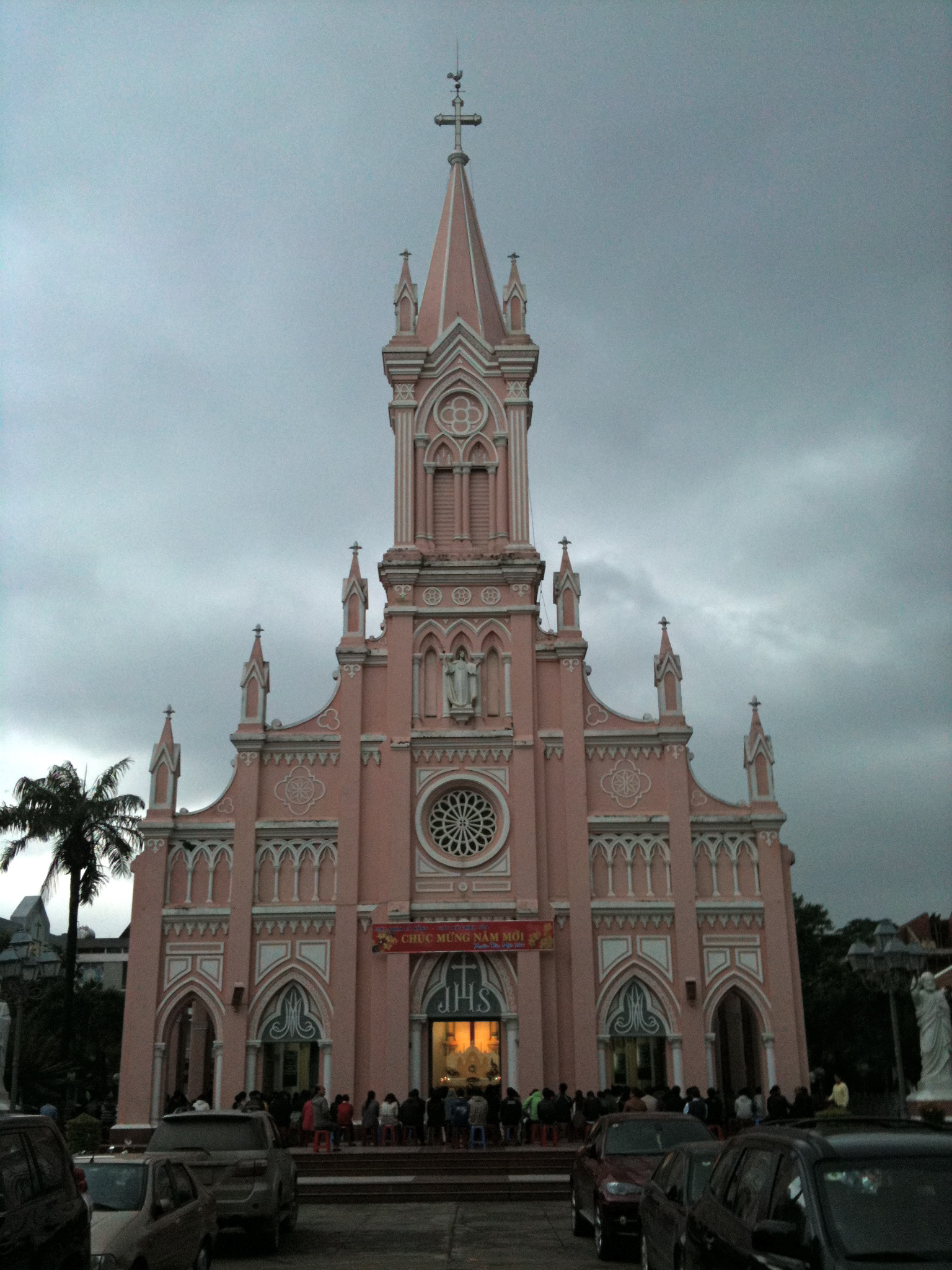
Da Nang’s Cathedral of the Sacred Heart of Jesus is the kind of place that doesn’t demand attention but lingers in the mind long after you’ve left. Built in 1923 during the French colonial period, it sits quietly on a small hill in the city center, surrounded by low-rise buildings and the hum of daily life. From the outside, it’s unassuming—soft pink walls, a pointed bell tower, and stained glass that glows faintly in the midday sun. There’s no grandeur here, no overwhelming scale like in Europe’s great cathedrals. Instead, there’s a quiet authenticity, as if the building has simply existed, unchanged, since the early 20th century.
The architecture blends French neo-Gothic influences with subtle Vietnamese touches. The tower, crowned with a cross, echoes European traditions, while the facade’s delicate patterns hint at local craftsmanship. Inside, the space feels airy, with high ceilings and wooden pews darkened by decades of use. The marble altar is simple, and the stained glass, though not as vivid as in European churches, casts a gentle, diffused light that’s especially beautiful in the morning. There are no gilded decorations or elaborate frescoes, just a straightforwardness that feels unexpectedly sincere.
The cathedral is deeply tied to Da Nang’s history. During the French colonial era, it was both a place of worship and a symbol of cultural influence. After Vietnam gained independence, it remained one of the few Catholic structures in the city, a quiet witness to the changes around it. Today, it still serves its congregation, but it has also become part of the urban landscape, drawing visitors who are curious about the city’s past. A small parish has grown around it, offering a moment of calm in an otherwise bustling city.
One of the cathedral’s most striking features is its location. Perched on a slight elevation, its steps offer a view of Da Nang’s rooftops, palm trees, and, in the distance, the mountains and sea. On hot days, the spot is particularly inviting—a place to sit and watch the city move below. In the mornings, locals gather here to pray or enjoy the cool air, while evenings bring a quiet stillness, broken only by the glow of streetlights on the old walls. The cathedral seems to exist at its own pace, untouched by the usual tourist rhythms.
Though it’s not one of Da Nang’s headline attractions, the cathedral plays a meaningful role in the city’s life. Services are held in Vietnamese and French, and the parish organizes charitable events. For many locals, it’s more than just a church—it’s a place tied to personal milestones: baptisms, weddings, or moments of quiet reflection. In this way, the cathedral is both a historical landmark and a living space where past and present intersect.
Visiting the cathedral offers a different perspective on Da Nang. Unlike the crowded beaches or the Marble Mountains, this is a place where time slows down. Inside, the air is cool even on the hottest days, and the scent of wood and wax creates a sense of comfort. If you’re lucky, you might catch a service or simply sit in silence, listening to the distant chime of the bell.
The Cathedral of the Sacred Heart of Jesus doesn’t announce itself loudly, but it leaves an impression. It’s unlike the vibrant, fast-paced attractions that define much of Vietnam. Here, the atmosphere is one of quiet, dimly lit spaces and walls that have absorbed decades of stories. Perhaps that’s why it draws people in—because it feels real, unpolished, and untouched by tourism. It’s just a place to pause, reflect, and feel the weight of time.