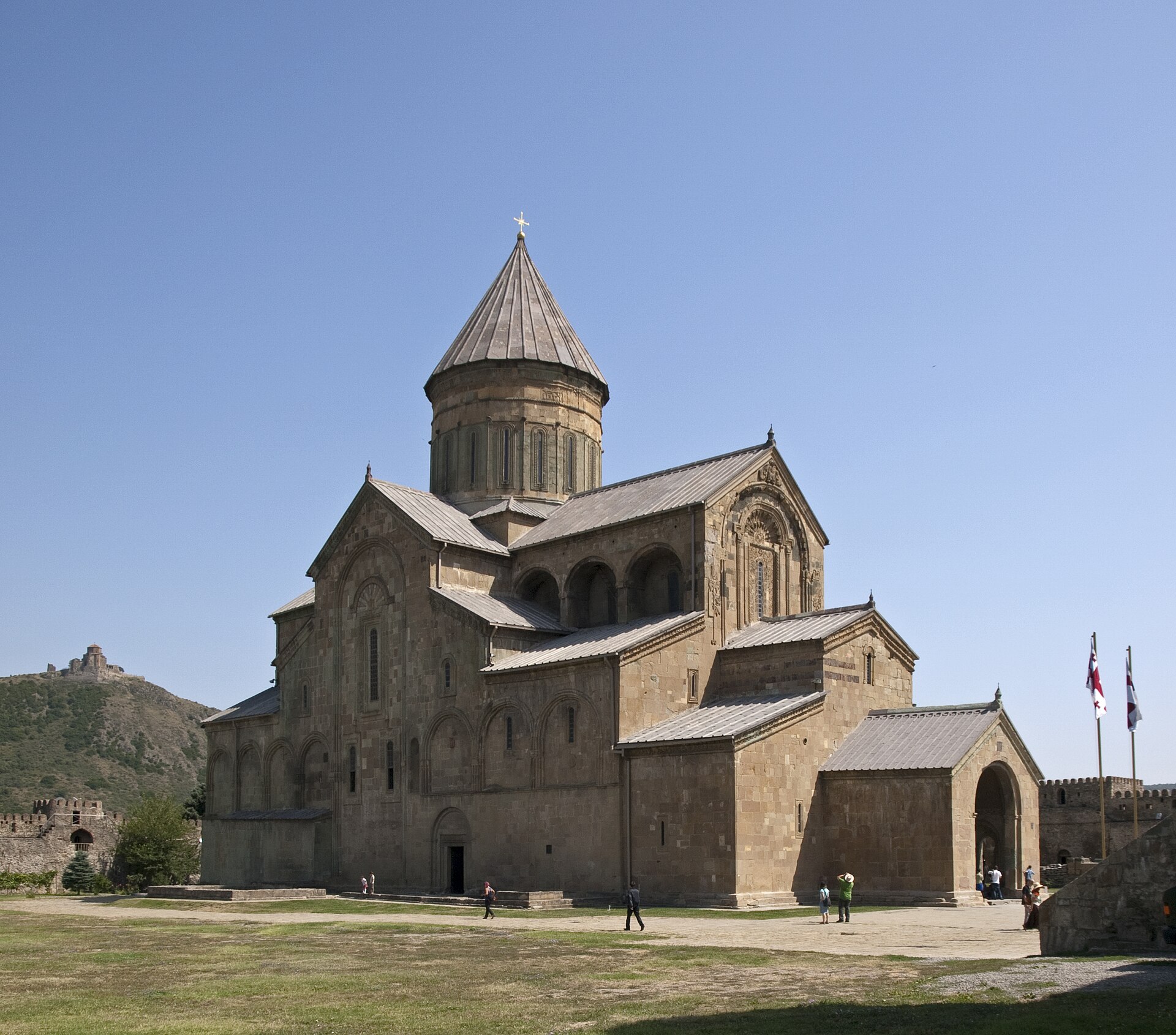
Svetitskhoveli Cathedral stands in Mtskheta, a town that was once the heart of Georgia and remains one of its most sacred places. For over fifteen hundred years, it has drawn pilgrims and visitors, not just as a monument of stone and mortar, but as a living testament to faith and history. The name itself—"Life-Giving Pillar"—hints at the legends woven into its foundations. According to tradition, the cathedral was built where a sacred lime tree once grew, its wood used to construct the first church. From its roots, a pillar emerged, said to exude a fragrant oil with miraculous properties. Whether myth or memory, the story has endured, giving the cathedral a weight that goes beyond its physical presence.
The origins of Svetitskhoveli trace back to the 4th century, when Georgia adopted Christianity as its state religion. King Mirian III, the first Christian ruler, commissioned the earliest church here, while Saint Nino, the woman who brought the faith from the south, baptized the nation along the banks of the nearby Kura River. That first structure did not survive—Persian invaders destroyed it in the 7th century—but the site remained sacred. The cathedral we see today rose in the 11th century under King Bagrat III, becoming a masterpiece of medieval Georgian architecture. Though restored over the centuries, its core has remained intact, a silent witness to the country’s turbulent past.
The cathedral’s design reflects the harmony and strength of Georgian ecclesiastical architecture. Built in the shape of a cross with an elongated western arm, it follows the traditional layout of the era. The central dome rests on four sturdy pillars, while the facades are adorned with intricate carvings and stone crosses. The southern and northern portals, in particular, showcase the skill of Georgian stonemasons, their patterns still sharp despite the passage of time. Inside, fragments of 12th-century frescoes linger on the walls, depicting scenes from the life of Christ and Georgian saints, though much has faded or been lost to damp and neglect.
Stepping inside, the dim light creates an atmosphere of quiet reverence. The main altar, as in all Orthodox churches, faces east, while a massive chandelier—gifted by a Russian emperor in the 19th century—hangs beneath the dome. But the true heart of the cathedral lies hidden: the pillar that gave it its name. Enclosed behind an ornate screen, it is barely visible, yet pilgrims still approach to touch it, whispering prayers. Nearby, the tombs of Georgia’s last Bagrationi kings rest in the shadows, a reminder of the cathedral’s role not just as a place of worship, but as a symbol of national continuity.
Svetitskhoveli has always been more than a church. It was here that kings were crowned, where critical decisions shaping the nation’s fate were made, and where people sought refuge in times of war. In the Middle Ages, it served as a cultural hub, where scribes copied manuscripts by hand and artisans created works that would outlast their creators. Even after Tbilisi became the capital, Mtskheta and its cathedral remained the spiritual core of Georgia, a place of pilgrimage for those seeking connection with their heritage.
Today, the cathedral remains an active place of worship. Services are held regularly, baptisms and weddings still take place beneath its vaulted ceilings, and the scent of incense lingers in the air. The courtyard outside, with its ancient gravestones and remnants of fortress walls, offers a quiet space to reflect. Mtskheta itself is a town where history feels tangible—ruins of Roman baths, other medieval churches, and the gentle flow of the Kura River all contribute to its timeless atmosphere. Yet Svetitskhoveli remains the focal point, drawing both the devout and the curious.
For Georgians, the cathedral is a symbol of identity, a link to the past that defines their culture and faith. For visitors, it offers a glimpse into a history that is both deeply personal and universally resonant. There is no grand spectacle here, no modern distractions—just the weight of centuries pressing gently against your shoulders. The silence is profound, broken only by the murmur of prayers or the soft footsteps of those moving through the nave.
A visit to Svetitskhoveli is not just about admiring architecture or ticking off a landmark. It is about stepping into a story that began long before you arrived and will continue long after you leave. The cathedral does not demand attention; it simply exists, as it has for generations, a quiet guardian of memory and belief. Whether you come as a pilgrim, a historian, or simply a traveler, the experience lingers—not in photographs or souvenirs, but in the quiet understanding of what it means to stand in a place where time feels suspended.