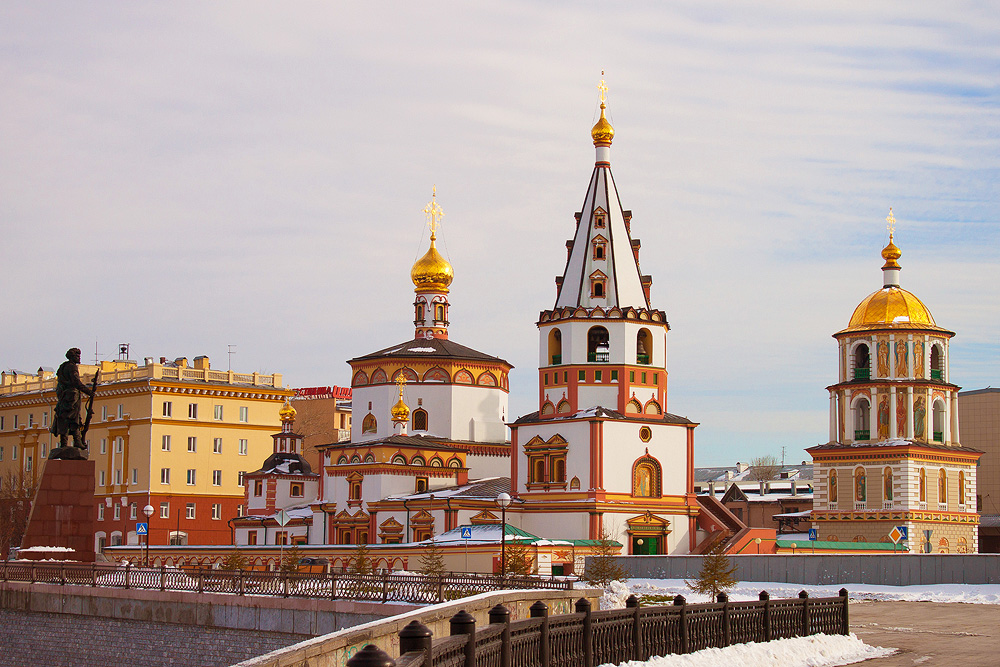
The Epiphany Cathedral in Irkutsk is one of those rare places where time seems to stand still, preserving the layers of the city’s past within its walls. Built in the early 18th century, it wasn’t just a place of worship but a cornerstone of spiritual and cultural life in Siberia. The first wooden structure appeared here in 1718, but within decades, it was replaced by a stone building crafted by local artisans. The cathedral’s architecture blends Siberian Baroque with traditional Russian design, offering a glimpse into the region’s unique history. Its proportions and details reflect both the grandeur of imperial Russia and the practicality of a frontier town, where every stone tells a story of survival and faith.
Over the centuries, the cathedral has weathered fires, reconstructions, and political upheavals. The most significant transformation came after the devastating fire of 1879, which reshaped its appearance into what we see today. The restoration introduced intricate decorative elements, including a lavish iconostasis and frescoes painted by local artists. Inside, the cathedral feels like a sanctuary frozen in time—high vaulted ceilings, gilded domes, and centuries-old icons create an atmosphere of quiet reverence. The craftsmanship speaks of a time when art and devotion were inseparable, and every brushstroke carried meaning.
Beyond its religious role, the Epiphany Cathedral has long been a hub of Irkutsk’s public life. In the 18th and 19th centuries, it housed important city records and chronicles, serving as an unofficial archive of Siberian history. During wars and revolutions, its doors opened to those seeking refuge, offering shelter when the world outside was chaotic. Even in the Soviet era, when many churches fell into disrepair, the cathedral endured, though its role was diminished. The 1990s brought a revival, with restoration efforts carefully returning the building to its former glory. Today, it stands as both a working church and a monument to Irkutsk’s resilience.
The cathedral’s architecture is a study in contrasts. Its facades are adorned with delicate stucco work and columns, while the main entrance is framed by an ornate portal that hints at the craftsmanship of a bygone era. The bell tower, rising above the surrounding buildings, has long been a landmark for those navigating the historic center of Irkutsk. Inside, the frescoes are particularly striking—they depict biblical scenes but carry the unmistakable imprint of Siberian culture. The faces of saints and angels seem to echo the harsh beauty of the taiga, while the colors reflect the muted tones of the region’s landscapes.
Located near the Angara River embankment, the cathedral sits at the heart of Irkutsk, where the past and present coexist. The streets around it buzz with modern life, but stepping inside feels like entering another world. The noise of the city fades, replaced by the soft light filtering through stained glass and the scent of incense lingering in the air. For many locals, the cathedral is more than a tourist attraction—it’s a place tied to personal memories, family traditions, and moments of quiet reflection. Some come to pray, others to admire the artistry, but all leave with a sense of having touched something enduring.
Irkutsk, founded as a fortress in the 17th century, has always been a crossroads of cultures. Russian settlers, indigenous Siberian peoples, and merchants from distant lands all left their mark on the city. The Epiphany Cathedral embodies this diversity, its architecture and history reflecting the influences of different eras. It’s a reminder that Irkutsk isn’t just a gateway to Lake Baikal but a city with a rich spiritual heritage. The cathedral’s walls have witnessed centuries of change, yet it remains a constant—a place where the past is never truly forgotten.
For those interested in the history of Orthodoxy in Siberia, the cathedral holds particular significance. It was one of the first stone churches in the region and, for much of its history, served as the spiritual center of Eastern Siberia. Renowned priests once preached here, and the cathedral played a role in the city’s civic life, hosting gatherings and events that shaped Irkutsk’s identity. Even during the Soviet period, when religious life was suppressed, the Epiphany Cathedral drew the faithful, albeit discreetly. Its survival is a testament to the enduring power of faith in a land where extremes—of climate, politics, and culture—have always been the norm.
Today, the cathedral remains an active place of worship, where services, baptisms, and weddings are held regularly. It welcomes visitors of all backgrounds, whether they come to explore its history, soak in the atmosphere, or simply find a moment of peace. Tourists with cameras mingle with locals attending services, while school groups on field trips listen to stories of the past. Each person experiences the cathedral differently—some see it as an architectural gem, others as a sanctuary for the soul. What unites them is the sense of stepping into a space where time moves differently.
Irkutsk is often called the capital of Eastern Siberia, and the Epiphany Cathedral is one reason why. It stands at the intersection of centuries, a silent witness to the city’s evolution. Visiting it isn’t just about seeing a historic site; it’s about understanding Irkutsk as a living entity, shaped by the people who built it and the forces that have tested it. There’s no rush here, no artificiality—just the quiet dignity of a place that has endured. In a world where so much feels transient, the cathedral offers something rare: a connection to something lasting.