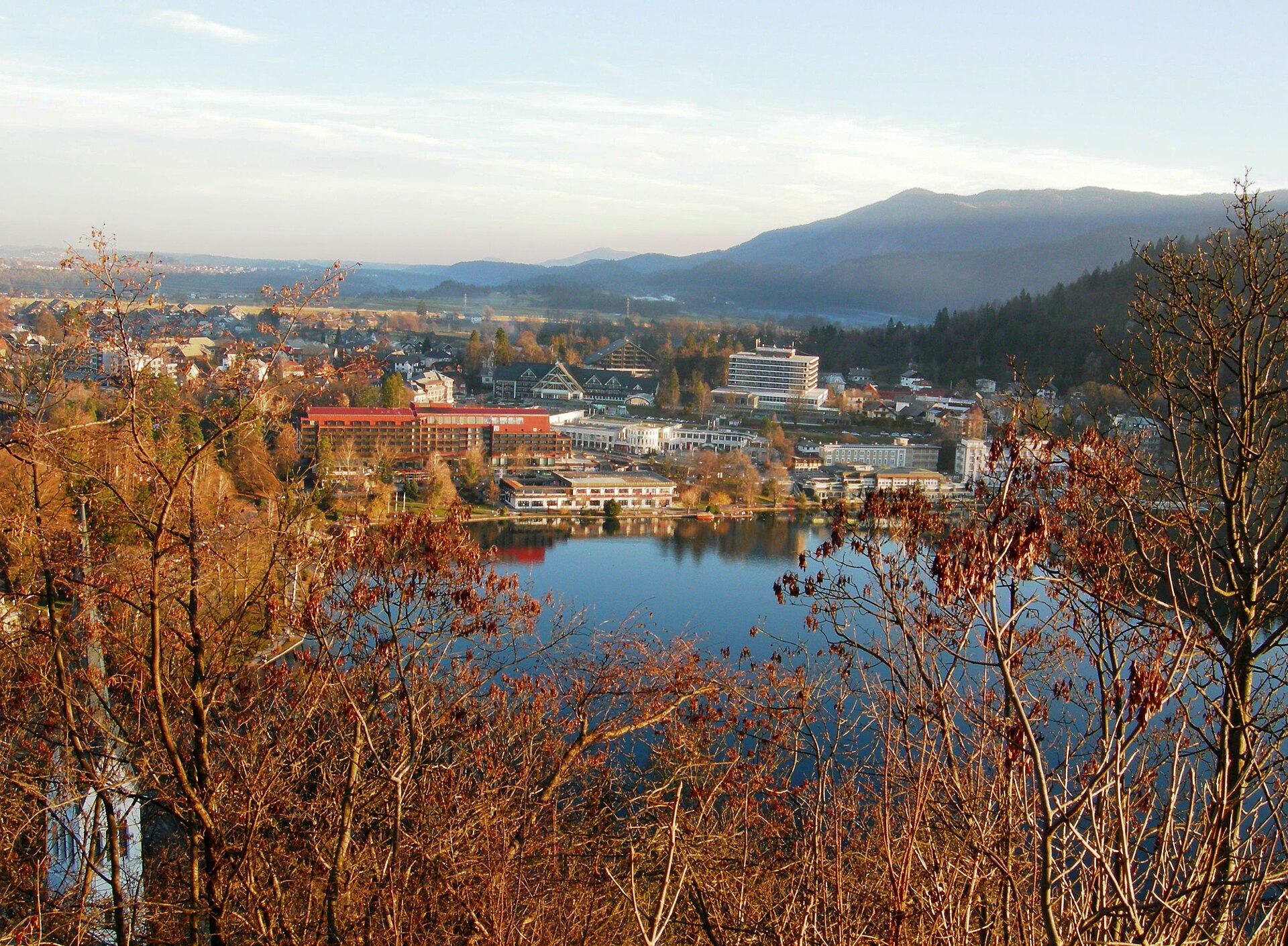
Perched on a sheer cliff above Lake Bled, the castle’s viewpoint offers one of those rare moments when a landscape feels both grand and intimate. The view unfolds like a living painting: the lake’s milky-blue waters stretch below, framed by rolling green hills, while the tiny island church stands alone in the center, its white steeple catching the light. From here, the scale of the scene shifts with the weather—mist softens the edges in the morning, while afternoon sun sharpens the contrast between the dark forest and the shimmering water.
Reaching the castle is part of the experience. The most direct route winds up the cliffside road, a narrow path that clings to the rock, passing under the castle’s stone gate. For those who prefer walking, a steep trail begins near the lake’s edge, weaving through beech trees and past small shrines before emerging at the castle walls. The climb is gradual but steady, and with each switchback, the view expands—first the rooftops of Bled, then the lake itself, and finally the distant peaks of the Julian Alps.
The castle’s history is as layered as the rock it stands on. Its origins trace back to the early 11th century, when it was gifted to the bishops of Brixen, though little remains of that original structure. Over the centuries, it endured sieges, fires, and reconstructions, each era leaving its mark. The medieval core survives in the thick defensive walls, the clock tower, and the central courtyard with its deep stone well. Inside, the museum’s collection—rusted armor, faded tapestries, and a curious assortment of ceremonial masks—hints at the lives of those who once ruled here. But the real draw isn’t the exhibits; it’s the way the castle feels alive with the past. The worn cobblestones underfoot, the creak of wooden stairs, the scent of aged timber and damp stone—all of it lingers in the air like an echo.
The viewpoint itself occupies the highest terrace, where the wind carries the faint sounds of the lake below. On clear days, the Karawanks ridge rises to the north, its jagged silhouette cutting into the sky, while the Julian Alps loom to the west, their snow-capped peaks visible even in summer. The best time to visit is late afternoon, when the light turns golden and the lake’s surface glows as if lit from within. Below, the town of Bled hums quietly—cafés spill onto sidewalks, boats drift toward the island, and the occasional church bell rings across the water.
Though the castle is now a tourist destination, it hasn’t lost its sense of purpose. Weddings are held in the courtyard, where couples exchange vows beneath the clock tower. In summer, classical concerts fill the air with music, while winter transforms the scene into something almost mythical, the castle’s towers dusted with snow against a backdrop of frozen peaks. The café on the lower terrace serves strong Slovenian coffee and local wines, and the small shop sells handmade lace, pottery, and bottles of Bled’s signature dessert wine, a sweet Riesling that pairs perfectly with the view.
The castle’s strategic location once made it a key stronghold along trade routes between Austria and Italy. Later, it became a residence for bishops and noble families, each adding their own touches—new towers, frescoed halls, or ornate chapels. Some of these additions still stand, though time has softened their edges. The surrounding area is just as rich in history and legend. Forested trails lead to hidden viewpoints, crumbling chapels, and the Osojnica waterfall, while nearby caves are said to be haunted by the spirits of those who once lived in the castle’s shadow.
What makes Bled Castle special isn’t just its age or its views, but the way it connects the present to the past. Some visitors come for the photographs, others for the quiet moments of reflection. A few linger in the courtyard, trying to imagine the generations who walked these same stones—soldiers, monks, nobles, and travelers, all drawn to this spot above the lake. The castle doesn’t reveal its secrets easily, but that only makes it more compelling.
Leaving is always difficult. The eye keeps returning to the cliff, to the towers and walls that have watched over the lake for a thousand years. There’s a sense that the place isn’t just a relic of history, but a living part of it—one that continues to shape the stories of those who visit. Whether you stay for an hour or a day, the castle leaves an impression that lingers long after you’ve descended the hill.