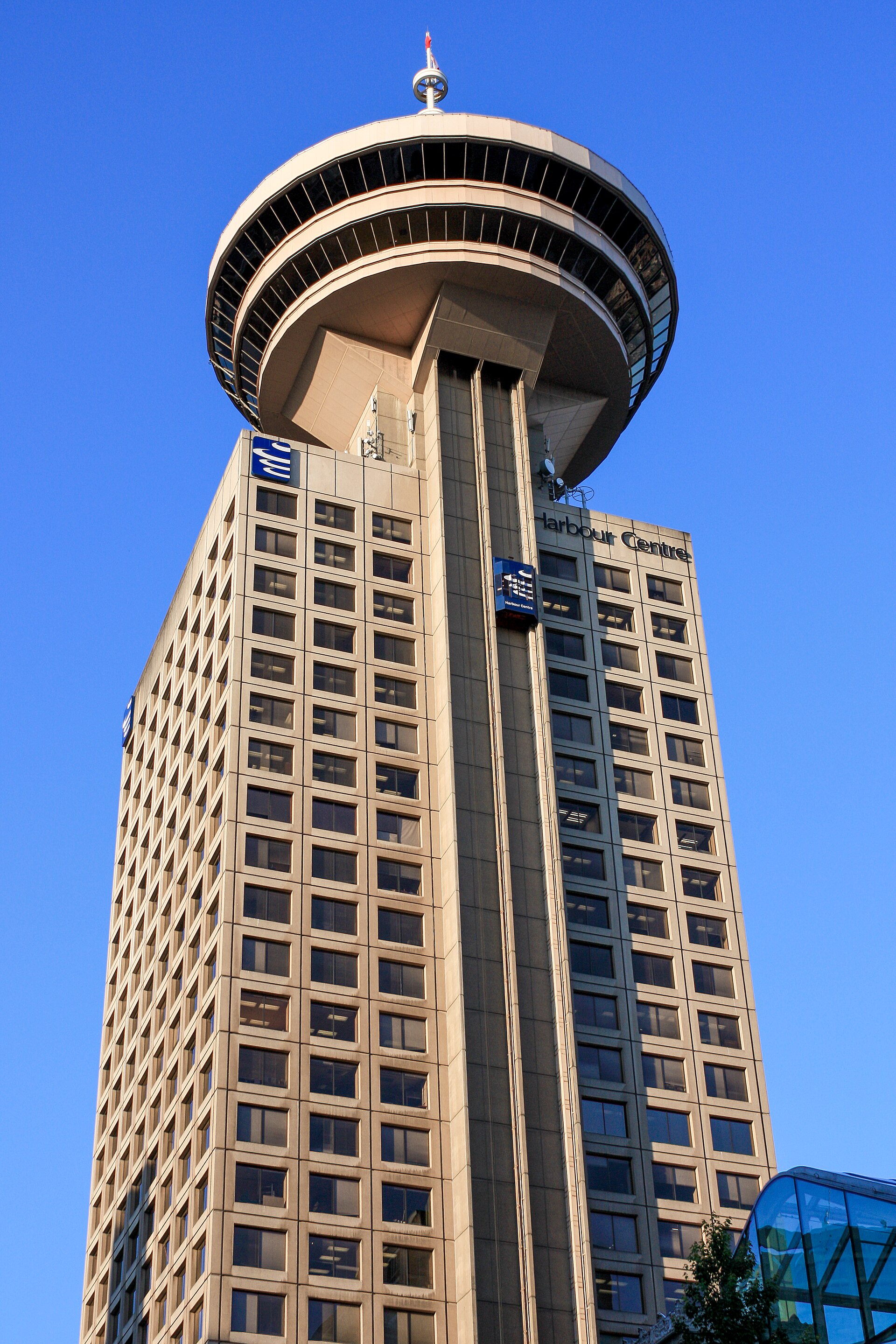
Vancouver is a city where the urban landscape and the natural world blend so seamlessly that it’s easy to forget where one ends and the other begins. Among its towering skyscrapers and sprawling green spaces, the Harbour Centre stands out—not just as another high-rise, but as one of the city’s most recognizable landmarks. At first glance, it appears to be a typical office and retail complex, but its real magic lies above, where the observation deck offers a perspective that reshapes how you see Vancouver and its surroundings.
Built in 1977, the Harbour Centre arrived at a time when Vancouver was still evolving into the metropolis it is today. The city was in the midst of a growth spurt, and high-rises like this one symbolized progress. The building was designed as a mixed-use hub, combining offices, shops, and restaurants with an observation deck meant to draw both tourists and locals eager for a bird’s-eye view of the city. Over the years, it has become more than just a tourist attraction—it’s a fixture in Vancouver’s business and social life, a place where the city’s past and present intersect.
The architecture of the Harbour Centre is understated, reflecting the practical, no-frills style of 1970s commercial development. The building rises 177 meters, its upper floors tapering slightly to give the structure a sense of lightness. Inside, the layout is straightforward: wide corridors, clear signage, and elevators that whisk visitors to the top in seconds. There’s nothing flashy about it, but that’s part of its charm—it’s a building that serves its purpose without pretension.
From the observation deck, Vancouver unfolds in a way that’s impossible to grasp from the ground. Floor-to-ceiling windows wrap around the space, revealing a panorama that shifts with the time of day and the seasons. To the north, the snow-capped peaks of the North Shore Mountains loom, their white summits visible even in summer. To the east, the Port of Vancouver bustles with activity, ships gliding in and out of the harbor like toys on a vast blue table. Westward, the Gulf Islands dot the horizon, and on clear days, the outline of Vancouver Island emerges in the distance. Below, the city sprawls in every direction—a patchwork of glass towers, leafy parks, and winding streets teeming with life.
The view is especially striking at dusk, when the city begins to glow. The downtown core transforms into a sea of lights, while the harbor reflects the flickering illumination of bridges and ships. In winter, when daylight fades early, the observation deck becomes a popular spot to watch the sunset paint the sky in shades of pink and gold before the city slips into evening. In summer, the long twilight hours offer a chance to pick out details that disappear in the dark: the green rooftops of buildings, the curve of the Fraser River, the distant suburbs dissolving into the foothills.
Beyond the views, the Harbour Centre serves as a useful starting point for exploring Vancouver. From this height, the city’s layout becomes clear—where Gastown’s historic cobblestone streets and old-fashioned lampposts sit, where Stanley Park’s ancient trees meet the ocean, and where the modern glass-and-steel districts rise. For visitors, the observation deck acts as a kind of map, helping them understand the scale and geography of the city before they set out to explore its neighborhoods on foot.
While the observation deck is the main draw, the Harbour Centre is a bustling place in its own right. The lower floors house cafés and restaurants where people grab a coffee or a meal with a view of the water. Shops sell everything from souvenirs to local specialties, and the office spaces above hum with activity. It’s a place where business and leisure coexist, where workers take breaks to step outside their routines and soak in the city from above.
Vancouver has changed a lot since the Harbour Centre was built, and newer skyscrapers have since surpassed it in height. Yet the building hasn’t lost its relevance. For locals, it’s a place to revisit old memories or show friends a side of the city they might not otherwise see. For tourists, it’s a chance to take in the full scope of Vancouver—to understand its geography, its rhythm, and its place between the mountains and the sea.
The observation deck isn’t just a vantage point; it’s a place where the city reveals itself as something alive and ever-changing. Whether you spend an hour watching the light shift over the mountains, tracking the movement of ships in the harbor, or simply taking in the way the urban landscape stretches in every direction, the experience feels strangely intimate. It’s one of those rare spots where a functional building becomes something more—a part of the city’s identity, a meeting point for history, architecture, and everyday life. And perhaps that’s why, decades after it was built, the Harbour Centre remains one of those places in Vancouver that people keep coming back to.