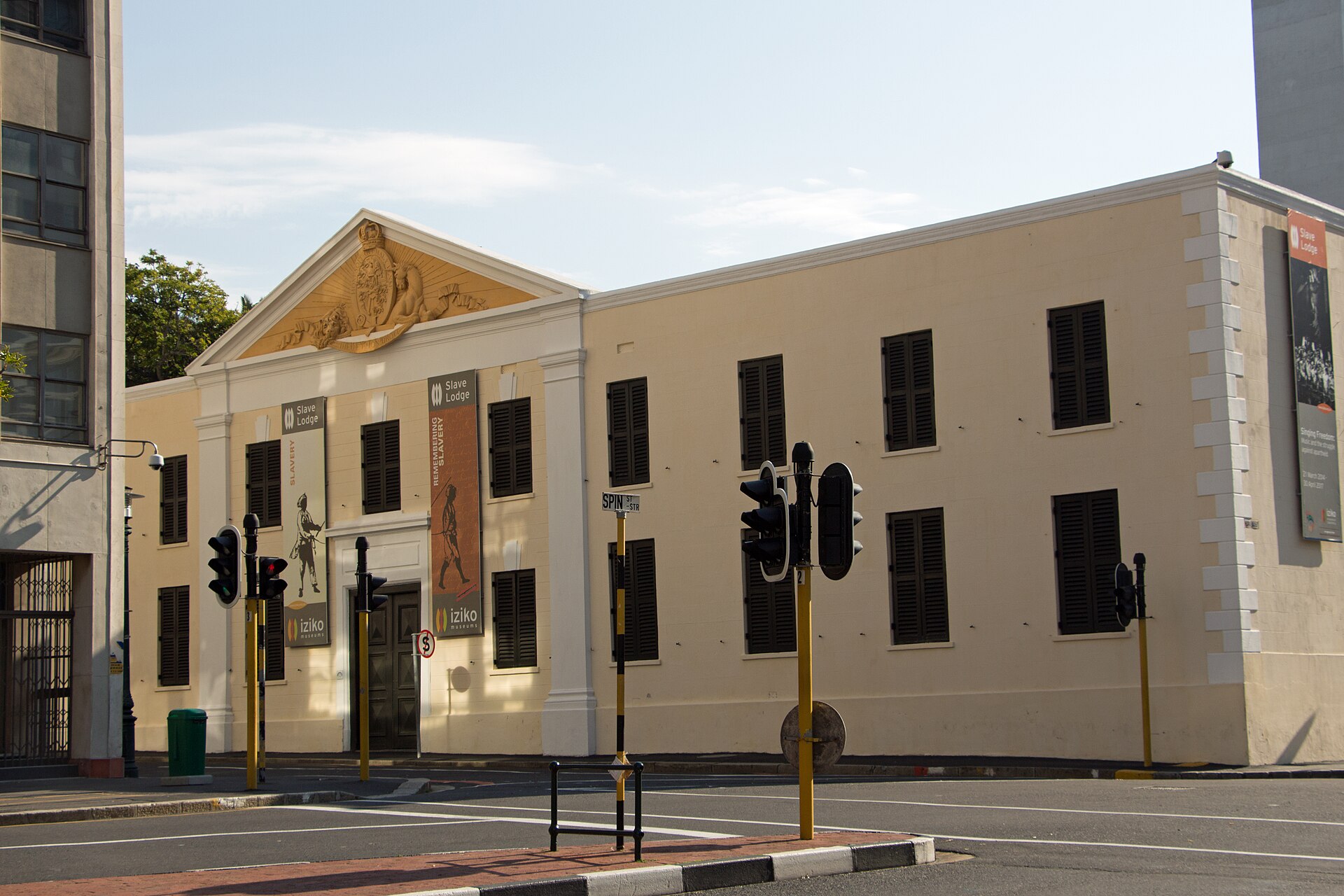
The Slave Lodge in Cape Town is one of those places that doesn’t immediately demand attention, yet leaves a quiet, unsettling weight long after you’ve walked away. Tucked into a corner of Adderley Street, its modest two-story facade—whitewashed walls, unassuming windows—blends almost too easily into the city’s colonial architecture. But behind its understated appearance lies a history deeply entwined with one of the darkest chapters of South Africa’s past. For over a century and a half, this building stood at the heart of the Cape’s brutal slave trade, a place where thousands of lives were broken under the rule of the Dutch East India Company.
Built in 1679, the Slave Lodge was originally constructed to house enslaved people brought to the Cape from across Africa, Madagascar, India, and Southeast Asia. At the time, Cape Town was a critical stopover for European ships en route to Asia, and slave labor was the backbone of its growth—building harbors, roads, and fortifications. Conditions inside the Lodge were appalling. Hundreds of men, women, and children were crammed into cramped, airless rooms, subjected to disease, malnutrition, and the whims of overseers. Few lived past their mid-twenties. Many died within these walls; others perished on the farms and estates that dotted the surrounding landscape. The Lodge wasn’t just a holding pen—it was a place where human beings were reduced to property, their lives measured in labor and suffering.
By the time slavery was abolished in the British Empire in 1834, the building’s purpose had shifted. It became a government office, housing courts, archives, and later a library and museum. Yet its origins were never entirely erased. In the late 20th century, as South Africa began to reckon with its colonial and apartheid past, the decision was made to transform the Slave Lodge into a memorial. Today, it serves as a museum not just about slavery, but about the broader legacy of human rights violations—both in South Africa and beyond. The exhibits are designed to make visitors confront the scale of what happened here, not through sensationalism, but through the quiet accumulation of facts and personal stories.
Walking through the museum, you encounter recreations of daily life for the enslaved—scenes of labor, resistance, and the small acts of defiance that kept some alive. The focus is often on individuals, names pulled from dusty archives: Krotto, a woman from Madagascar; Abraham, a man who attempted escape and was recaptured. These stories remind you that behind every statistic was a person, a life cut short or bent under the weight of oppression. The museum doesn’t rely on shock value. The reality is stark enough: the average life expectancy of an enslaved person in Cape Town was around 25 years. The exhibits let the facts speak for themselves, leaving visitors to sit with the discomfort of what that means.
The building itself is a testament to its past. The thick walls, narrow corridors, and small windows were all designed to prevent escape. In the basement, where the most rebellious were once held, heavy doors and rusted bars remain. Yet there are also traces of later eras—high ceilings and large windows added in the 19th century when the building served bureaucratic functions. The contrast is striking: a place built to confine later became a symbol of authority, its original purpose nearly buried under layers of time. It’s a physical reminder of how history is often rewritten, how the stories we tell about a place can change while the walls themselves hold the truth.
The Slave Lodge sits in the middle of Cape Town, just steps away from other landmarks like the Castle of Good Hope and Greenmarket Square. This isn’t a coincidence. The city was literally built on slave labor, and its streets, buildings, and even place names carry echoes of that era. Nearby Long Street, for instance, was once the site of slave auctions. Today, Cape Town is a vibrant, modern city, but its past is never far away. The museum forces visitors to confront that duality—to see the beauty of Table Mountain or the charm of the Victoria & Alfred Waterfront while acknowledging the suffering that made it all possible.
Visiting the Slave Lodge isn’t like touring a typical museum. There are no flashy displays or souvenir shops, no neatly packaged narratives. Instead, there’s silence, documents, photographs, and the occasional audio recording of a descendant’s testimony. The museum doesn’t offer easy answers. It doesn’t try to tie history up in a neat bow. What it does is ask questions: How could one group of people justify owning another? How did slavery shape the society that would later become South Africa? And what does it mean to remember, not just as an act of looking back, but as a way to ensure the same horrors aren’t repeated?
In recent years, the Slave Lodge has expanded its role beyond a historical site. It now hosts exhibitions and discussions on contemporary human rights issues—modern slavery, discrimination, and inequality. By partnering with activists and researchers, the museum draws connections between the past and present, showing that the themes it explores are far from obsolete. In this way, it serves as both a memorial and a call to action, a place that refuses to let history remain in the past.
For many visitors, the Slave Lodge comes as a surprise. Cape Town is often sold as a destination of breathtaking landscapes, wine estates, and coastal beauty. But the city’s history is far more complex. The museum doesn’t exist to ruin the experience of visiting—it exists to deepen it. It asks you to look beyond the postcard images and see the layers beneath: the labor, the pain, the resilience. It’s not an easy place to visit, but that’s precisely why it matters. To truly understand Cape Town, you have to see it whole—light and shadow, past and present. The Slave Lodge makes sure you don’t look away.