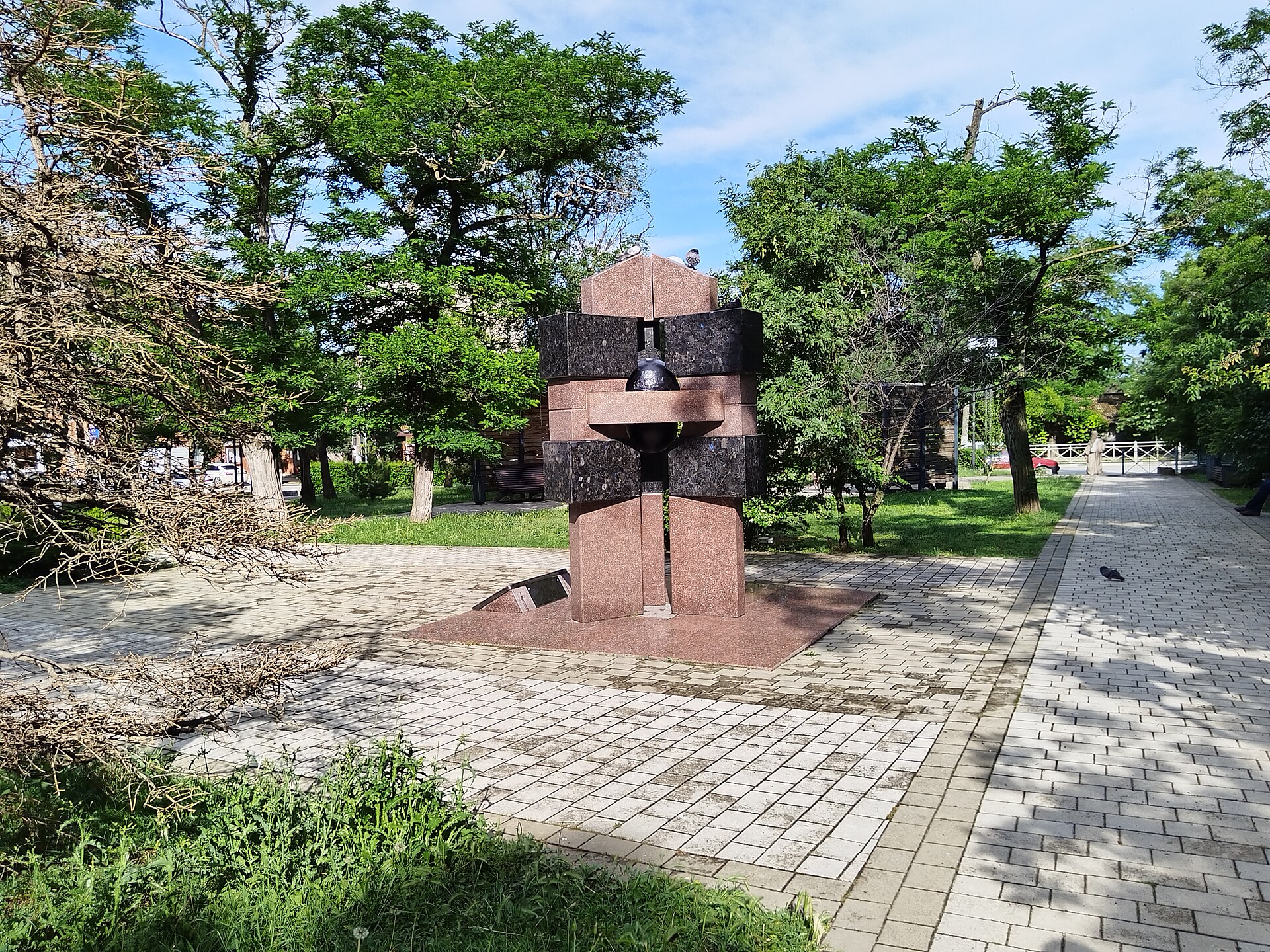
In the late 1980s, as the full scale of the Chernobyl disaster became impossible to ignore, cities across the Soviet Union began setting aside small spaces to honor those who had suffered. Feodosia, a quiet Crimean port town with a long history of its own, was one of them. On Boevaya Street, a modest square appeared—not as a grand statement, but as a quiet place of remembrance for the liquidators who risked everything to contain the catastrophe, and for all those who never came home from the exclusion zone.
The square itself is easy to miss if you don’t know it’s there. There are no towering monuments or ceremonial arches, just a few benches under the shade of trees, a scattering of flowerbeds, and a simple memorial stone. The inscription is brief, almost understated, as if the words themselves are reluctant to disturb the silence. Visitors leave flowers here, not just on official anniversaries but at odd moments throughout the year, as if the place has a way of pulling people in when they least expect it. It doesn’t demand reverence; it simply offers a space to pause.
Feodosia has always been a city of layers. Genoese fortresses stand alongside Ottoman mosques, while Soviet-era apartment blocks and monuments add another dimension to its streets. The Chernobyl memorial fits into this mix naturally, another quiet chapter in the city’s long story. It doesn’t compete with the drama of ancient ruins or the lively charm of the seaside promenade. Instead, it exists alongside them, a small but persistent reminder that history isn’t just about the grand and the glorious—it’s also about the moments of loss that shape a place in ways no one can fully articulate.
What makes this square unusual is how unremarkable it is. There’s no grand design, no sweeping vistas meant to inspire awe. People come here to sit, to think, or to leave a flower. There’s no formal protocol, no sense that you’re supposed to behave a certain way. In summer, the sound of the nearby sea blends with the rustling of leaves, while in winter, the square feels quieter, more introspective. It’s not a place for celebration, but it’s not exactly mournful either. It’s just a corner of the city where the past lingers, unobtrusive but impossible to ignore.
The memorial has never become a site for large gatherings or political speeches. Official ceremonies are rare, and that might be why it retains its quiet dignity. Most visitors come alone or in small groups, pausing for a moment to lay flowers or stand in silence. Sometimes, photographs of the liquidators appear near the stone, along with handwritten notes—names, messages, small tokens left by families and friends. These aren’t part of any official display; they’re personal, fleeting, and all the more powerful for it.
Architecturally, there’s nothing striking about the square. It’s just trees, benches, and paved paths—ordinary elements that could belong to any small urban space. But that’s precisely what makes it meaningful. There’s no attempt at grandeur, no dramatic symbolism meant to impress. The simplicity of the place feels deliberate, as if to say that memory doesn’t need to be monumental to matter. It’s a space where the past and present coexist without fanfare, where the weight of history is felt in the quiet rustle of leaves rather than in marble or bronze.
Feodosia is a city where the sea and history intertwine in unexpected ways. The echoes of different eras are always present—whether in the crumbling walls of a Genoese fortress or the faded murals of Soviet propaganda. The Chernobyl memorial fits into this atmosphere effortlessly, a quiet counterpoint to the city’s more flamboyant landmarks. It doesn’t demand attention, but it doesn’t let you forget, either. Even those who pass by every day without a second thought often slow their pace when they near it, as if sensing something unspoken in the air.
Over the years, the square has become part of the rhythm of Feodosia. Some locals walk past it daily, barely noticing, while others visit once a year, on the anniversary of the disaster. Even those who don’t fully understand its significance often find themselves pausing, as if the place has a way of making itself known. It’s not a site of spectacle, but it’s not invisible, either. It exists in that in-between space, where memory is neither forced nor forgotten.
Chernobyl was an event that left its mark on an entire generation. The memorial in Feodosia isn’t about reliving that trauma; it’s about acknowledging it, about ensuring that the stories of those who were there aren’t erased by time. It’s a small but vital part of the city’s identity, a reminder that memory isn’t just preserved in grand monuments or official histories. Sometimes, it lives in the quiet corners of a city, in the moments when people pause to remember, even if just for a moment.