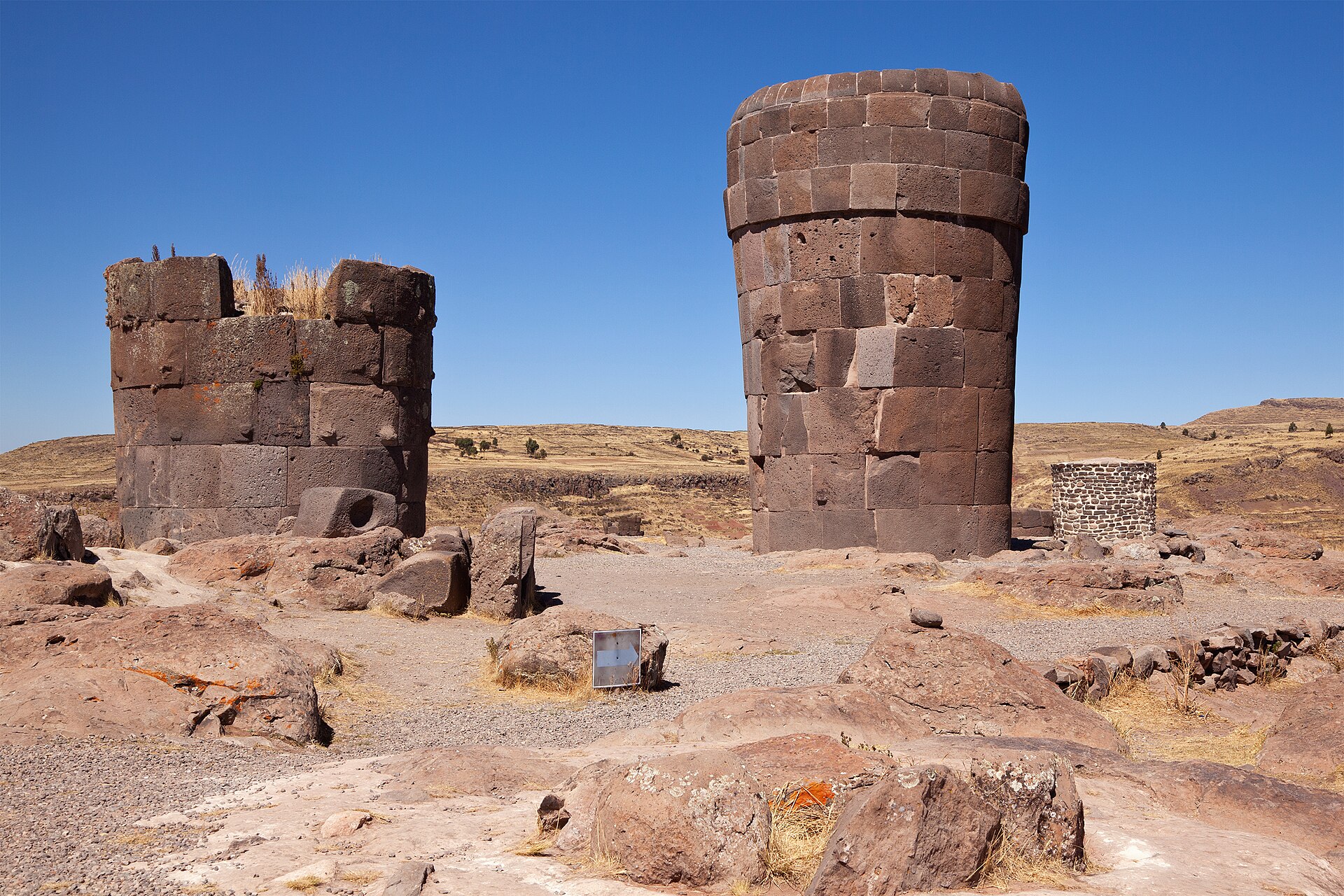
Sillustani sits on a windswept hillside overlooking Lake Umayo, a short drive from the city of Puno in southern Peru. The site feels suspended between earth and sky, as if time itself has settled into the quiet rhythm of the highlands. Here, at nearly four thousand meters above sea level, the air is thin and the light has a sharp clarity that makes the landscape seem both vast and intimate. The most striking feature of Sillustani is its collection of chullpas—towering funerary structures built by the Qolla people, who ruled this region long before the Inca Empire rose to power. These cylindrical stone towers, some reaching over twelve meters in height, stand like silent sentinels, their weathered surfaces bearing witness to centuries of wind, rain, and the slow passage of time.
The chullpas were not merely tombs but monumental expressions of a culture deeply attuned to the natural and spiritual worlds. The Qolla, who flourished between the 12th and 15th centuries, were master builders, constructing these towers with massive stone blocks fitted together so precisely that the seams between them are nearly invisible. The craftsmanship is astonishing, especially considering the tools available at the time. Some scholars suggest that the chullpas may have served additional purposes beyond burial sites—perhaps as astronomical markers, aligned with the solstices or equinoxes, or as symbols of power for the ruling elite. The Inca, who later conquered the region, adopted and adapted the tradition, though their chullpas tend to be more angular and less ornate than those of their predecessors.
The history of Sillustani is intertwined with the broader story of the Titicaca Basin, a region that has long been a crossroads of cultures. Before the Qolla, the area was influenced by the Tiwanaku civilization, which left its mark on the architecture and cosmology of the highlands. The Qolla themselves were part of a larger cultural tapestry that included the Lupaca and other Aymara-speaking groups, all of whom shared a deep connection to the land and its cycles. When the Inca arrived in the 15th century, they incorporated many of these traditions into their own empire, blending local beliefs with their expanding state religion. The chullpas at Sillustani, therefore, are not just relics of a single people but layers of history, each era leaving its imprint on the landscape.
Visiting Sillustani is a physical experience as much as an intellectual one. The climb to the site is gradual but demanding, the altitude making every step feel deliberate. As you ascend, the view opens up—Lake Umayo stretches out below, its surface shimmering under the Andean sun, while the altiplano unfolds in all directions, a patchwork of golden grass and distant mountains. The air carries the scent of wild herbs, and the only sounds are the occasional cry of a bird or the distant bleating of alpacas grazing on the hillsides. It’s easy to imagine why this place was chosen for such sacred structures. The isolation, the vastness of the sky, the sense of being at the edge of the world—all of it must have felt like a threshold between the living and the dead.
The site is still considered sacred by the local Aymara communities, who continue to honor the spirits of their ancestors here. Visitors might see small offerings left at the base of the chullpas—bundles of coca leaves, flowers, or coins—placed with quiet reverence. The Aymara, who have lived in these highlands for generations, see the land as alive, imbued with memory and meaning. Their traditions persist in the way they dress, with women wearing brightly embroidered shawls and bowler hats, a style introduced by European settlers but now woven into the fabric of local identity. In the evenings, when the sun dips below the horizon, the sound of pan flutes and drums sometimes drifts across the water, a reminder that the past is never far away.
One of the most striking things about Sillustani is its silence. There are no crowds, no guided tours shouting over one another, no vendors hawking trinkets. The site feels untouched by the noise of the modern world, a place where it’s possible to sit and listen—to the wind, to the rustling of grass, to the distant lapping of water against the shore. In moments like these, it’s not hard to understand why the Qolla chose this spot for their most important burials. The chullpas were built to last, not just as tombs but as bridges between the earthly and the divine. Standing among them, you can almost feel the weight of history pressing in, a tangible presence that lingers in the stones.
For travelers making their way to Lake Titicaca, Sillustani is often a stop along the route, a detour that offers a glimpse into a different side of Peru. The journey from Puno takes you through small villages where life moves at a slower pace, where farmers tend their fields and children play in the dusty streets. Along the way, there are opportunities to try local foods—perhaps a bowl of quinoa soup, a staple of Andean cuisine for centuries, or cuy, the traditional roasted guinea pig that remains a delicacy in the region. These simple meals, like the chullpas themselves, are a testament to a culture that has endured, adapting to change while holding fast to its roots.
Sillustani is not like Machu Picchu or the other more famous archaeological sites in Peru. There are no grand plazas, no intricate carvings, no dramatic mountain backdrops. What it offers instead is something quieter, more introspective. It’s a place that demands patience, a willingness to slow down and listen. The chullpas are not just ruins; they are stories etched in stone, waiting to be read by those who take the time. Standing at the base of one of these towers, looking up at the sky through its open doorway, it’s impossible not to wonder about the people who built them—their beliefs, their fears, their hopes for the afterlife. In that moment, Sillustani feels less like a destination and more like a conversation, one that has been unfolding for centuries and is still not over.