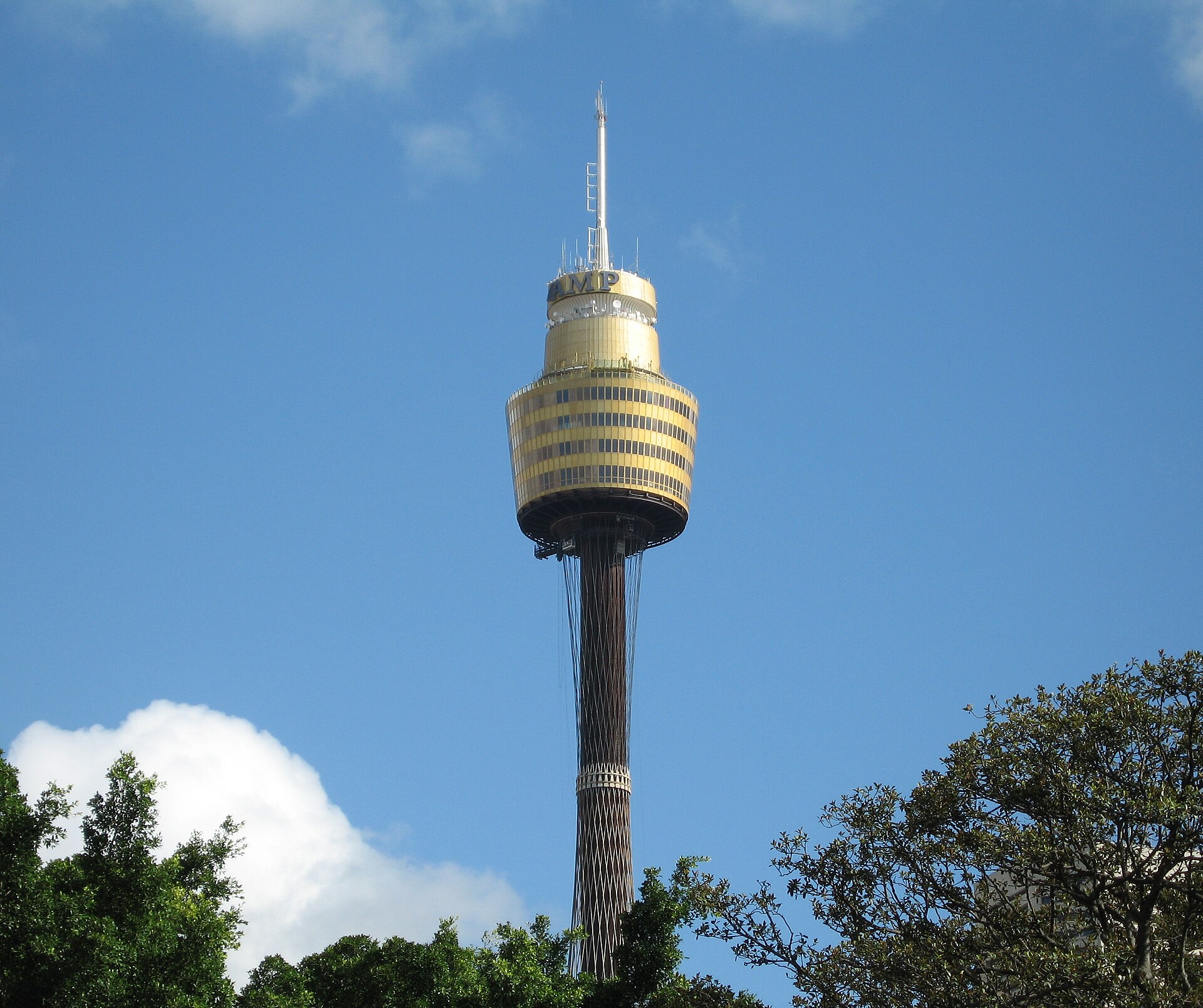
Sydney Tower is one of those places that quietly becomes part of a city’s identity—not just because it’s tall, but because it feels like it belongs. Rising above the heart of Sydney, it stands as a reminder of the city’s restless energy, always reaching upward. Built in 1981, when Australia had long outgrown its colonial past and Sydney had become a confident, fast-moving metropolis, the tower took years to complete. By the time it opened, it wasn’t just another observation deck; it had already woven itself into the city’s skyline, its glowing crown impossible to ignore.
The design is straightforward but striking. The tower rests on a solid concrete base, its slender shaft stretching skyward before giving way to a glass-topped observation deck. There’s no unnecessary ornamentation—just clean lines and purpose. At night, the structure transforms. Lights outline its shape, and the rotating neon ring at the top turns it into a beacon visible from miles away. It’s not trying to be grand; it’s simply doing what it was built for: offering a view of the city from above.
The observation deck, perched 250 metres up, is why most people come. On a clear day, the panorama stretches far beyond the city limits—ocean on one side, mountains on the other, and Sydney sprawled between them. The harbour is the real showstopper, with the Opera House and Harbour Bridge looking almost delicate against the vast expanse of water. As evening falls, the city lights up, and the tower becomes the perfect place to watch the transition from day to night.
But Sydney Tower isn’t just about the view. Inside, there’s a whole world of its own. The revolving restaurant on the observation level lets diners watch the city slowly turn beneath them. The food isn’t cheap, but the experience is worth it—few places let you eat while the landscape shifts around you. Below, there are cafes and shops selling everything from postcards to locally made opal jewellery, small reminders of the country’s culture.
Beyond its role as a tourist attraction, the tower serves practical purposes. It transmits radio and television signals, and its summit houses weather-monitoring equipment. In emergencies, it even has shelters for staff and visitors. It’s a rare mix of entertainment, utility, and safety—a modern skyscraper that actually works for the city.
For locals, the tower is just part of the scenery, but that doesn’t mean they take it for granted. It’s a landmark that helps people navigate the city; when someone says they live near the tower, everyone knows the area. For visitors, it’s often the first thing they notice, a starting point for exploring Sydney. In that way, it plays a role similar to the Eiffel Tower or the Empire State Building—not just a building, but a symbol that helps people find their bearings.
A visit to the tower is also a chance to step back from the city’s hustle. Down below, life moves fast—traffic, crowds, street performers, cafes buzzing with conversation. Up here, it all becomes a quiet, shifting panorama. For a moment, you can see Sydney as a whole, imagining how it grew from a colonial port into the sprawling city it is today. The harbour, once the gateway for settlers, is now the centrepiece of a modern metropolis.
Sydney Tower doesn’t claim to be the most beautiful or extravagant building in the world. It’s not a masterpiece of architecture, nor does it have centuries of history. But that’s its strength—it’s unpretentious, functional, and unmistakably Sydney. It doesn’t try to be anything more than what it is: a place that lets people see the city from a new angle. And in that simplicity, there’s something quietly compelling.