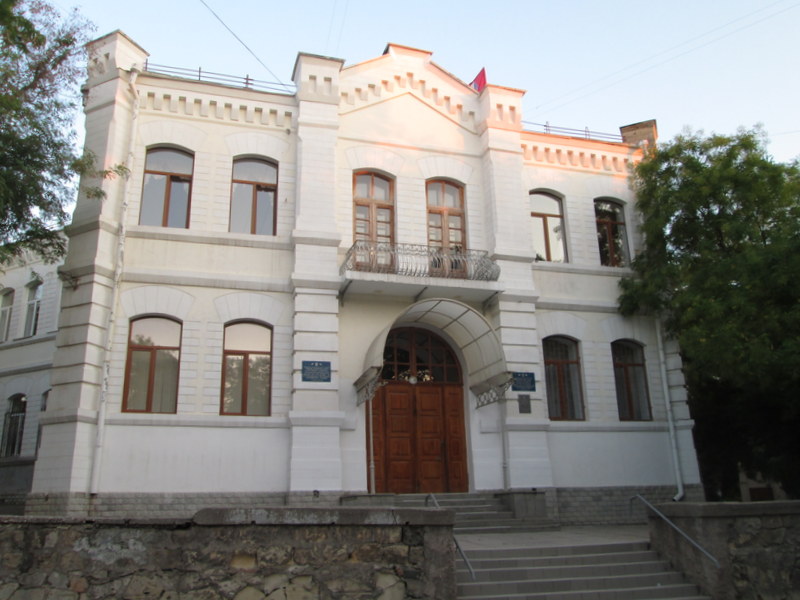
The Konstantinovsky Real School in Sevastopol is one of those rare places where the past feels almost tangible, where the weight of history isn’t just preserved in documents but embedded in the very walls. Built in the late 19th century, it stands as a quiet testament to an era when education was more than a system—it was a cornerstone of the city’s identity. Sevastopol was then a place of rapid transformation, evolving from a fortified naval base into a hub of culture and industry, and the school emerged as a response to that change. Its architecture, restrained yet imposing, reflects the values of its time: order, discipline, and a belief in progress. The high ceilings, tall windows, and wide corridors weren’t just practical choices; they were statements about the kind of future the school aimed to shape.
The building was named after Grand Duke Konstantin Nikolayevich, the second son of Emperor Nicholas I, whose influence extended far beyond the military and political spheres. A man of intellectual curiosity, he saw education as a tool for national strength, particularly in fields like engineering, navigation, and shipbuilding—industries that were vital to Sevastopol’s growth. The school was designed to produce not just scholars but professionals who could meet the demands of a modernizing empire. Its curriculum blended theory with hands-on training, preparing students for careers that would leave a mark on the city and beyond. Many of its graduates went on to become engineers, architects, and naval officers, their work shaping the infrastructure and defense of the country.
Architecturally, the school is a fine example of Russian neoclassicism, a style that favored symmetry, proportion, and a sense of grandeur without excess. The facade is adorned with pilasters and cornices, giving it a dignified presence, while the interior layout—spacious classrooms, a grand assembly hall, and a library—was designed to foster both learning and community. What’s remarkable is how little the building has changed over the decades. Sevastopol has endured wars, revolutions, and reconstructions, yet the Konstantinovsky School has remained largely intact, a rare survivor in a city where history has often been rewritten by conflict.
The school’s alumni include figures who played significant roles in Russia’s development. Some became engineers who built the country’s first railways, others designed buildings that still stand in cities across the former empire, and a few rose to high ranks in the navy. The institution was known for its rigorous standards, not just in academics but in discipline. Students were expected to uphold a code of conduct that emphasized responsibility and perseverance—qualities that would serve them long after graduation. The school didn’t just teach subjects; it shaped character, instilling in its students the belief that knowledge was a tool for both personal and national advancement.
Today, the building still serves an educational purpose, housing a faculty of Sevastopol State University. The transition from a real school to a modern academic institution hasn’t erased its past. If anything, the layers of history are still visible in the details—the worn wooden floors, the high ceilings, the way light filters through the tall windows. Occasionally, the building opens its doors to the public for exhibitions, lectures, and tours, offering a glimpse into its storied past. For students and visitors alike, it’s a place where the present and the past coexist, where the echoes of 19th-century lessons linger in the air.
Sevastopol is a city where history is never far from the surface, and the Konstantinovsky School is a perfect example of that. It stands at the intersection of different eras, each leaving its mark. The imperial ambitions of its founders, the Soviet-era adaptations, and the modern academic life all coexist within its walls. Walking past it, it’s hard not to wonder about the lives that have passed through its doors—the dreams, the struggles, the quiet moments of discovery. The building isn’t just a relic; it’s a living part of the city’s narrative, a reminder that education isn’t just about facts and figures but about the people who carry that knowledge forward.
In recent years, there’s been a growing appreciation for Sevastopol’s architectural heritage, with more people taking notice of buildings that were once overlooked. The Konstantinovsky School is one such place. Its facade, facing one of the city’s central streets, draws the eye with its understated elegance, while the interior, despite some modern updates, retains a sense of timelessness. It’s a building that invites reflection, not just on the history of education but on the broader story of Sevastopol itself—a city that has always been more than just a port or a military stronghold.
Of course, Sevastopol today is a different place from the one that existed when the school was founded. The city has grown, changed, and adapted to new realities. Yet places like the Konstantinovsky School serve as anchors, connecting the present to the past. They remind us that history isn’t just a series of events but a continuum, a thread that runs through the lives of those who come after. Preserving such buildings isn’t just about saving architecture; it’s about keeping alive the stories they hold. And in a city like Sevastopol, where history is always close at hand, those stories matter more than ever.