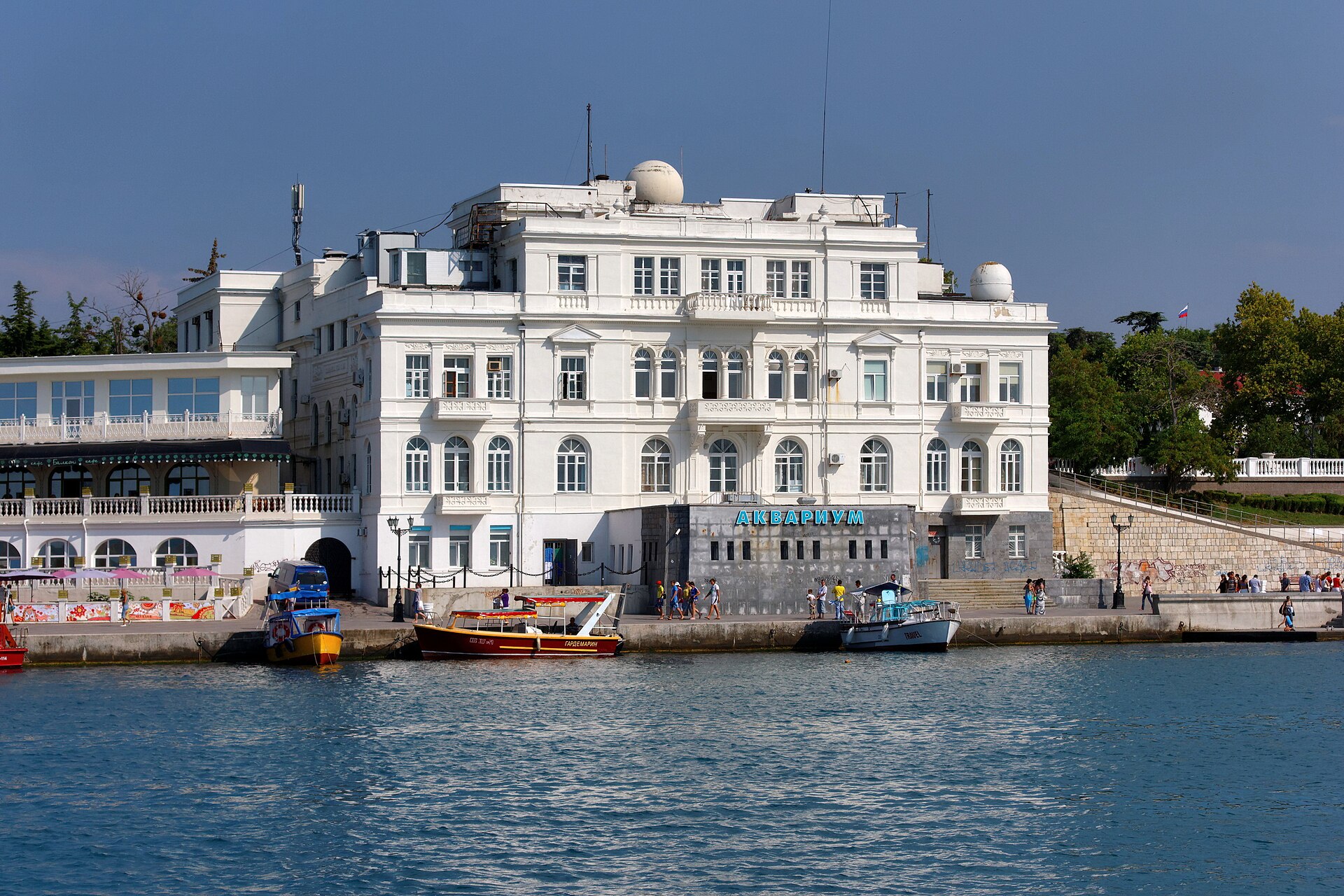
Nestled along Nakhimov Avenue in the heart of Sevastopol, the Biological Station is one of those quiet places that reveal their significance only to those who take the time to look closer. Founded in the late 19th century, it was Russia’s first marine biological research center, established by scientists eager to explore the mysteries of the Black Sea. At the time, Sevastopol was already a city of strategic importance, both militarily and scientifically, and the station’s creation marked a natural step in the development of Russian marine biology. The building itself, unassuming in its design, reflects the practical needs of scientific work from that era—thick stone walls, tall windows to maximize natural light, and a layout that prioritized function over ornamentation.
Inside, the station retains much of its original character. Laboratories, aquariums, and collections of marine specimens still occupy the same spaces where researchers once worked over a century ago. Some of the earliest samples gathered here remain preserved, offering a tangible connection to the station’s beginnings. The architecture, though modest, speaks to the seriousness of the work conducted within its walls. It was never meant to be grand; it was built to serve a purpose, and that purpose has endured through decades of change.
From the start, the station was more than just a research facility. It became a hub for education and collaboration, attracting biologists who studied everything from Black Sea fish and mollusks to algae and microorganisms. By the early 20th century, it had gained international recognition, drawing scientists from across Europe. This was a golden age for the station, when Sevastopol was seen as a key player in global marine biology. The work done here laid the groundwork for many scientific discoveries, some of which still influence research today.
The station’s history, like that of Sevastopol itself, is marked by resilience. During World War II, the building suffered damage, and much of its equipment was lost. Yet even during the siege of the city, research continued in whatever form possible. After the war, the station was rebuilt, and its focus shifted to address new challenges. The Soviet era brought expanded studies on pollution, aquaculture, and fish migration, turning the station into a vital center for marine science in the USSR. The work done here wasn’t just academic—it had real-world implications for the health of the Black Sea and the communities that depended on it.
Today, the Biological Station remains an active institution, though its role has evolved. Modern researchers here grapple with contemporary issues like climate change, human impact on marine ecosystems, and the preservation of biodiversity. In recent decades, the station has become part of the Institute of Marine Biological Research, allowing for broader scientific collaboration. While much of the work is technical and specialized, the station occasionally opens its doors to the public through guided tours and lectures. Visitors can explore a small museum filled with historical instruments, collections of shells, algae herbariums, and even taxidermied specimens of rare fish. The atmosphere is one of quiet dedication—hallways lined with old equipment, the faint scent of seawater lingering in the air, and the sense that important work is still happening behind closed doors.
For those who venture inside, the station offers a glimpse into a side of Sevastopol that isn’t often discussed. The city is known for its military history and naval significance, but places like this remind us that it has also been a center of scientific inquiry. The researchers who worked here over the generations were driven by curiosity about the natural world, and their legacy continues to shape our understanding of the Black Sea. It’s a place where the past and present intersect, where old collections sit alongside modern laboratories, and where the challenges of today’s marine ecosystems are met with the same spirit of discovery that defined its earliest days.
The station’s relevance has only grown in recent years as environmental concerns take center stage. It’s not just a relic of scientific history; it’s an active participant in the effort to protect and study the Black Sea. The work done here helps predict how the sea might change in the face of climate shifts and human activity, offering insights that extend far beyond Sevastopol. For anyone interested in science, history, or the hidden layers of a city, the Biological Station is a reminder that some of the most important places aren’t the ones that draw crowds, but the ones that quietly shape our understanding of the world.