Santa Maria Novella stands where Florence’s past feels most alive—not as a relic behind glass, but as something still breathing. This is a place where the city’s layers unfold naturally, where medieval stonework meets Renaissance elegance, and where the sacred and the scientific once shared the same walls. Unlike the more famous cathedrals that dominate the skyline, Santa Maria Novella doesn’t demand attention. It waits, quietly, for those who notice.
The church was founded in the early 13th century by Dominican friars, when Florence was still finding its footing as a center of trade and culture. Construction stretched over decades, a slow process that mirrored the city’s own transformations—plagues, political upheavals, the rise of banking dynasties. The Dominicans, known for their intellectual rigor, chose a site just outside the old city walls, near the Arno and the bustling markets. Over time, the neighborhood grew around it, and what was once on the periphery became central, both geographically and in the life of the city.
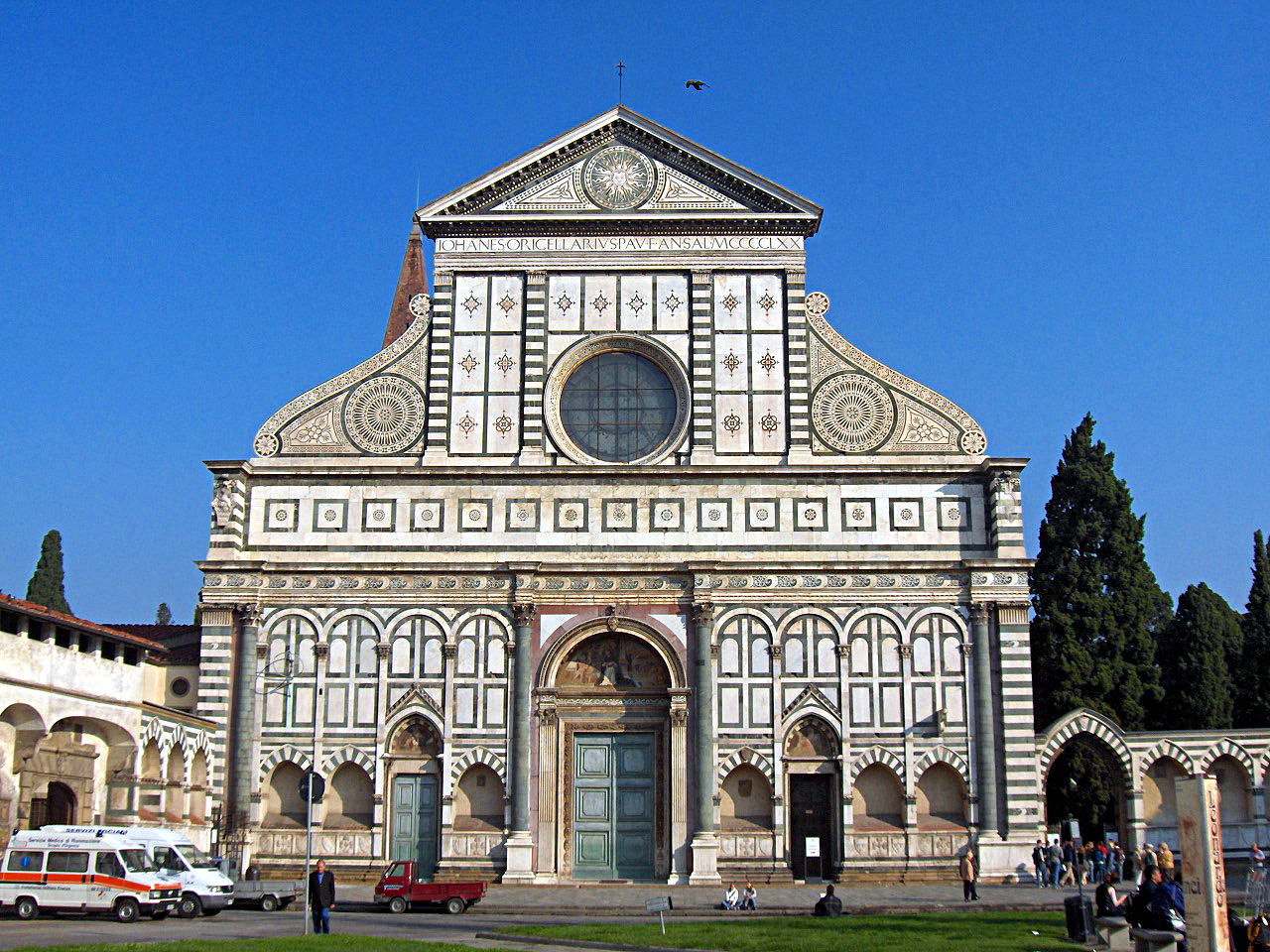
The facade is where the church first reveals its character. The geometric pattern of white and dark green marble, arranged like a chessboard, is a hallmark of Tuscan Gothic style, though its clean lines also hint at the Renaissance to come. Leon Battista Alberti, one of the great minds of the early Renaissance, completed the design in 1470, nearly two centuries after work began. His contribution wasn’t just decorative; he brought a sense of proportion and balance that reflected the humanist ideals of the time. The contrast between the lower, Romanesque half and the upper, more refined sections tells its own story—of a city evolving, of art and architecture in dialogue.
Inside, the church feels surprisingly light and spacious. High vaults and slender columns create an airy atmosphere, a departure from the dim, heavy interiors of many medieval churches. Sunlight streams through large windows, illuminating the frescoes that cover the walls. The Tornabuoni Chapel, painted by Domenico Ghirlandaio in the late 15th century, is a masterpiece of storytelling. His scenes from the lives of the Virgin Mary and John the Baptist are more than religious narratives; they’re a snapshot of Florentine life, filled with portraits of merchants, nobles, and even members of the Medici family, all rendered with meticulous detail.
Santa Maria Novella has long been a place where faith and reason intersected. The monastery attached to the church was home to figures like Leonardo da Vinci and Galileo Galilei, who conducted experiments here. The monastery’s pharmacy, one of the oldest in Europe, produced medicines using recipes developed by Dominican monks, and some of the original vessels and tools are still preserved. The church also played a role in the advancement of science—it was here that public anatomical dissections were first performed in Europe, a radical act in an era when knowledge was still tightly controlled by the Church.
Despite its age, Santa Maria Novella remains an active place of worship. Mass is still celebrated, the organ still played, and in the side chapels, you might find people praying. Yet it’s also open to visitors, who can wander freely, close enough to touch the frescoes or trace the carvings on the wooden pews. The Strozzi Chapel, with its dramatic frescoes by Filippino Lippi, is particularly striking. The figures seem to move, their expressions so vivid that the biblical scenes feel immediate, almost alive.
The church is a record of Florence’s history, with each era leaving its mark. Gothic arches stand beside Renaissance altars, medieval frescoes alongside Baroque embellishments. It’s as if the building itself absorbed the city’s spirit—its passion for art, its pursuit of knowledge, its belief in harmony. Even those who aren’t drawn to history or religion often find themselves lingering, caught by the quiet intensity of the place. There’s something about standing beneath those high ceilings, listening to the echo of footsteps on stone, that makes the past feel present.
Outside, Piazza Santa Maria Novella is where the city’s energy spills into the open. Tourists pause to photograph the facade, locals hurry past on their way to work, and street musicians fill the air with melodies. In the evenings, the square sometimes becomes an impromptu concert hall, with classical or jazz performances drawing small crowds. From here, the rest of Florence is easily within reach—the Duomo is a short walk away, and tucked around the corner are cafés where the espresso is strong and the conversations lively.
What makes Santa Maria Novella special isn’t grandeur or spectacle. It’s the way it holds time without trying to impress. The facade’s precise lines, the hush of the interior, the stories embedded in the walls—all of it feels inevitable, as if the church has always been exactly as it is. That’s why it resonates, not just as a monument, but as a living part of Florence. It doesn’t just belong to history; it belongs to the city’s rhythm, its quiet persistence, its unshaken belief in beauty.