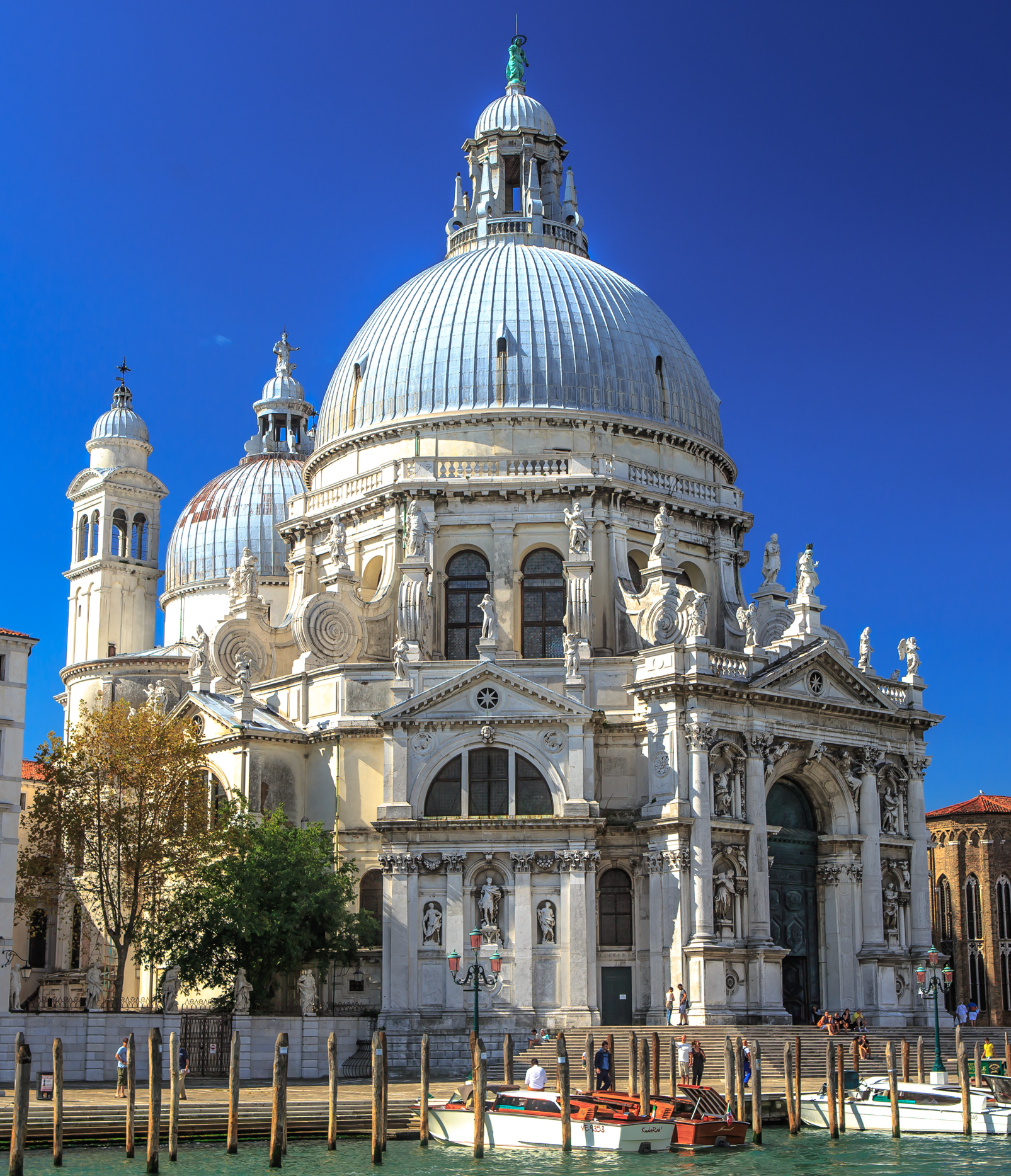
Santa Maria della Salute stands where the Grand Canal opens into the lagoon, its domes rising like a promise above the water. For centuries, it has been the first thing travelers see when arriving in Venice by boat—a silent guardian at the city’s threshold. Built in the 17th century, the church was conceived not as a monument to power, but as an offering of gratitude after one of the darkest chapters in Venetian history.
The story of the Salute begins with plague. In 1630, the disease swept through Venice, claiming nearly a third of its people. The city, already weakened by war and economic decline, turned to prayer. The Senate vowed to build a church in honor of the Virgin Mary if she would intercede and spare the survivors. When the epidemic finally receded, construction began on what would become one of Venice’s most iconic landmarks.
The architect Baldassare Longhena won the commission after a competition that drew twelve proposals. His design was ambitious, blending the grandeur of Baroque with the lightness of Venetian tradition. Work started in 1631, but progress was slow. Longhena died before the church was finished, and his students carried on the project for decades. The result was a structure that seemed to defy gravity, its massive dome balanced by sweeping volutes that anchor it to the earth.
From the outside, the Salute is all curves and contrasts. The octagonal base gives way to a soaring dome crowned with a statue of the Madonna, while two smaller domes flank it like attendants. The facade is a play of light and shadow, with columns, niches, and intricate carvings that catch the sun at different angles. At dusk, the stone glows warmly, as if lit from within.
Inside, the church feels both vast and intimate. The high arches draw the eye upward, while the white marble floors and walls reflect the light streaming through the tall windows. The main altar is dedicated to the Madonna della Salute, her statue surrounded by saints and angels in a composition that feels almost theatrical. The space is filled with works by some of Venice’s greatest artists. Luca Giordano’s ceiling frescoes depict scenes from the life of the Virgin, while Titian’s *Saint Mark Enthroned* holds a place of honor. The sculptures by Giusto Le Court add a sense of movement, their figures seeming to step out of the stone.
Beyond its artistic treasures, the Salute remains a living part of Venetian life. Classical music concerts are held here, their notes echoing under the dome. During the Venice Biennale, the church occasionally hosts contemporary art installations, creating a dialogue between past and present. But its most enduring tradition is the Festa della Salute, held every November 21st. On that day, a temporary pontoon bridge spans the Grand Canal, and thousands of Venetians walk to the church to light candles and offer prayers. The ritual has been observed for nearly four hundred years, a quiet act of remembrance and hope.
Unlike the crowded Basilica di San Marco, the Salute offers a sense of stillness. Even in high season, it’s possible to find a moment of solitude beneath its dome. The church sits in Dorsoduro, one of Venice’s quieter neighborhoods, where the pace slows and the canals feel less like thoroughfares than reflections of the sky. From here, it’s a short walk to the Zattere promenade or the Accademia Gallery, but many visitors linger, drawn by the way the light shifts across the marble or the sound of water lapping against the steps outside.
More than just a building, the Salute is a testament to Venice’s resilience. It was born from suffering, yet it stands as a celebration of survival. The city has faced countless challenges since its founding—floods, wars, economic crises—but the Salute endures, a reminder that beauty can emerge from the darkest times. For those who take the time to look beyond its facade, the church offers something rare in Venice: a place to pause, to reflect, and to remember what it means to hope.