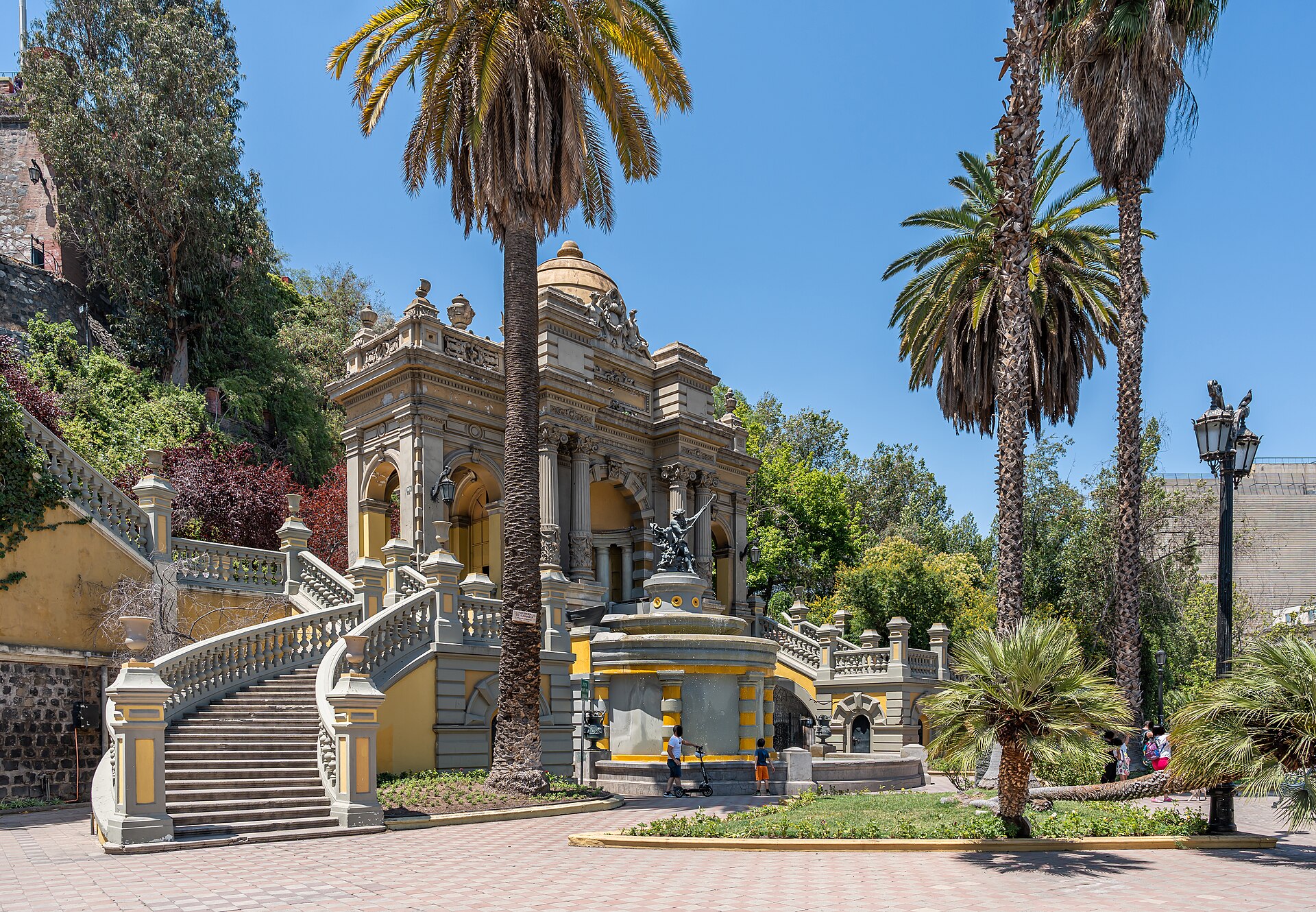
Santa Lucía Hill is one of those rare places where history feels alive without trying too hard. Rising above the heart of Santiago, it’s more than just a green space in the middle of the city—it’s a quiet witness to Chile’s past, a breathing pause in the urban rhythm, and a viewpoint that puts the entire capital into perspective. From its summit, the city unfolds between the Andes and the distant Pacific, and on clear days, the snow-capped peaks of the Cordillera frame the valley like a painting. But the real magic isn’t just the view; it’s the way this small hill has shaped—and been shaped by—the story of a nation.
Long before Santiago existed, the hill was sacred to the indigenous peoples of the Mapocho Valley. They gathered here for rituals, tracked the movements of the stars, and saw in its slopes something greater than the land itself. When Pedro de Valdivia founded the city in the 16th century, the hill became an anchor—a natural landmark, a lookout post, and later, a grim stage for colonial justice. For centuries, it stood apart from the growing city, a silent observer until Chile’s independence in the early 1800s transformed it into something new. The country was forging its identity, and Santiago was becoming a modern capital. Santa Lucía, once a forgotten outcrop, was about to get a second life.
That transformation came in 1872, when President Federico Errázuriz Zañartu decided to turn the neglected hill into a public park. The task fell to Lucien Ambroise, a French landscape architect who gave the place the romantic, slightly theatrical style of 19th-century European gardens. Winding paths replaced rough trails, artificial grottos appeared like hidden stages, and fountains were installed to add the sound of water to the rustling leaves. At the summit, the Neptune Fortress—a small but striking neoclassical structure with columns and statues—became the park’s centerpiece. Exotic trees and shrubs, many imported from Europe, were planted along the slopes, and soon, Santa Lucía became the kind of place where Santiago’s elite would stroll in the afternoons, a living postcard of progress and refinement.
Today, the park is a kind of open-air museum, where every path, monument, and architectural detail tells a piece of Chile’s story. On the lower terraces, a bust of Pedro de Valdivia stands as a reminder of the city’s founding, while nearby, a statue of the Mapuche leader Lautaro honors the resistance against Spanish rule. Higher up, a granite memorial with an eternal flame pays tribute to the soldiers who died in the War of the Pacific, a conflict that defined Chile’s borders in the late 1800s. Even the park’s design carries meaning: the staircases and terraces, arranged like steps, were meant to symbolize the ascent toward knowledge and enlightenment—a fitting metaphor for a young nation eager to prove itself.
Walking through Santa Lucía is like stepping into a slower, more deliberate version of the city. The paths twist past grottos where couples once met in secret, past small ponds that mirror the trees above, and past a cannon that once fired salutes for national holidays. Near the summit, a stone altar dedicated to the Virgin Mary hints at the colonial era’s lingering influence. The best times to visit are early morning, when the air is cool and the city below is still waking up, or late afternoon, when the setting sun turns the Neptune Fortress golden. In those quiet hours, it’s easy to imagine the park as it was in the 1800s, filled with men in top hats and women in long dresses, all moving at the unhurried pace of another time.
But Santa Lucía isn’t just a relic—it’s a living part of Santiago. Locals come here to jog before work, to take family photos on weekends, or to sit on a bench with a book and watch the city go by. Street musicians sometimes play near the entrance, and on weekends, artisans set up stalls selling handmade jewelry and crafts. In winter, when the air is crisp but the sun still warms the stone, the park feels especially inviting. In summer, the shade of the trees offers relief from the heat. For visitors, it’s one of the first places that truly feels like Santiago—not because of grand monuments or famous landmarks, but because of the way it balances history with everyday life.
Over the years, Santa Lucía has been restored several times, but its original character has been carefully preserved. Some features have disappeared, like the small zoo that once occupied part of the hill or the open-air cinema that screened films in the mid-20th century. Yet even without those additions, the park hasn’t lost its charm. It remains one of the few places in Santiago where the past isn’t just remembered—it’s still present in the worn steps, the gnarled trees, and the way the light filters through the leaves. It’s a reminder that history isn’t just something you read about; it’s something you can touch, smell, and feel.
For first-time visitors, Santa Lucía often comes as a surprise. Santiago is a city of contrasts—skyscrapers next to colonial churches, bustling markets beside quiet plazas—and this hill sits right at the intersection of all of it. Unlike the crowds at La Moneda Palace or the chaos of La Vega Central Market, Santa Lucía offers a different kind of experience: no rush, no agenda, just the quiet rhythm of a place that has seen centuries unfold. Maybe that’s why it’s still one of the most beloved spots in the city, not just for tourists, but for Santiaguinos themselves. Here, you can simply be—no guidebook, no itinerary, just the hill, the city, and the sky.