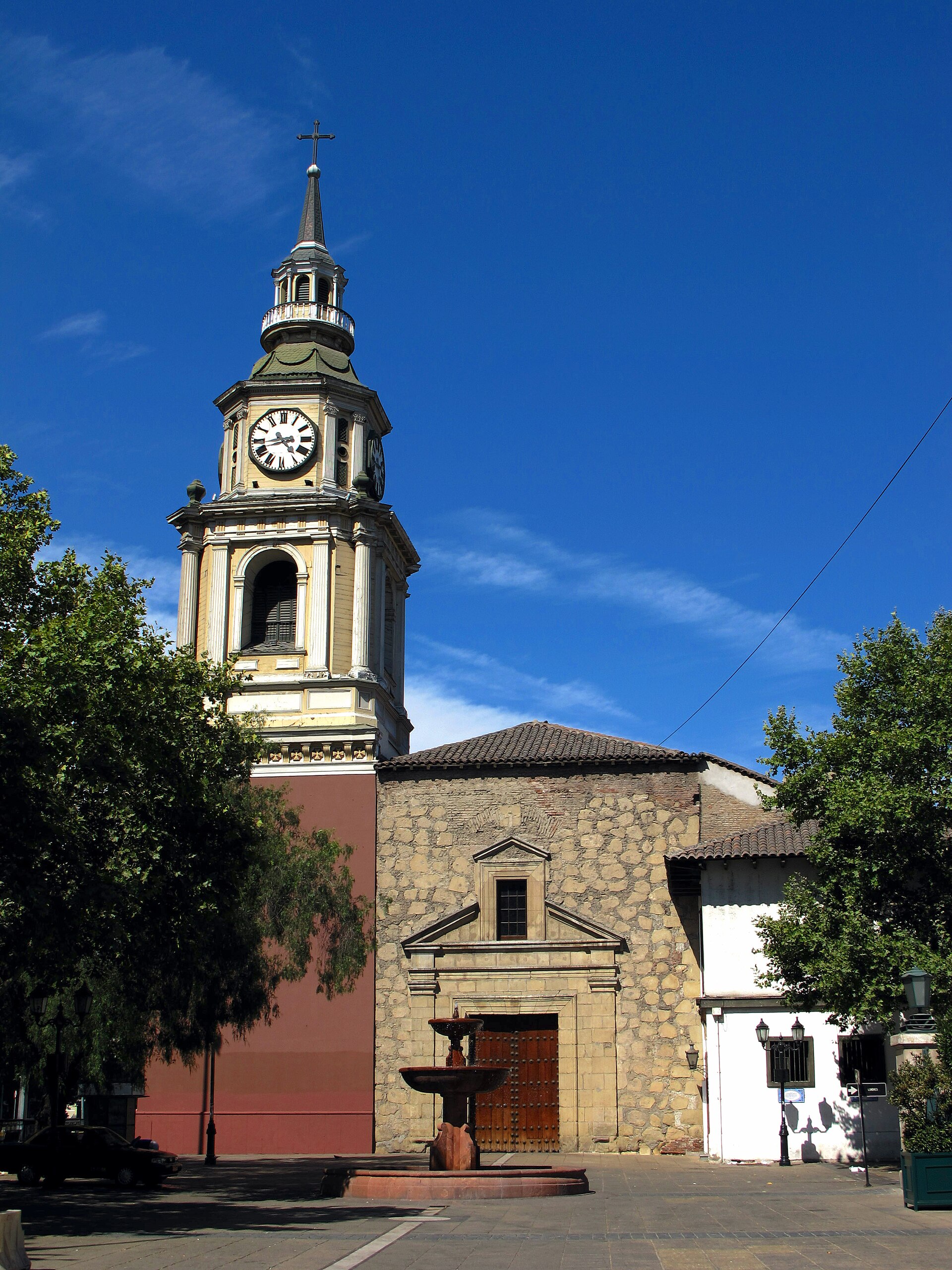
San Francisco Church stands as the oldest surviving structure in Santiago, a quiet witness to nearly five centuries of the city’s history. Built in the mid-1500s on the site of an earlier chapel, it rose when Santiago was little more than a cluster of adobe houses at the foot of the Andes, serving as both a spiritual anchor and a symbol of Spanish authority in a distant colony. Over the years, it has endured earthquakes, fires, and the slow march of time, yet its presence remains steadfast, a rare constant in a city that has grown and changed around it.
The church’s architecture carries the weight of its age. The thick walls and sturdy bell tower, once a landmark for travelers crossing the Mapocho Valley, reflect the practical needs of a frontier settlement. The facade is simple, almost austere, with clean lines that speak more of endurance than ornamentation. Inside, the high ceilings and dark wooden beams create a sense of solemnity, while the old altars and flickering candlelight evoke the rituals of another era. The building was never meant to impress with grandeur but to serve—a place of refuge and reflection in a land still being shaped.
Beyond its religious role, the church played a part in the intellectual and social life of early Santiago. In the 17th century, the adjoining monastery became a center of learning, where Franciscan monks taught local people skills like carpentry and medicine, and even established the first library in Chile. The monastery’s halls hosted Spanish governors and early Chilean thinkers, making it a quiet hub of knowledge in a colony far from the centers of European power. Some of the artworks still housed here—paintings, icons, and sculptures—were brought from Europe, while others were crafted by local artists, including José Gil de Castro, whose works adorn the altars.
The church has seen Santiago transform from a colonial outpost to a modern capital. It survived the devastating earthquake of 1647, which leveled much of the city, and was rebuilt within a few years. After Chile gained independence in the 19th century, it became a place where new leaders gathered to pray for the nation’s future. In the 20th century, it was declared a national monument, ensuring its preservation as a piece of living history. Today, it remains an active place of worship, where services, festivals, and concerts of sacred music still take place.
The area around the church is just as steeped in history. A small square offers shade and a moment of quiet, while the former monastery now houses a museum of colonial art. Inside, visitors can see everyday objects from the past—religious artifacts, old books, and documents that tell the story of Santiago’s early days. The museum doesn’t draw crowds, but those who wander in often find themselves lingering over the details: a handwritten ledger, a child’s toy, a priest’s robe—small things that connect the present to the past.
For locals, the church is more than a tourist stop. Some come to pray, others to remember family members who worshipped here generations ago. Students sometimes slip inside to escape the noise of the city, sitting in the pews to read or think. On feast days, the church comes alive with flowers, candles, and the sound of hymns, a reminder that its purpose has never been just about the past. The heavy wooden doors are almost always open, as if inviting anyone to step in and take a moment away from the rush of modern life.
What makes San Francisco Church special is its unassuming authenticity. There are no grand claims here, no flashy displays—just the quiet accumulation of history in stone, wood, and light. The bell tower still rises above the city, a familiar sight to those who pass by, while inside, the air carries the scent of old wood and wax. The church doesn’t try to be anything other than what it is: a place where time moves differently, where the weight of centuries is felt in the creak of a floorboard or the soft glow of a candle.
In a city that is constantly reinventing itself, San Francisco Church remains a grounding presence. It doesn’t demand attention, but those who take the time to notice it often leave with a sense of connection—to the people who built it, to the generations who have prayed here, and to the quiet resilience of a place that has outlasted empires, earthquakes, and the relentless pace of change. For Santiago, it is less a monument than a living thread, woven into the fabric of the city’s identity.