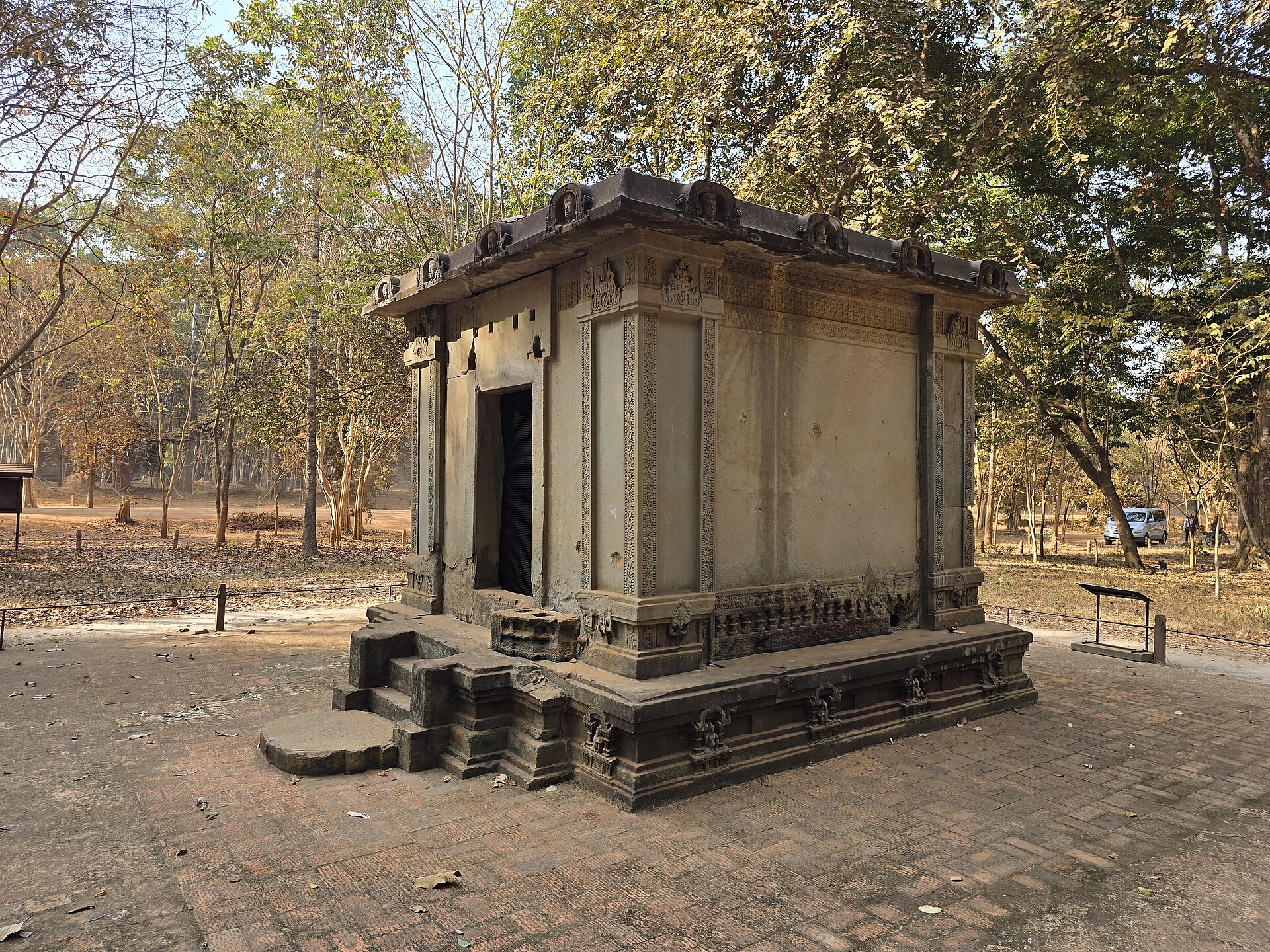
Sambor Prei Kuk feels like a place where time has quietly settled into the earth. Tucked deep in the Cambodian jungle, these ancient ruins carry the echoes of Chenla, the kingdom that came before the mighty Angkor Empire. Unlike the crowded temples of Siem Reap, this site remains largely untouched, visited only by the occasional local bringing offerings or by archaeologists carefully brushing away centuries of overgrowth. The complex sprawls across roughly twenty-five square kilometers, though much of it still lies hidden beneath dense vegetation and layers of soil. Those who make the journey here step into a world where history seeps through cracks in the stone, and the only sounds are the rustle of leaves and the distant calls of monkeys in the treetops.
The architecture of Sambor Prei Kuk is a rare blend of Indian and early Khmer styles, reflecting a time when Buddhism and Hinduism coexisted without conflict. Built between the seventh and eighth centuries, the temples were constructed using brick—a material handled with remarkable precision. The masonry is so tight that not even a knife’s blade could slip between the blocks. Unlike the sandstone structures of Angkor, where stone was carved into grand narratives, here brick itself becomes part of the artistry. Faded carvings of apsaras, lions, and mythical creatures still cling to the surfaces, though time and monsoon rains have worn them smooth in places.
The site is divided into three main temple groups, each with its own character. The central cluster, Prasat Sambor, was once the religious heart of Ishanapura, Chenla’s capital. Three main sanctuaries stand in a row, aligned to the east as ancient traditions dictated. Local lore claims one once housed a golden statue of Shiva, later moved to Angkor. To the north, Prasat Yeai Poeun is notable for its octagonal towers, an unusual feature in Khmer architecture. Their shape resembles lotus buds, a symbol of purity and enlightenment in both Hinduism and Buddhism. The southern group, Prasat Tao, takes its name from the stone lions guarding its entrances. Though weathered, these sculptures still carry a sense of power, as if the beasts might step down from their pedestals at any moment.
Sambor Prei Kuk was not always forgotten. In the seventh century, Ishanapura was one of Southeast Asia’s most important cities, its rulers maintaining ties with China and India. The Chinese monk Yi Jing, traveling through the region in 671, described it as a key center of Mahayana Buddhism. But by the ninth century, as the capital shifted to Angkor, the city faded into obscurity. The jungle slowly reclaimed the temples, and they remained lost for centuries. French explorers rediscovered them in the nineteenth century, yet even then, they drew far less attention than Angkor’s grand monuments. Perhaps because Sambor Prei Kuk lacks the imposing scale of Angkor Wat—there are no vast bas-reliefs recounting battles or myths, no grand terraces built to hold thousands. Instead, the site feels intimate, each temple a quiet world of its own.
Visiting Sambor Prei Kuk is less about ticking off a landmark and more about stepping into the past. The journey itself is part of the experience: a bus from Phnom Penh or Siem Reap, followed by a long ride along dusty backroads, past rice fields and villages where life moves at the same unhurried pace it has for generations. During the rainy season, the roads turn to mud, and the last stretch can only be navigated by motorbike or four-wheel drive. Even in the dry months, the final approach is a walk through dense undergrowth, often guided by a local who knows the paths better than any map. The reward is the thrill of discovery, when the first crumbling towers emerge from the greenery, draped in vines and moss.
Unlike Angkor, where every stone has been polished by millions of visitors, Sambor Prei Kuk retains a sense of untouched mystery. There are no signs at every turn, no crowds posing for photos in front of every carving. You can wander for hours, stumbling upon forgotten shrines that don’t appear in any guidebook. At times, it feels as though you’re the first person in centuries to set foot on these stones. The sensation is strongest at dawn, when mist curls over the ground and sunlight barely filters through the canopy. In that half-light, the ruins seem less like remnants of the past and more like a doorway to another era.
Though still remote, Sambor Prei Kuk is slowly gaining attention from travelers seeking an alternative to Cambodia’s more crowded sites. Small guesthouses have begun to appear nearby, and locals now offer tours in English. Yet the place remains peaceful, drawing those who come not to check off a destination but to experience something deeper. There are no souvenir stalls selling mass-produced trinkets, no restaurants with menus in a dozen languages, no guides hurrying groups along. Instead, there’s the chance to sit quietly on ancient steps, listening to the jungle, or to watch as monks in saffron robes make their rounds, leaving trails of incense in their wake.
Sambor Prei Kuk is a reminder that Cambodia’s history extends far beyond Angkor. This is a place from an earlier time, when Khmer civilization was still taking shape, when the lines between religions and cultures were fluid, and art had yet to become rigidly codified. There are no grand tales of conquest here, just the quiet beauty of ruins waiting to be noticed. Perhaps that’s why it holds such appeal—it asks nothing of visitors except respect for the past and a willingness to see it as it is. In a world that often demands spectacle, Sambor Prei Kuk remains a humble testament to the value of what lies hidden.