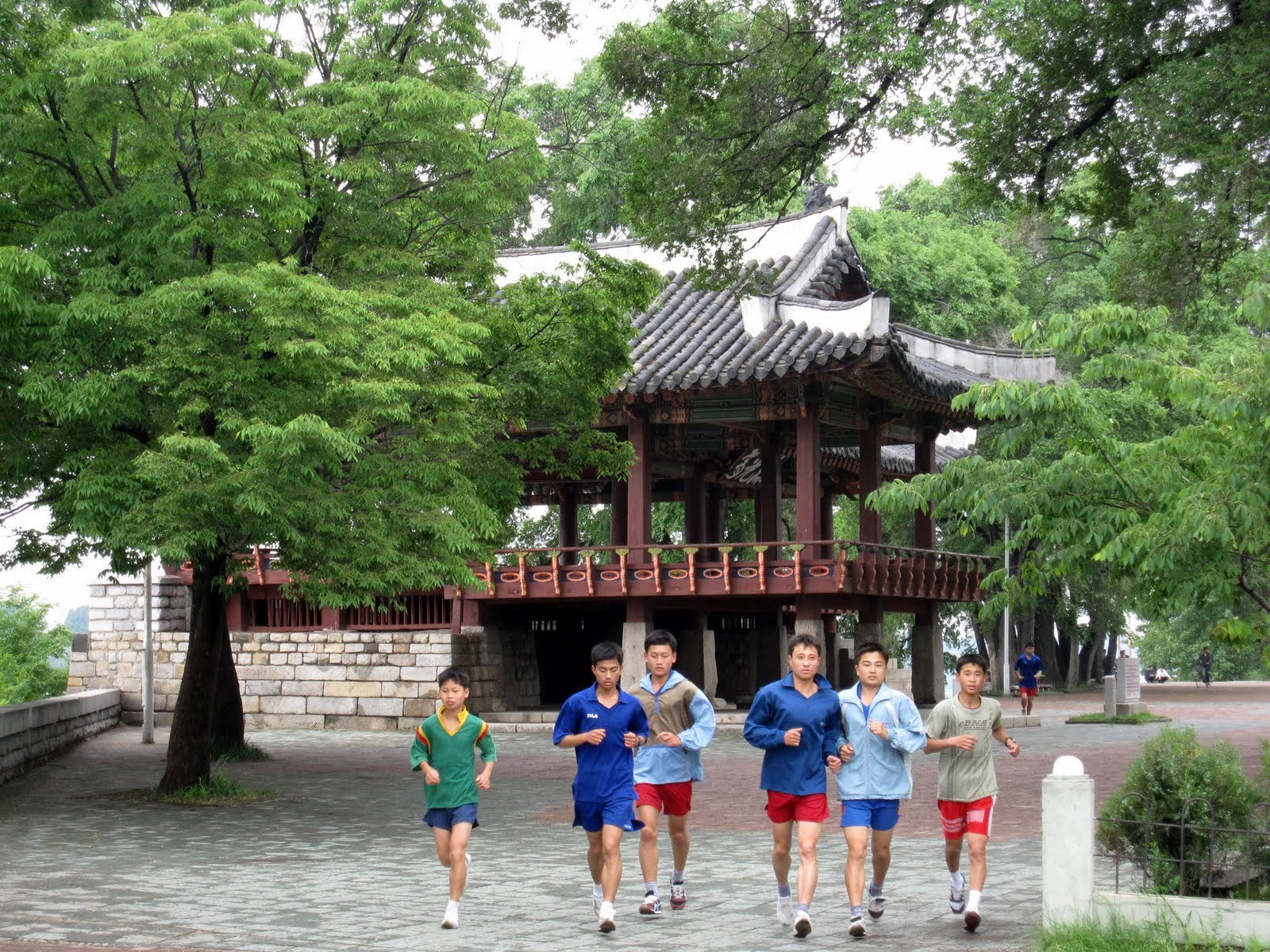
Perched on a gentle hill along the banks of the Taedong River, Ryongwang Pavilion is one of those rare places in Pyongyang where time seems to slow down. From its wooden terraces, the view stretches across the water, taking in the bridges and the older parts of the city that lie beyond. The pavilion itself is modest in size, but its graceful lines and balanced proportions give it a quiet elegance, a sense of harmony that feels almost deliberate. Pine trees surround it, their needles softening the edges of the stone paths, while below, a small park offers benches where locals sometimes sit, watching the river drift by.
The history of Ryongwang Pavilion reaches back over six centuries, to the late 1300s, when it was built during the Goryeo Dynasty. At the time, Pyongyang was not yet the capital, but it was already a city of significance on the Korean Peninsula. The pavilion was originally a retreat for rulers and nobility, a place to escape the demands of court life and find peace in the landscape. Later, under the Joseon Dynasty, it was rebuilt and restored, though its essential character remained unchanged. By then, it had taken on a more symbolic role, serving as a venue for diplomatic receptions and official ceremonies, a quiet assertion of authority against the backdrop of the river.
The architecture of Ryongwang Pavilion is a fine example of traditional Korean design. The two-story wooden structure, with its gently curving tiled roof, rests on sturdy stone foundations. The roof appears almost weightless, its upturned eaves a signature feature of old Korean buildings, giving the impression that it might lift into the air at any moment. Inside, the space is open and airy, with wooden columns and beams carved in intricate patterns. The ceiling is particularly striking, adorned with painted motifs of dragons and clouds, a nod to the celestial themes that often appear in Korean art.
A low stone wall encircles the pavilion, marking the boundaries of what was once a much larger complex. Long ago, gardens and smaller pavilions stood here, though now only their foundations remain. The entrance is framed by a pair of stone gates, their pillars carved with simple but precise designs. A flight of steps leads up to the pavilion, and as you climb, the view shifts—first the trees and rocks, then the river, and finally the city beyond, as if the landscape itself is unfolding.
Ryongwang Pavilion has witnessed much of Pyongyang’s history. During the Japanese occupation in the early 20th century, many of the city’s old buildings were destroyed or altered, but this pavilion survived, perhaps because of its secluded location or simply by chance. After the Korean War, when Pyongyang lay in ruins, the pavilion was restored once more, and today it looks much as it did centuries ago. For North Koreans, it is more than just an architectural landmark; it is a piece of their heritage, a reminder of a time when Korea was unified and independent.
Few tourists visit Ryongwang Pavilion, and on most days, it is the locals who come here—families on weekend outings, individuals taking a quiet walk. Inside, a small exhibit traces the pavilion’s history through photographs, models, and brief descriptions, but the real draw is the atmosphere. The scent of wood and pine needles lingers in the air, carried by the breeze off the river. It is easy to imagine the pavilion as it once was, a place where rulers and scholars gathered on these same terraces, watching the sunset while discussing matters of state or poetry.
Nearby, a modest museum offers a glimpse into Pyongyang’s past, from its earliest days to the present. The exhibits include archaeological finds, old maps, and models of buildings that no longer exist. Some of the most compelling displays focus on the Japanese occupation and the Korean War, offering a sense of the hardships the city has endured. The museum does not claim to tell the whole story, but for those who want to understand the context of Ryongwang Pavilion, it provides a useful starting point.
In the evening, the pavilion takes on a different mood. As the sun dips below the horizon, the river reflects the fading light, and the distant glow of bridge lamps begins to flicker. The crowds thin out, and the place grows still. Sitting on the steps, listening to the water and the rustle of leaves, it is not hard to see why this spot was cherished in the past. It offers a rare moment of quiet in a city that has seen so much change, a chance to step away from the present and feel a connection to something older, something enduring. Whether you are visiting Pyongyang for the first time or the tenth, Ryongwang Pavilion always seems to welcome you the same way—with silence, and the unspoken invitation to pause and reflect.