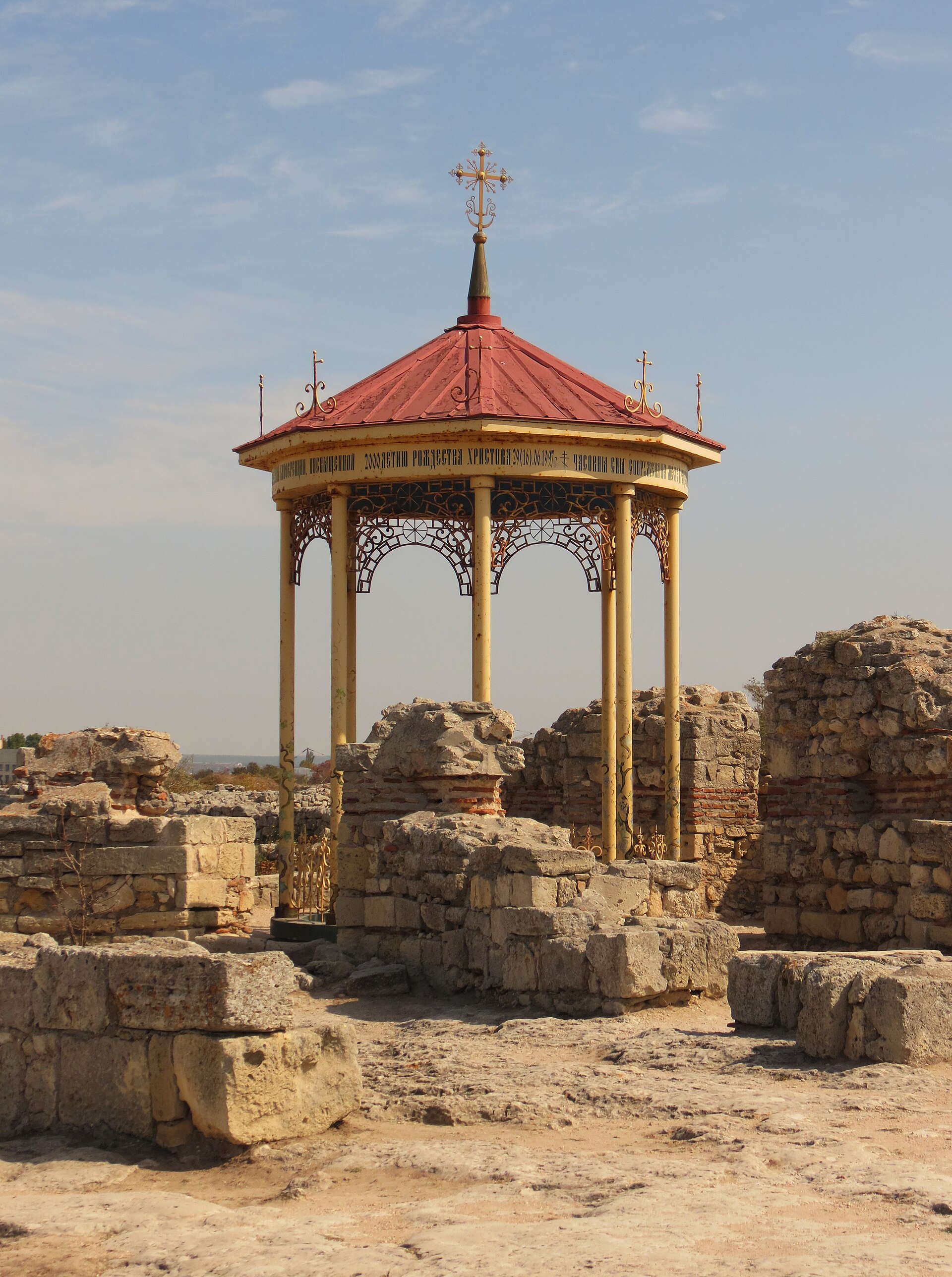
The Rotunda in Chersonesus is one of those rare places where history isn’t just something you read about—it’s something you can almost touch. Standing within the ruins of an ancient city founded by Greek settlers in the 5th century BCE, it occupies a site that was once a thriving hub of trade, culture, and later, faith. Known in antiquity as Chersonesus Taurica, this city flourished as a key outpost of the Byzantine Empire, a crossroads where civilizations met and left their mark. The Rotunda itself, however, arrived much later, emerging during the early Christian period when Chersonesus had already become a stronghold of the new religion.
Though small in size, the Rotunda carries an outsized significance. Its simple circular design, topped with a dome, is a classic example of early Byzantine architecture. Such structures were often built as memorial chapels or baptisteries, and this one was likely no exception. Archaeologists believe it may have been part of a larger complex, perhaps even linked to an episcopal residence. Inside, fragments of mosaic floors, faded frescoes, and remnants of marble cladding hint at the grandeur it once possessed. These details, though worn by time, still whisper of the people who once gathered here—merchants, pilgrims, and worshippers drawn to this sacred space.
Today, the Rotunda appears modest, its stone walls partially restored, its dome long gone, leaving the sky as its only ceiling. Yet this very simplicity gives it a quiet power. There are no gilded mosaics or towering arches like those in Constantinople or Rome, but there is something far more compelling: authenticity. Each stone feels like a witness to centuries of history, from the prayers offered beneath its roof to the footsteps of soldiers guarding the empire’s borders. It stands as a reminder that even the most unassuming places can hold profound stories.
Chersonesus has always been a place where cultures collided and blended. Greeks, Romans, Byzantines, Khazars, and Genoese all left their imprint here, and the Rotunda sits at the heart of this layered past. The city around it was once alive with the hum of markets, the murmur of prayers, and the clatter of daily life. Now, only ruins remain, but they carry a sense of dignity, as if the land itself refuses to forget. Walking through the archaeological site, it’s easy to imagine Chersonesus in its prime—a bustling port city where ideas, goods, and beliefs flowed freely.
The best time to visit the Rotunda is in the quiet hours of early morning or late afternoon, when the crowds thin and the light softens. The sun casts long shadows across the ancient stones, highlighting their texture and age. In these moments, time seems to slow, as if the weight of history presses gently against the present. Sitting on a nearby bench, watching the colors shift from gold to violet as the day fades, it’s possible to feel a connection to the past that goes beyond words.
The Rotunda is also tied to one of the most pivotal moments in Slavic history. According to legend, it was in Chersonesus that Prince Vladimir of Kiev was baptized in the late 10th century, an event that would shape the religious and cultural identity of Rus’. While historians debate the exact location of his conversion, the city itself is forever linked to the birth of Orthodox Christianity in the region. The Rotunda may not have been the site of that baptism, but it stands as a silent testament to the era when Chersonesus was already a Christian stronghold.
Today, the Rotunda is part of the Chersonesus Taurica Museum-Reserve, one of Russia’s largest archaeological sites. The surrounding ruins—basilicas, residential quarters, defensive walls, and an ancient theater—each tell their own story. Yet the Rotunda holds a unique place among them. It feels like an oasis of stillness amid the sprawl of history, a spot where the noise of the modern world fades, and the past feels almost tangible.
Visiting Chersonesus is like stepping into a time machine, but the Rotunda makes that journey especially vivid. There are no flashy reconstructions or dramatic plaques here, just stone, sky, and sea—much as it would have been centuries ago. It doesn’t demand attention; instead, it invites contemplation. That’s why it lingers in the memory: not as a relic behind glass, but as a living piece of history that continues to exist, quietly, beside us.