Varna’s Roman Baths are one of the few surviving remnants of the city’s ancient past, a quiet but imposing reminder of how this Black Sea port once thrived under Roman rule. Built in the late 2nd century AD, these ruins are among the largest Roman bath complexes still standing in the Balkans, stretching over nearly 7,000 square meters. Though much of the structure has crumbled over time, the sheer scale of what remains gives a sense of the grandeur that once defined public life here. The baths were not just a place for bathing—they were a social hub, where people gathered to exercise, gossip, discuss business, or simply escape the Mediterranean heat.
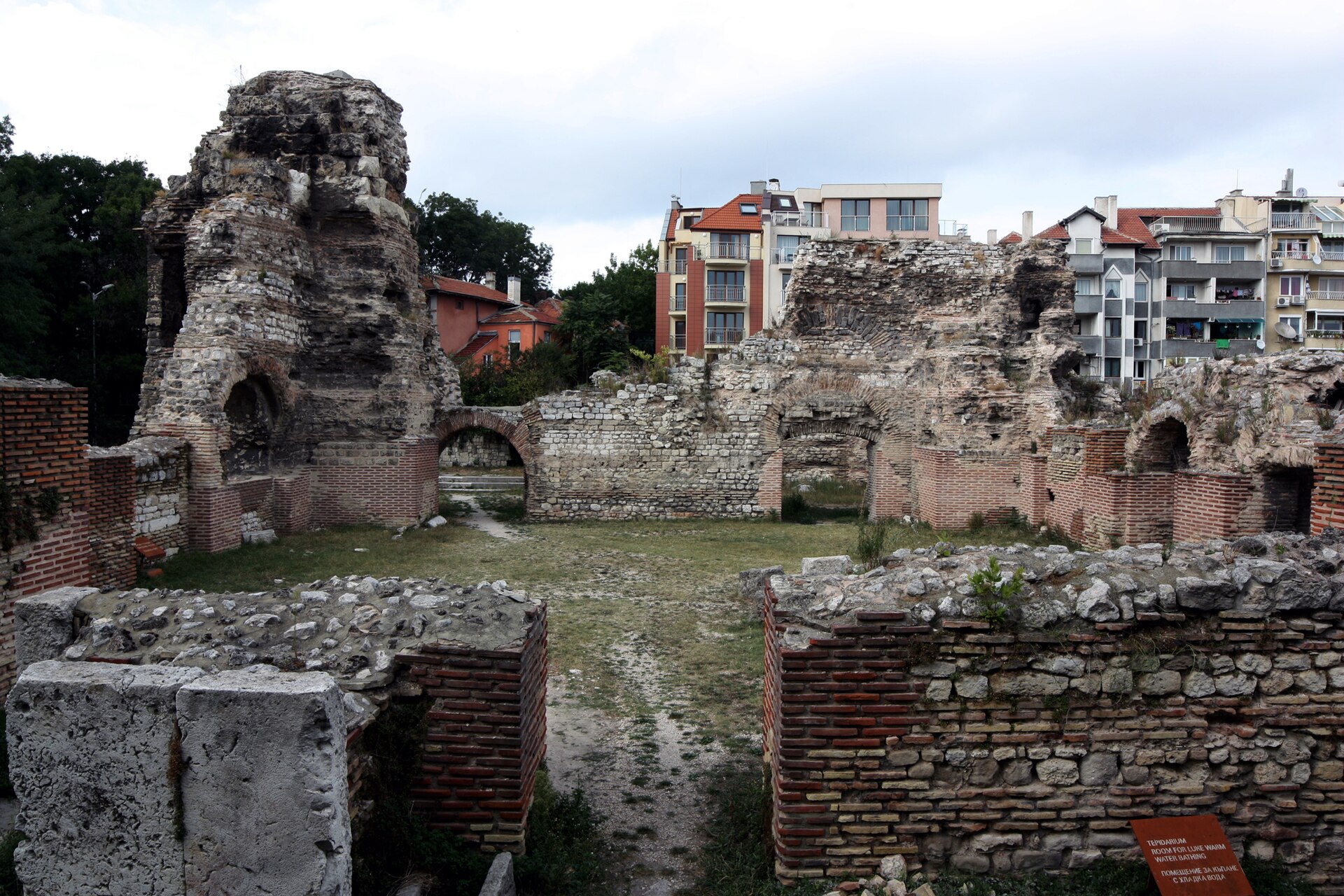
The architecture follows the classic Roman design, with distinct sections for different stages of the bathing ritual. The frigidarium, or cold room, still has its vaulted ceilings partially intact, while the tepidarium and caldarium—warm and hot rooms—hint at the sophisticated heating system beneath the floors. Hypocausts, the network of brick pillars that circulated hot air from underground furnaces, are visible in places, a testament to Roman engineering. The baths also included a palaestra, an open courtyard for wrestling and other physical activities, though little of it remains today. What does survive, however, is the sense of symmetry and order that defined Roman public spaces, with arched doorways and thick walls built to last.
Varna, known in antiquity as Odessos, was a key city in the Roman province of Moesia Inferior, serving as a military and commercial outpost. The baths were likely built during a period of prosperity, when the city was expanding and Roman influence was at its peak. They would have been a center of civic life, frequented by soldiers, merchants, and local elites. The complex was in use for several centuries, even as the empire’s fortunes waned, and it wasn’t until the late 3rd or early 4th century that it fell into disrepair. By then, Odessos had already begun its slow transformation into the medieval city that would later become Varna.
Today, the ruins sit in the heart of modern Varna, surrounded by a mix of Soviet-era apartment blocks and newer developments. The contrast between the ancient stones and the urban landscape is striking, yet the site feels oddly at home in the city’s fabric. Unlike some archaeological sites that are cordoned off and treated as mere relics, the Roman Baths are integrated into the daily life of the neighborhood. Locals walk their dogs past the ruins, children play nearby, and the occasional tourist stops to take photos. There’s no grand entrance or polished visitor center—just a low fence and a few informational plaques, which makes the experience feel more intimate, as if you’ve stumbled upon a secret rather than a curated attraction.
The baths are best visited in the early morning or late afternoon, when the light casts long shadows across the weathered bricks and the crowds thin out. The site is small enough to explore in under an hour, but it’s worth lingering to imagine the sounds that once filled these spaces—the splash of water, the murmur of conversations, the clatter of sandals on mosaic floors. Some of the original flooring survives in fragments, though most of the decorative elements have long since disappeared. What remains is the raw structure, stripped of its former opulence but still commanding in its simplicity.
One of the most interesting aspects of the Roman Baths is how they reflect the broader history of Varna. The city has always been a crossroads, shaped by waves of conquerors and settlers—Thracians, Greeks, Romans, Byzantines, Bulgars, Ottomans. The baths are a rare physical link to the Roman era, a time when this stretch of the Black Sea coast was part of a vast empire. They also serve as a reminder of how quickly civilizations rise and fall. The same stones that once echoed with the voices of Roman citizens now stand silent, their purpose forgotten but their presence undeniable.
For those interested in history, the baths offer a tangible connection to the past, but even casual visitors will find something to appreciate. The site is unpretentious, free of the commercialism that often surrounds major tourist attractions. There are no souvenir stalls or guided tours pushing you to hurry along—just the ruins, the breeze off the sea, and the occasional stray cat napping in the sun. It’s a place to pause and reflect, not just on the history of Varna, but on the passage of time itself.
The Roman Baths may not be as famous as the ruins of Rome or Pompeii, but that’s part of their charm. They exist on a human scale, a fragment of history that feels accessible rather than overwhelming. Whether you’re a history buff or simply someone who enjoys wandering through old places, the baths offer a quiet moment of connection to the past. And in a city as lively as Varna, that kind of stillness is a rare and welcome thing.