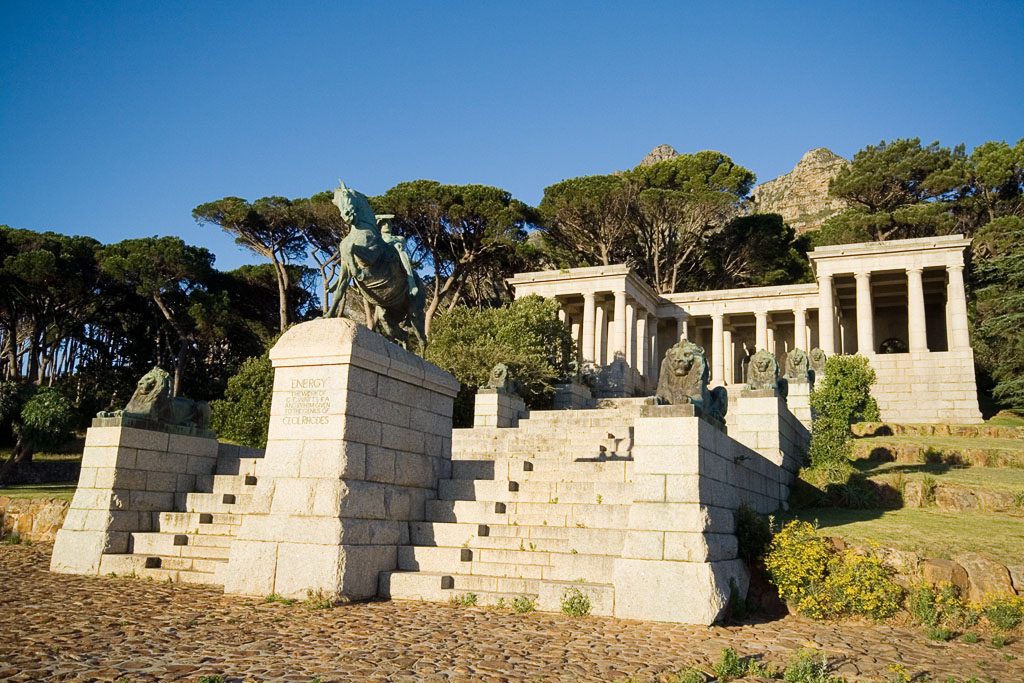
Perched on the slopes of Table Mountain, Rhodes Memorial feels like a place where time moves differently. The air is cooler here, the light softer, and the views stretch so far that the city below seems almost unreal. From its terraces, Cape Town unfolds in layers—rooftops giving way to the curve of the bay, the Atlantic shimmering in the distance, and the jagged peaks of the Twelve Apostles framing the horizon. It’s a spot that invites lingering, whether you’re here for the history, the architecture, or simply the quiet.
The memorial was built in the early 1900s to honor Cecil John Rhodes, a man whose legacy is as contested as it is significant. To some, he was a visionary who shaped the region’s infrastructure and politics; to others, a symbol of colonial exploitation. The memorial itself doesn’t take sides. Instead, it stands as a physical marker of an era that still shapes South Africa today. The design, by architect Herbert Baker, draws on neoclassical influences, with a grand colonnade of granite columns that evoke the temples of ancient Greece. At the top of the broad staircase, a bronze statue of Rhodes on horseback gazes outward, as if surveying the land he once sought to control. The effect is imposing, yet the setting softens it—the manicured lawns, the rustling trees, the way the light shifts across the stone as the day progresses.
Rhodes himself chose this spot. He often rode up here, drawn to the solitude and the views, and it’s said that some of his most consequential decisions were made while sitting on these slopes. After his death in 1902, the site was selected for the memorial as a way to preserve his connection to the landscape he loved. Construction began in 1906, and over the years, the surrounding park took shape, becoming a place where Capetonians came to walk, picnic, and escape the city. Even now, the memorial feels less like a static monument and more like a living part of the mountain, something that has grown into the land rather than been imposed upon it.
Today, the memorial is as much a public space as it is a historical one. On any given morning, runners weave along the paths that wind through the park, their breath visible in the crisp air. Families spread out blankets on the grass, children chasing each other between the trees while parents unpack snacks. On weekends, the place hums with activity—students lounging on the steps, photographers framing shots of the columns against the sky, couples sharing quiet conversations with the city sprawled below. There’s a sense of ease here, a feeling that this is a place where people come not just to see, but to be.
Yet the memorial is also a place of reflection, and not always a comfortable one. Rhodes’ legacy has become a focal point in broader conversations about how South Africa reckons with its colonial past. Should monuments like this be preserved as historical artifacts, or do they need to be recontextualized—or even removed—to reflect a more nuanced understanding of history? The debate isn’t abstract here; it’s woven into the very stone of the memorial. Some visitors come specifically to grapple with these questions, while others simply enjoy the view, unaware of the tensions beneath the surface. Either way, the memorial doesn’t offer easy answers. It stands as it always has, a silent witness to the passage of time and the shifting ways we interpret it.
For those exploring Cape Town, the memorial is a natural starting point. From here, you can hike up into Table Mountain National Park, where trails lead through fynbos and rocky outcrops, or descend toward Kirstenbosch Botanical Gardens, where indigenous plants spill across the slopes in a riot of color. The surrounding neighborhoods, with their leafy streets and old Cape Dutch houses, offer a glimpse of the city’s colonial past, though one that’s been reclaimed and reshaped over the decades. On clear days, the view from the memorial extends all the way to the wine lands beyond the city, where vineyards roll across the valleys like a patchwork quilt. In the late afternoon, as the sun dips lower, the light turns golden, casting long shadows across the columns and making the stone glow.
What makes Rhodes Memorial unusual is its lack of pretense. There are no guided tours, no plaques explaining every detail, no prescribed way to experience it. Instead, it offers space—space to sit, to think, to argue, or to simply watch the clouds drift over the mountain. Some visitors come for the history, others for the views, and a few might leave unsettled by the questions it raises. But that ambiguity is part of what gives the place its power. It doesn’t tell you what to feel or what to believe. It just presents itself, as it has for over a century, and lets you decide what it means.
In the end, Rhodes Memorial is more than a monument to one man. It’s a reminder of how landscapes hold stories, how the past lingers in the present, and how even the most contentious figures become part of the places they once shaped. Whether you come here for the architecture, the views, or the chance to ponder history’s complexities, the memorial leaves an impression—not because it demands attention, but because it quietly insists on being noticed. And perhaps that’s the point. Some places don’t need to shout to be heard. They just need to endure.