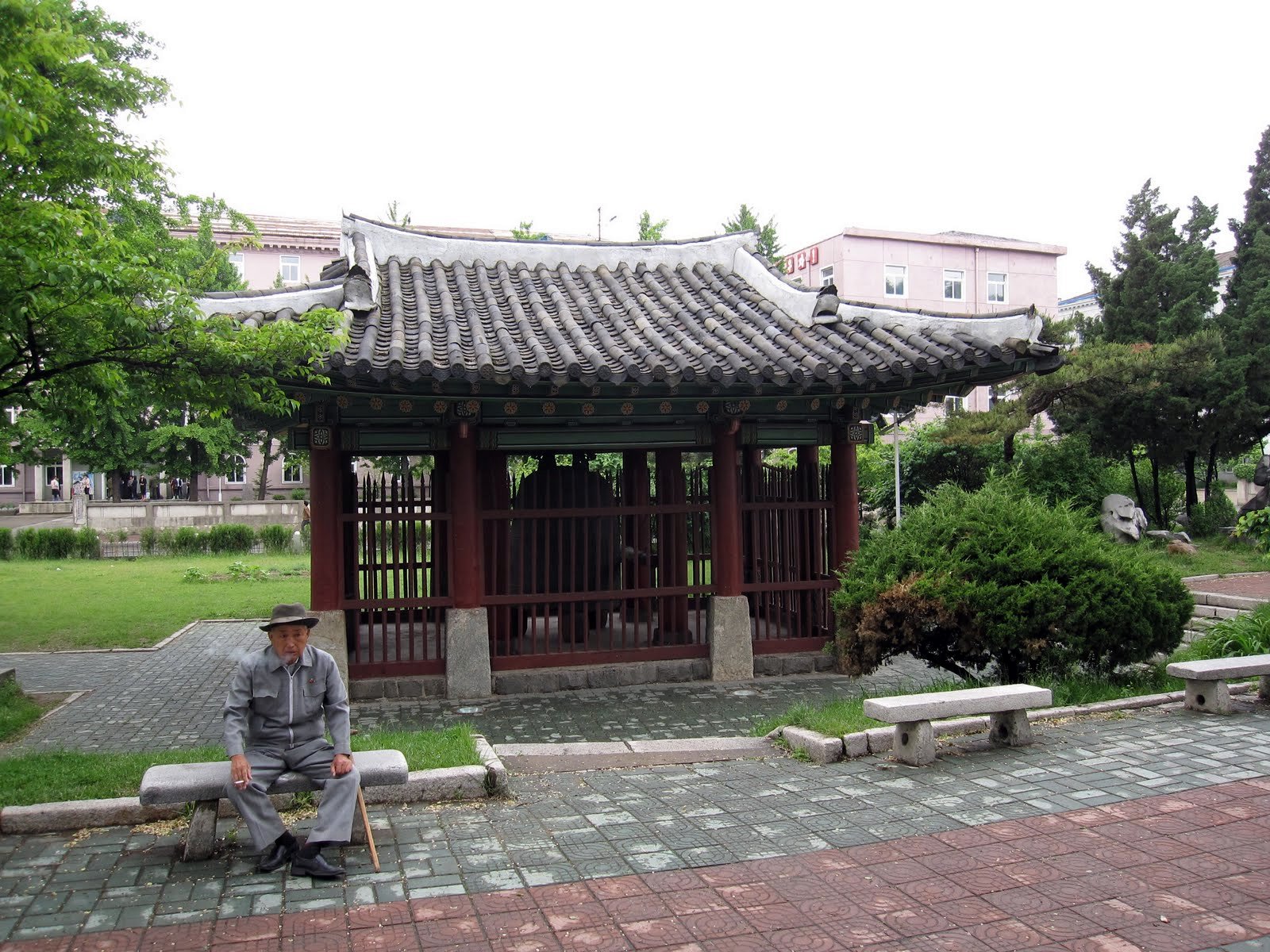
The Pyongyang Bell is one of those quiet witnesses to history that doesn’t need words to tell its story. Standing in the heart of the city, not far from the Taedong River, it has long since fallen out of use but remains a subtle yet enduring part of Pyongyang’s landscape. Cast in the mid-18th century during the Joseon Dynasty, when the city was a cultural and administrative hub of Korea, the bell once served more than just a ceremonial purpose. In those days, urban bells marked time, warned of fires, floods, or other emergencies, and called people to gather. This particular bell, weighing around 13 tons, was forged in 1726 and originally hung in one of the city’s towers until a fire destroyed it in the 19th century.
Now resting on a stone pedestal in the open air, the bell can be examined from all sides. Its bronze surface has developed a soft green patina over the centuries, and the metal is etched with fine cracks and the marks of time. The bell is adorned with relief inscriptions in hanja, the classical Korean script used before the 20th century. These carvings record who cast the bell and when, along with wishes for the city’s prosperity and safety. Such inscriptions weren’t merely decorative—they were part of a ritual, believed to imbue the bell with protective power, as if the words themselves could safeguard the place where it stood.
Architecturally, the Pyongyang Bell embodies the understated elegance of traditional Korean design. Unlike the heavy, ornate bells of Europe, this one appears more refined despite its size. Its shape resembles an inverted dome with smooth, flowing lines, and the top is decorated with reliefs of dragons and clouds—motifs common in Korean art of the period. In Korean culture, dragons symbolize strength and protection, while clouds often represent the heavens and divine favor. These elements give the bell not just historical significance but also artistic value, reflecting the craftsmanship and symbolism of its time.
Over the years, the bell has inspired its share of legends. One story claims its sound could carry for miles, waking even the spirits of ancestors. Another tells of the master foundryman who cast the bell in a single attempt, a feat that usually took years. According to the tale, he used a secret family technique, and the spirit of the city itself guided his work. While these stories can’t be verified, they add a layer of mystique, turning the bell from a mere monument into a living relic of the past.
Today, the Pyongyang Bell is more of a museum piece than a functional instrument. It no longer rings, but it still draws the attention of locals and the occasional visitor. Schoolchildren often gather around it on field trips, studying the inscriptions and listening to guides explain its history. For North Koreans, the bell is a symbol of continuity, a reminder that their city has endured centuries of war, change, and upheaval. For outsiders, it offers a quiet moment to reflect on how borders, names, and regimes shift over time—while some things, like a bronze bell, remain unchanged.
A visit to the Pyongyang Bell doesn’t take long, but it’s a good excuse to explore the city center. Nearby are other landmarks, like Kim Il Sung Square, the Korean Revolution Museum, and the Taedong River promenade, where locals gather in the evenings. The bell sits on a slight elevation, accessible by a few stone steps, surrounded by flower beds and informational plaques. The setting is peaceful, especially in the early morning when the city is still quiet and the air is calm.
In North Korea, historical monuments are treated with particular reverence. Visitors are expected not to touch them, pose inappropriately, or make noise nearby. The Pyongyang Bell is no exception. Locals approach it with respect, and tourists are usually reminded that it’s not just a sightseeing spot but part of the nation’s heritage. The bell has survived Japanese occupation, the Korean War, and the challenges of post-war reconstruction, emerging almost untouched—a rare continuity in a country that has seen so much change.
Occasionally, small events are held near the bell, celebrating Pyongyang’s history. On city holidays, there might be performances of traditional music or displays of old crafts like calligraphy or woodcarving. For visitors, these moments offer a rare glimpse into Korean culture as preserved in the North, where traditions often feel more intact than in the South. These gatherings aren’t large-scale, but if you’re lucky, you might witness one.
The Pyongyang Bell isn’t just a chunk of bronze—it’s a piece of living history. It reminds us that Pyongyang is far older than it might seem at first glance, that beneath its modern avenues and monuments lies a city with centuries of stories. The bell doesn’t demand attention or proclaim its importance, but if you pause beside it, you might sense the echoes of the past—the faint chime that once called people to the square, warned of danger, or marked the start of a new day. Today, that sound exists only in memory, but the bell endures, a silent guardian of time.