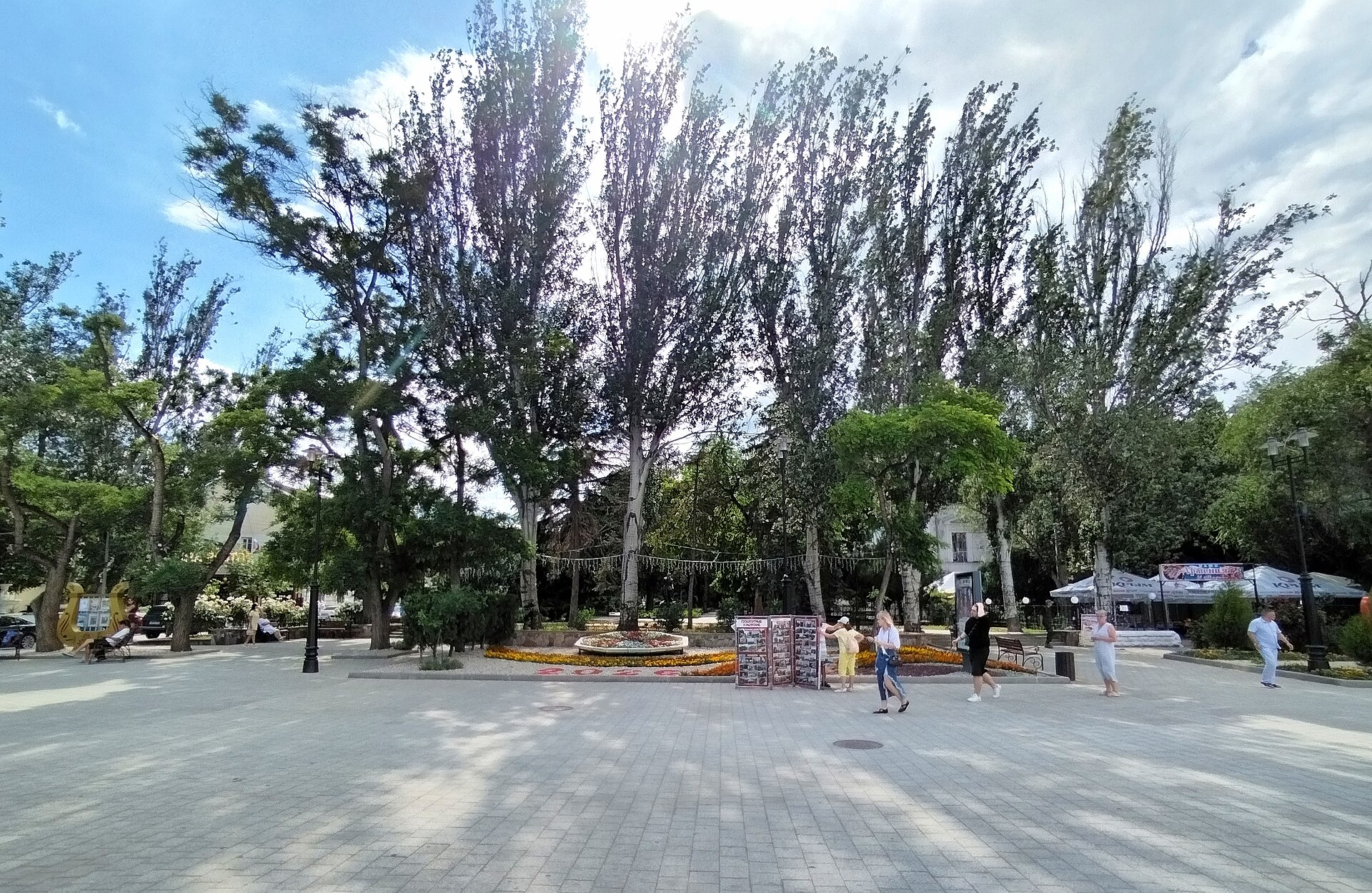
Pushkin Square in Feodosia is one of those rare places where the city’s past and present exist side by side without pretension. Tucked along the seafront, it isn’t just a decorative park but a natural part of the urban landscape, where every tree and pathway carries the quiet weight of history. The square took shape in the late 19th century, when Feodosia was flourishing as a resort and cultural hub of Crimea. Back then, it was a favorite spot not only for locals but for the artists, writers, and performers who flocked to the city, drawn by its mild climate and the salty tang of the Black Sea.
The square is named after Alexander Pushkin for a reason. The poet passed through Feodosia in 1820 during his journey across Crimea, and though he spent only a few days here, the city left its mark on his work. In his writings, he described Feodosia as a place where the sea meets ancient land, a city steeped in Eastern charm. The statue of Pushkin, installed in the 1980s, stands not as a grand monument but as a quiet acknowledgment of the city’s connection to Russian literature—a reminder that even brief encounters can shape art.
There’s nothing elaborate about the square’s design. The paths are paved with simple tiles, lined with old plane trees and umbrella pines that offer shade on hot summer days. A small fountain sits at its center, a gathering spot for both locals and visitors. In the evenings, the glow of streetlamps reflects off the water, softening the air. Spring brings magnolias in bloom, while autumn turns the leaves into warm hues, making the square feel like a living painting that changes with the seasons.
Beyond being a place for leisurely strolls, Pushkin Square serves as an open-air stage for the city’s cultural life. In summer, it hosts concerts, poetry readings, and art exhibitions, with musicians playing guitars and painters displaying their work along the paths. On such days, the square hums with energy, drawing in anyone who appreciates creativity. Winter, though, is quieter—just the occasional passerby hurrying through, while frost dusts the trees, turning the square into something almost magical.
Over time, the square has woven itself into the fabric of local life. Older residents still recall how sailors once gathered here before setting off to sea, while others remember it as the go-to spot for romantic rendezvous in Soviet times. Today, you’ll find young couples, families with children, and elderly locals sitting on benches with newspapers or simply enjoying the sea breeze. There’s no forced charm here—just the easy rhythm of a place that has always belonged to the city.
Feodosia’s history is layered, and Pushkin Square reflects that complexity. The city has been a Greek colony, a Genoese stronghold, and a Russian resort town, and the square sits at the intersection of these eras. It’s just a short walk from the port, where the distant hum of ship horns serves as a reminder that Feodosia has always been a city of sailors and travelers. From here, you can watch the bay as evening falls, with the lights of pleasure boats flickering on the water and the horizon blurring into the sky.
In recent years, the square has also become a place of remembrance. Memorial plaques honor notable figures from Feodosia’s past—artists, poets, and scientists who shaped the city’s identity. One commemorates Konstantin Bogaevsky, a renowned Crimean landscape painter who was born and worked here. His paintings, capturing the essence of Feodosia’s scenery, are now considered classics of Russian art. Walking through the square, it’s easy to imagine how he might have seen these same streets over a century ago.
Pushkin Square isn’t a museum, though. It’s a living space where history and modernity coexist without fuss. There are no rigid rules here—just the flow of everyday life. You can bring a book and spend hours on a bench, meet friends for coffee at a nearby café, or simply wander the paths, watching how the city shifts with the seasons. The square doesn’t demand attention; it simply offers a chance to feel the pulse of Feodosia, to sense its past and present in the most unassuming way. That’s what makes it special—it gives without asking for anything in return.