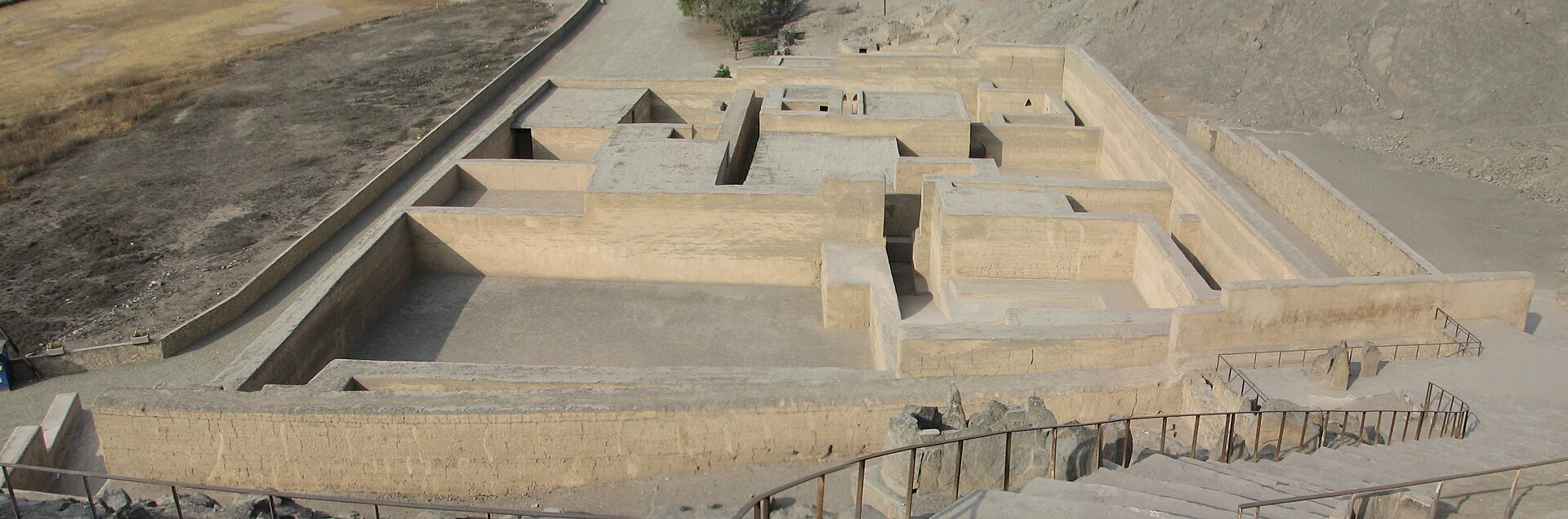
Puruchuco sits on the edge of Lima, a quiet reminder of the city’s deep past. Unlike the crowded plazas and polished museums downtown, this place feels untouched by time, as if the modern world has only brushed against it. There’s no fanfare here—no souvenir stalls, no guided tours pressing you to hurry along. Just the low walls of an ancient palace, the weight of history in the air, and the occasional rustle of wind through the dry grass.
The ruins are what remain of a once-thriving administrative and ceremonial center, built during the height of the Inca Empire. The palace itself was the residence of a local ruler, a governor who answered to the Sapa Inca, the empire’s supreme leader. The structure is modest by Inca standards—small rooms, narrow corridors, walls of rough stone held together with clay. Staircases climb to upper levels, where the ruler would have looked out over the valley and the distant Pacific. It wasn’t a place of luxury, but of power, where decisions were made and rituals performed.
What makes Puruchuco interesting is how it layers two civilizations. Before the Inca arrived, this land belonged to the Ichma, a people who had controlled the central coast of Peru for centuries. The Inca didn’t erase their legacy; they absorbed it. You can see this in the architecture—trapezoidal doorways, a signature of Inca design, stand alongside the rectangular niches favored by the Ichma. These niches likely held offerings or sacred objects, a quiet testament to how the two cultures coexisted, even if one eventually dominated the other.
The site was more than just a political hub. It was a place of worship, deeply tied to the rhythms of nature. Water was sacred here, especially in a region where the desert meets the sea. Archaeologists have found remnants of a canal inside the palace, possibly used for ritual cleansings or offerings to the gods. The Inca, like the Ichma before them, understood the precarious balance of life on the coast. The palace was built on a hillside overlooking the Rímac River, a lifeline that still winds through Lima today. In a land where rain was rare, water wasn’t just a resource—it was divine.
When the Spanish arrived, they saw little value in preserving what they considered pagan ruins. Over time, the palace was buried under earth and forgotten. It wasn’t until the mid-20th century that archaeologists began uncovering its walls, piecing together its story. What they found wasn’t grand like Machu Picchu or mysterious like the Nazca Lines, but it was real—a fragment of the past that hadn’t been polished for tourists.
Today, Puruchuco feels almost overlooked. There are no reconstructions, no flashy exhibits, no crowds jostling for the best photo. The ruins are left as they were found, their stones worn by centuries of sun and wind. The site is small enough to explore in an hour, but it lingers in a way that grander monuments sometimes don’t. Maybe it’s the silence, or the way the light falls on the walls in the late afternoon. Maybe it’s the knowledge that this was once a place where people gathered to pray, to govern, to live.
The neighborhood around Puruchuco is unremarkable—rows of houses, the hum of daily life. For locals, the ruins are just part of the landscape, something they pass on their way to work or the market. But for visitors, it’s a rare chance to step away from Lima’s colonial heart and into a quieter, older version of the city. There’s no script here, no curated experience. Just the ruins, the sky, and the faint echo of a time when this land was ruled by different hands.
If you come, don’t expect a spectacle. There’s no dramatic reveal, no sweeping views of mountains or jungles. What you’ll find instead is something more intimate—a place where history isn’t performed, but simply exists. You can sit on one of the stone steps and imagine the ceremonies that once took place here, the voices of priests and rulers carried on the wind. Puruchuco won’t answer all your questions about the Inca or the Ichma, but it might make you feel their presence, just for a moment. And in a city as layered as Lima, that’s enough.