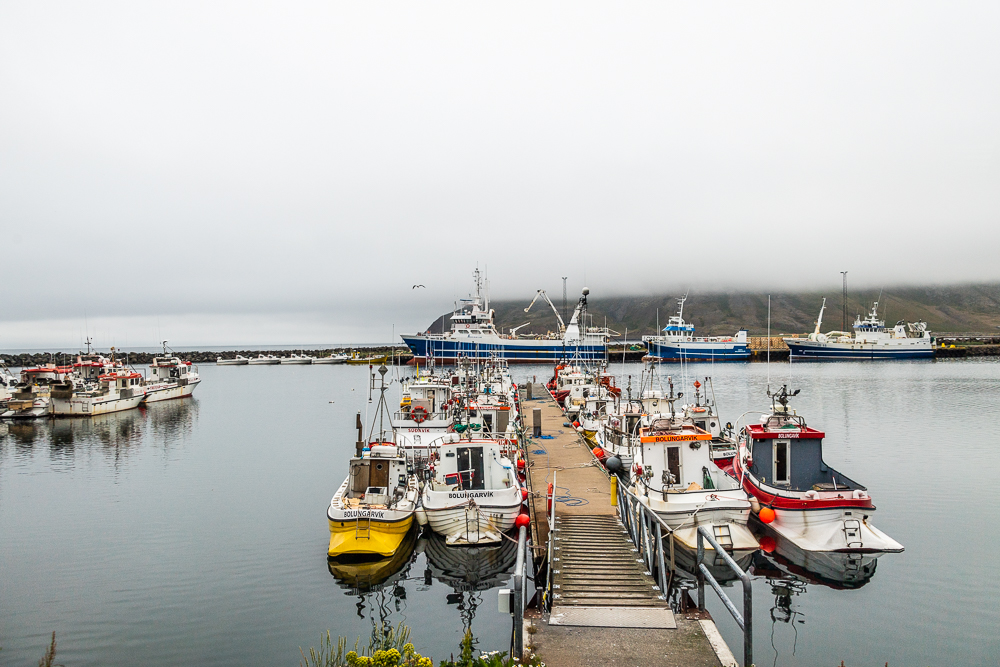
Bolungarvík is a quiet fishing village clinging to the edge of Iceland’s western coast, where the land drops sharply into the sea and the horizon stretches endlessly. There are no crowds here, no neon signs or souvenir shops—just the raw beauty of the North Atlantic and the kind of silence broken only by the cries of gulls and the rhythm of waves against the shore. The harbor is the heart of the place, its reason for being. For generations, fishing boats set out from here, and though the vessels have changed, the tradition remains. The port is still the lifeblood of the village, a place where the past and present meet in the daily work of those who depend on the sea.
This was once one of the most important fishing hubs in the Westfjords, where cod, herring, and halibut filled the nets. Families built their homes close to the water, and the village grew around the harbor like a shell on a rock. Even now, while other Icelandic ports have expanded into industrial zones, Bolungarvík has kept its unpolished character. There are no cruise ship docks or sprawling warehouses—just modest piers where fishing boats bob in the water and old storage sheds that sometimes double as spaces for local exhibitions. The harbor feels lived-in, not staged for visitors.
The architecture here is as straightforward as the landscape. Houses are built from wood and stone, painted in muted shades of gray, brown, and blue to blend with the cliffs and sea. Some have stood for over a century, weathering storms and winters that would test any structure. In the center of the village, an old church from the early 1900s rises with its simple white walls and steep roof. It looks fragile against the harsh climate, yet it still serves the community, just as the harbor still sustains it. There’s a quiet resilience in these buildings, a refusal to be overwhelmed by the elements.
The sea is both provider and threat. The Westfjords are known for sudden, violent storms, waves that crash against the shore with terrifying force. In the past, these tempests claimed lives, and the memory lingers. On a hill overlooking the village, a stone cross surrounded by a chain stands as a memorial to lost sailors. It’s a stark reminder that life here has always been a struggle, even now, when modern technology has made fishing safer. The ocean hasn’t softened—it still demands respect.
Today, Bolungarvík isn’t just a working port. It’s a place for those who want to see Iceland without the gloss. There are no famous waterfalls or glaciers here, but there’s something rarer: authenticity. You can walk the empty streets, stop in a small café where the catch of the day is served fresh, or sit by the water and watch the waves break against the rocks. In summer, the sun barely sets, casting the sky in pale pinks and blues. Winter brings long darkness, and the only lights come from the windows of homes and the glow of the harbor, proof that life here doesn’t stop, no matter the season.
The harbor isn’t just a place where boats dock. It’s a symbol of the endurance that defines Iceland. There’s no luxury here, just honesty—in the weathered buildings, the quiet streets, the way the villagers look at the sea. They know it can be cruel, but without it, there would be no Bolungarvík. That’s why the port remains the center of life, a link between past and future, between people and the forces that shape their world. It’s not a place for grand gestures, but for the quiet, daily work of living with the sea.