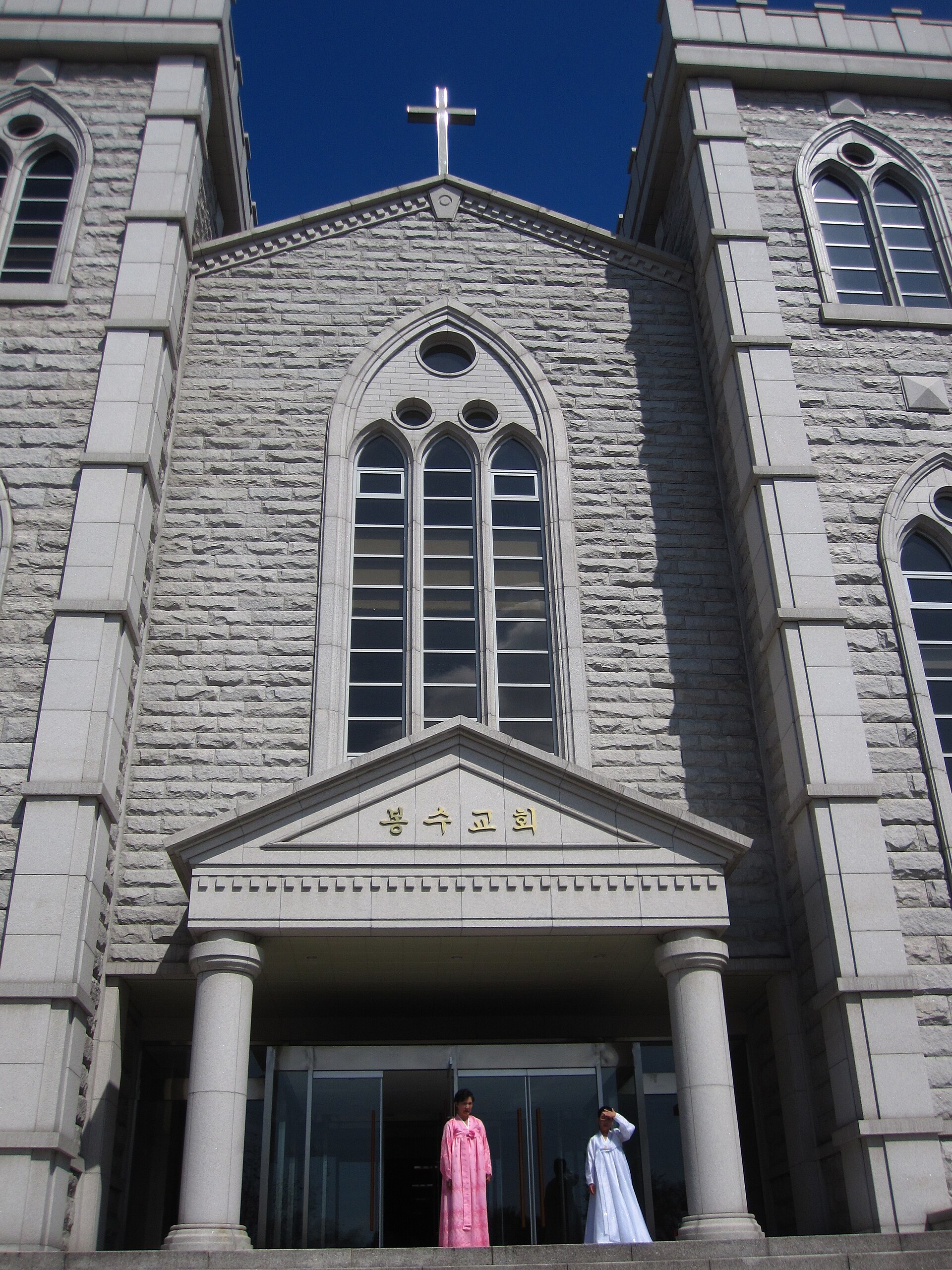
Pongsu Church stands quietly in Pyongyang’s Moranbong district, a place that defies easy categorization. Built in 1988, it is officially a Protestant house of worship, yet its purpose extends beyond the spiritual. The building itself is unassuming—a two-story structure of pale stone, its tall windows and modest bell tower giving it the appearance of a civic institution rather than a traditional church. Inside, the space is sparse: wooden pews, a small altar, and an absence of ornamentation. The design is deliberate, stripped of distractions, as if to suggest that faith here is a matter of focus, not spectacle.
The church occupies a curious place in North Korea’s relationship with religion. The country’s constitution guarantees freedom of belief, but in practice, worship is tightly regulated. Services at Pongsu are held regularly, though the congregation is a carefully curated mix of foreigners, diplomats, and a handful of local believers whose loyalty to the state is beyond question. Visitors are permitted, but the experience is closely managed—no photography inside, and every step guided by an official escort. The church exists in a kind of limbo, neither hidden nor truly open.
Its origins trace back to the 1980s, a period when North Korea sought to soften its image abroad. The construction of Pongsu, along with the Changchung Catholic Cathedral and the Holy Trinity Orthodox Church, was part of an effort to project an illusion of religious tolerance. Yet the reality is more complicated. Few ordained clergy remain in the country, and those who lead services often do so under state supervision. The church, in many ways, serves as a stage for a performance of faith rather than an expression of it.
Inside, the atmosphere is subdued. Services proceed without fanfare, the congregation seated in quiet order. There is no grandeur, no sense of ritualistic fervor. For some, particularly foreign visitors, the church offers a rare connection to a familiar world, a brief respite from the unfamiliar. For others, it is little more than a curiosity, a place that exists because it must, not because it is truly needed.
The streets around Pongsu are quiet, lined with low-rise buildings that blend into the cityscape. Locals pass by without a second glance, as if the church were just another structure in a city where every building has a purpose. To them, it is neither sacred nor significant—just another part of the carefully constructed reality that defines Pyongyang.
For outsiders, Pongsu Church is a window into the contradictions of North Korea. It is not hidden, nor is it promoted. It simply exists, a symbol of the state’s control over even the most personal aspects of life. The church does not reveal the full complexity of the country, but it does offer a glimpse of how deeply that control runs. Here, faith is not forbidden, but it is not free either.
Visiting Pongsu is less about architecture or spirituality and more about understanding the layers of meaning that shape this city. Pyongyang is a place where every detail is deliberate, where even silence carries weight. The church is no exception. It does not answer questions so much as it raises them, a quiet reminder of the boundaries between what is shown and what is real.
If you find yourself in Pyongyang, stepping inside Pongsu is worth the time—not for what it is, but for what it represents. In a country where every institution serves a dual purpose, the church stands as a small but telling example of how even the most personal beliefs are shaped by the state. It is a place that invites reflection, not devotion.