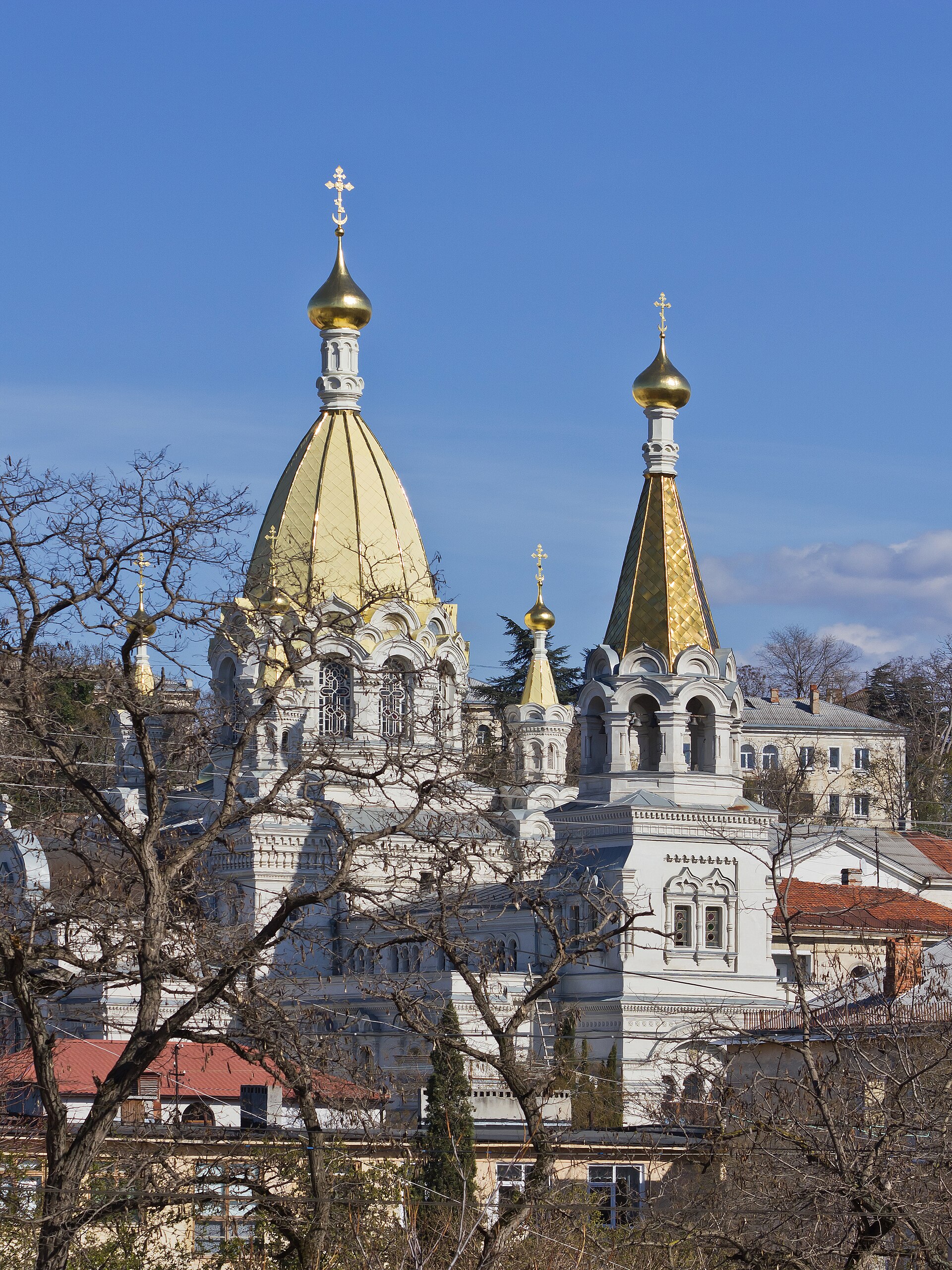
Perched on a quiet hillside in Sevastopol, the Church of the Intercession feels like a place where time moves at its own unhurried pace. Unlike the grand cathedrals that dominate the city’s skyline, this modest structure doesn’t demand attention—it earns it. From its elevated position, the church overlooks the bay and the sprawling port below, offering a view that shifts with the seasons: the deep blue of the water in summer, the muted gray of winter storms, the golden haze of autumn sunsets. There’s something unassuming yet enduring about it, as if the building itself has absorbed the quiet resilience of the city around it.
The church’s origins trace back to the mid-19th century, a time when Sevastopol was rapidly expanding as a naval stronghold. The area around it, known as the Ship Side, was home to sailors, officers, and their families—people who needed a place of worship close to their daily lives. Construction began in 1848, but progress was slow, shaped by practical concerns. The limestone used for the walls came from nearby quarries, and the design blended classical elements with traditional Russian church architecture. The result was a building that felt rooted in its surroundings, neither overly ornate nor austere, but perfectly suited to its purpose.
Inside, the atmosphere is warm and intimate, a stark contrast to the imposing interiors of larger cathedrals. The iconostasis, painted by local artisans, lacks the gilded opulence of more famous churches but carries a quiet sincerity. The icons themselves are simple, their colors softened by time, with one exception: the revered image of the Intercession of the Theotokos. According to local tradition, this icon survived the brutal bombardments of the Crimean War, a silent witness to the city’s suffering and endurance. It remains the heart of the church, drawing both pilgrims and those simply seeking a moment of reflection.
The church has seen its share of hardship. During the Siege of Sevastopol in 1854–1855, it served as both a place of worship and a makeshift hospital, its walls echoing with the prayers of the wounded and the dying. Later, in the Soviet era, it shared the fate of many religious sites—closed, repurposed as a warehouse, and eventually left to decay. It wasn’t until the 1990s that restoration began, and today, the church stands as a living piece of history, its doors open to all who wish to enter.
Architecturally, the Church of the Intercession is a study in subtle evolution. The original design leaned toward neoclassicism, but later additions, including a bell tower, gave it a more traditional Russian Orthodox appearance. The single dome rises modestly above the surrounding trees, its cross catching the light at dawn and dusk. The low stone wall encircling the churchyard feels more like an invitation than a barrier, and the old pines and oaks provide shade on even the hottest days. In summer, the scent of sea salt mingles with the resinous aroma of the trees, and the sound of bells carries across the bay, marking the hours in a way that feels timeless.
This isn’t a place that caters to tourists. There are no souvenir stalls, no guided tours with flags, no crowds jostling for the best photo. Instead, it offers something rarer: a glimpse of Sevastopol as it truly is—a city of contrasts, where grandeur and simplicity coexist. The church is still an active place of worship, and if you visit during a service, you might hear the haunting beauty of ancient hymns sung by the choir. Even outside of services, the quiet hum of prayer and the soft glow of candlelight create an atmosphere of peace.
For locals, the Church of the Intercession is more than just a building; it’s a thread in the fabric of their lives. Some were baptized here, others married beneath its vaulted ceilings, and many have come to light a candle in memory of loved ones. During the Soviet years, when the church was closed, people still found ways to visit, leaving flowers and lighting candles in secret. Today, it remains a place where the past and present intersect, where the weight of history feels tangible but not oppressive.
Reaching the church on foot takes about twenty minutes from the city center, a walk that’s as rewarding as the destination itself. The route winds through narrow streets lined with small cafés and shops selling local sweets, past viewpoints where you can pause to take in the panorama of the bay. From here, Sevastopol unfolds like a living map: the old naval quarters, the modern port, the ships gliding in and out of the harbor. Against this backdrop, the Church of the Intercession stands as a quiet anchor, a reminder that beauty often lies in the unassuming corners of the world.
In recent years, the church has become a subtle part of the city’s cultural life. Concerts of sacred music, exhibitions of religious art, and lectures on local history have all found a home here. Yet, for all its new roles, the church’s essence remains unchanged. It doesn’t seek to impress or overwhelm; it simply exists, offering a space for stillness in a city that has seen so much. Sevastopol has no shortage of grand cathedrals, but the Church of the Intercession holds its own kind of power—the power of quiet endurance, of a place that has witnessed history and yet remains open to the present.