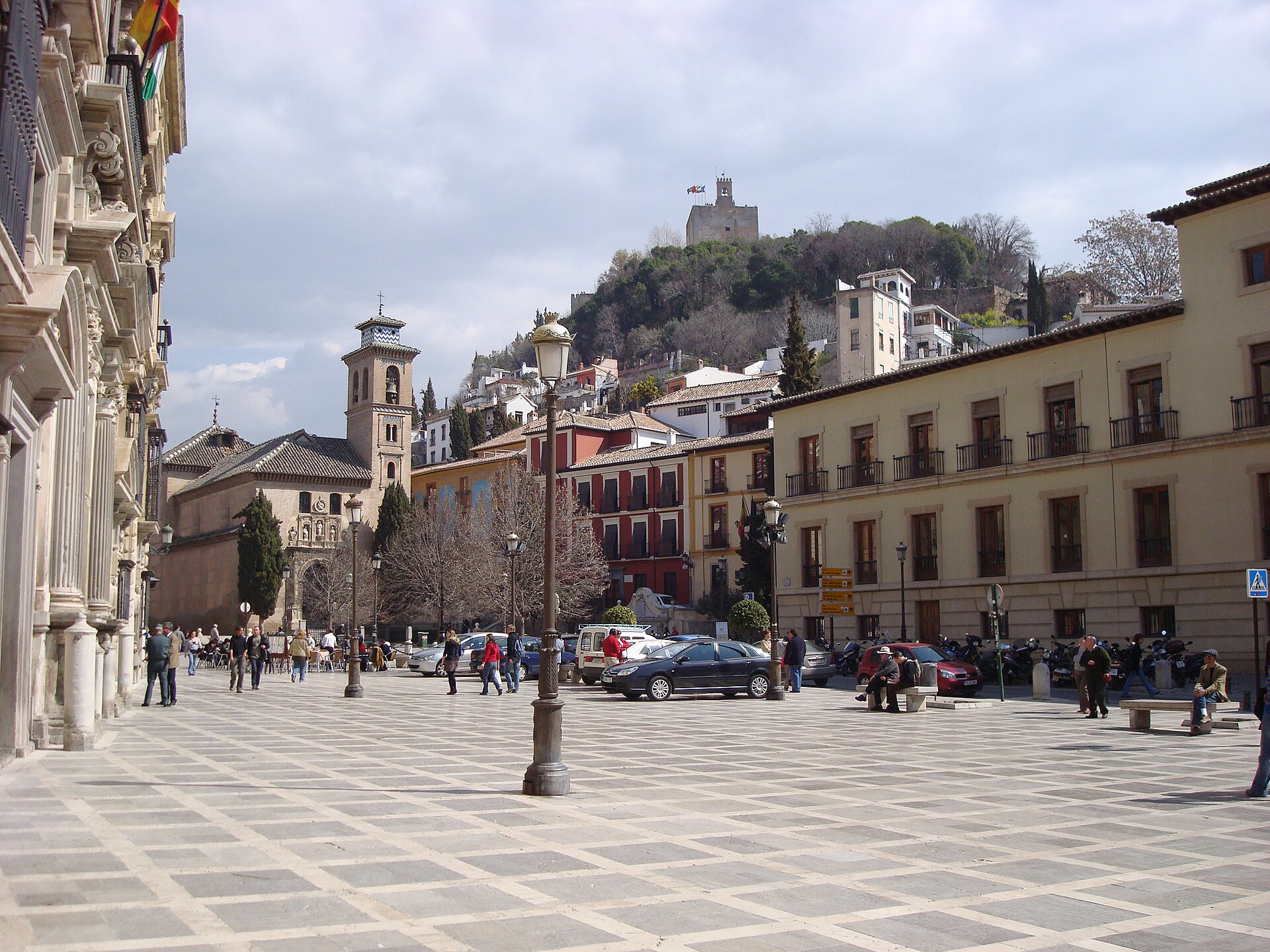
New Square is where Granada reveals itself without fanfare. It’s less famous than the Alhambra or Albaicín, which is why it feels like a place where the city’s daily rhythm still belongs to its people. The square sits at the foot of the hill where the Moorish quarter once sprawled, acting as a quiet link between the city’s past and present.
The Royal Chancellery, built in the sixteenth century, dominates the square. This Renaissance building, with its massive columns and heraldic crests, was once the highest court of the Kingdom of Granada. Today, it houses the Andalusian High Court, though parts of its courtyard—with a fountain and arched galleries—remain open to visitors.
Next to it stands the Church of Santo Domingo, founded in the fifteenth century on the site of a former mosque. Its façade mixes Gothic and Renaissance styles, and inside, wooden ceilings and old altarpieces survive. The church isn’t always open, but if you’re there when it is, the organ’s sound carries through the vaulted space.
The square wasn’t always a square. In medieval times, it was just a patch of ground near the city gates, used by merchants and pilgrims. Over time, it became a hub for craftsmen, then an administrative center after Granada was absorbed into Christian Spain. Its name changed too—once called the Square of the Holy Apostles, now simply New Square.
Mornings here start slowly. Locals drink coffee at small cafés, students from the nearby university pass through, and elderly residents sit on benches under the trees. Evenings bring lamplight across the cobblestones, softening the edges of the square. There are no crowds, just the quiet rhythm of the city.
The uneven cobblestones hint at old streets that once led to the city gates. Some buildings still have wooden balconies with carved railings, details that tie the square to its medieval past. These aren’t obvious at first glance, but they make the place feel like layers of time stacked together.
On weekends, artisan fairs set up stalls selling handmade ceramics, leather goods, and almond pastries baked from old recipes. The vendors aren’t performing for tourists—they’re just part of the city’s living culture. You can browse without pressure, or just sit and watch.
New Square doesn’t dazzle. It doesn’t have the Alhambra’s towers or the Albaicín’s alleys, but that’s why it works. It invites you to slow down, notice the small things, and feel Granada as it’s been for centuries. There’s no grand spectacle here, just the kind of authenticity that’s harder to find in the city’s more famous spots. Maybe that’s why people come back.