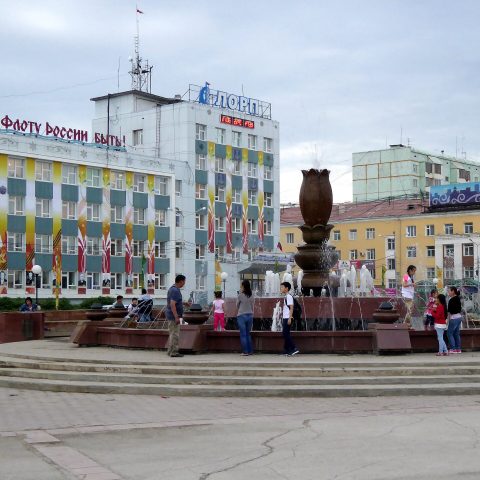
Lenin Square in Yakutsk is one of those places where the city reveals itself slowly, without haste but with a distinct character. There are no crowds of tourists here, no bustling energy like in the capitals—just the quiet pulse of real Yakutia. In winter, the air is sharp with frost, while in summer, brief but intense, the pavement warms under the sun, releasing the scent of heated earth, and the breeze carries the fragrance of blooming poplars. The square isn’t just a geographic center; it’s where history, daily life, and the small details that make a city feel alive all come together.
The architecture here doesn’t overwhelm with grandeur, but it has a quiet honesty. The buildings surrounding the square are classic Soviet structures—clean lines, muted colors, designed not to distract but to frame the space. At its heart stands the Lenin monument, erected in 1967. Unlike the imposing statues in other cities, this one feels almost understated, as if Lenin himself had simply stepped out for a stroll and decided to linger. Locals pass by without ceremony—some rushing to work, others sitting on benches with thermoses of tea, and in winter, children inevitably appear with sleds in tow.
Lenin Square is as much about the present as it is about the past. It’s where the city gathers for holidays, rallies, and open-air concerts. In summer, when temperatures climb above twenty degrees, the square becomes an impromptu stage for local performers. In winter, it transforms into an ice village or a market, bustling with activity. One of the most moving moments is Victory Day in early May, when the snow hasn’t fully melted but the sun already warms the air. Veterans gather here, wartime songs fill the square, and for a brief moment, time seems to stand still.
The square hasn’t always looked the way it does today. In the 19th century, this spot was home to the Yakutsk ostrog—a wooden fortress around which the city gradually grew. Later, a merchant arcade stood here, and in Soviet times, the area was cleared to create a grand public space. Old photographs show its evolution: from wooden buildings to stone structures, from dusty streets to paved roads. Even now, traces of the past linger—weathered bricks in nearby walls, the names of streets that hint at older layers of history.
One of the most striking buildings on the square is the Government House of the Republic of Sakha (Yakutia). Built in the 1970s, it’s a solid, columned structure with high windows, a classic example of Soviet monumentalism—weighty, dignified, and a little austere. Next to it stands the National Library, home to rare Yakut-language publications and archives that tell the story of the region. Together, these buildings symbolize the connection between power and memory, governance and culture.
Lenin Square also offers a glimpse into the rhythm of life in Yakutsk. Mornings are busy—people hurry to work, drop children off at school, and cafes open their doors. By midday, the pace slows, the square quieting under the sun or, in winter, the biting wind. Evenings bring a second wave of activity: streetlights glow, music drifts from nearby bars, and young people gather by the monument to chat or share news. In summer, when the sun never fully sets, the square stays alive late into the night—guitar music, laughter, and the scent of grilled meat lingering in the air until dawn.
What makes the square special are the small, unexpected details. In winter, you might see traditional Yakut sleds, called *ystanga*, carrying firewood or supplies. In summer, makeshift flower beds appear on the lawns, and sometimes horses graze nearby—a common sight in Yakutia, though still surprising to outsiders. Around the square, small shops and cafes serve local dishes: *stroganina* (thinly sliced frozen fish), lingonberry pancakes, or salty milk tea, a traditional drink that warms even in the coldest weather.
Lenin Square isn’t just a landmark; it’s a living part of the city. There’s nothing staged or artificial here—just the raw beauty of Yakutsk. The frost that stings your cheeks, the smell of fresh bread from a nearby bakery, the murmur of conversations in Yakut and Russian. It’s a place where history and modernity coexist, where the usual city rush gives way to a slower, more deliberate pace. If you come here expecting bright colors or exotic entertainment, you might leave disappointed. But if you want to understand Yakutsk—to feel its spirit, its character, and the way life unfolds in this remote northern city—this is where you’ll find it.