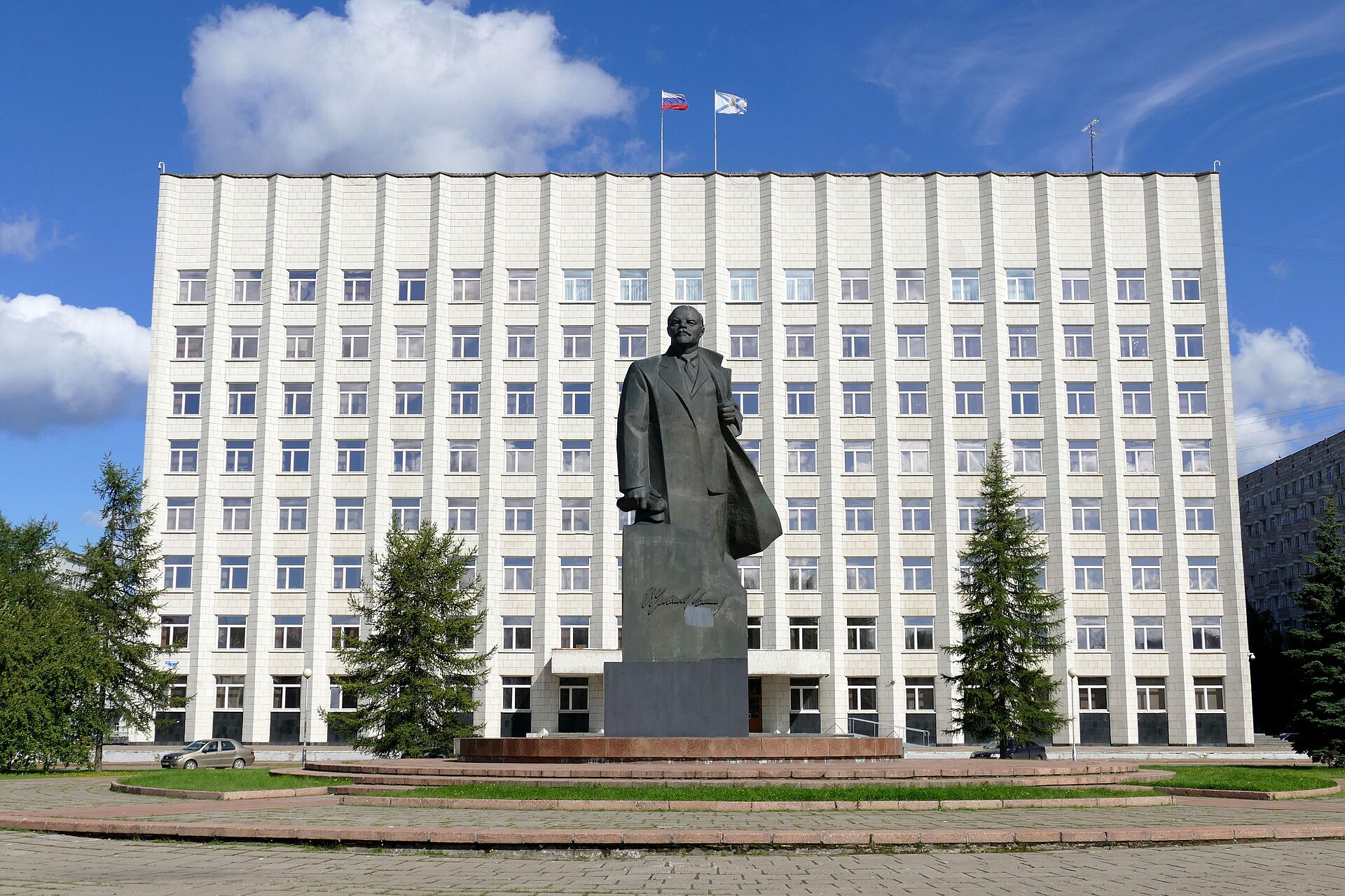
Lenin Square in Arkhangelsk is the kind of place where the city reveals itself slowly, without fanfare but with quiet confidence. There are no flashy signs or crowds of tourists here, just the unhurried rhythm of northern life, where history and everyday routines blend seamlessly. Located at the intersection of the city’s main streets, the square serves as a natural gathering point for locals and visitors alike. The buildings around it span different eras, from pre-revolutionary times to the Soviet period, each telling its own story about the city’s evolution.
The square’s architecture developed over time, with the most prominent structure being the House of Soviets, built in the mid-20th century. Its imposing facade, with tall columns and large windows, is typical of Soviet monumental design, yet in Arkhangelsk, it feels less overwhelming and more integrated into the urban fabric. The building stands as a reminder of the city’s post-war transformation. Nearby, older structures like the former real school—now home to the Northern State Medical University—showcase red brick walls and clean lines, reflecting the late classicism that shaped many northern Russian cities.
The square wasn’t always called Lenin Square. Before the revolution, it was known as Sobornaya (Cathedral) Square, named after the Trinity Cathedral that once stood here. Built in the early 19th century, the cathedral was one of Arkhangelsk’s largest churches and a spiritual center for the city. Like many religious sites across the country, it was demolished in the 1930s, but its memory lingers in street names and the stories of older residents. Today, a small park occupies the site, where locals stroll with their children or sit on benches by the fountain. The fountain, a more recent addition, has become a beloved feature, especially in summer when its water and greenery soften the square’s otherwise austere surroundings.
Winter transforms Lenin Square entirely. Snow blankets the rooftops and trees, and in the evenings, strings of lights cast a warm glow over the snow-covered sidewalks. This is when the northern character of Arkhangelsk feels most pronounced—not harsh, but cozy and intimate. Locals gather here for New Year’s celebrations, and children skate on a small rink set up in the square. Summer brings a different energy, with concerts, fairs, and festivals, though nothing as grand as in southern cities. Arkhangelsk doesn’t chase spectacle; it moves at its own pace, and Lenin Square reflects that perfectly.
For many residents, this square is more than just a public space—it’s a part of their personal history. Some remember May Day parades here, others recall their first kiss by the fountain, and many simply pass through on their daily commute. During the Soviet era, the square hosted official events, yet it never lost its human scale. Today, it’s neither grandiose nor neglected, just a place where ordinary life unfolds. Next to Lenin’s statue, you might see young people playing guitars or grandmothers selling homemade pies, a mix of old and new that feels entirely natural.
The Lenin monument on the square is one of Arkhangelsk’s most recognizable landmarks. Erected in the 1960s, it has become a familiar part of the cityscape. The statue doesn’t feel out of place; it’s simply there, a quiet marker of history that no longer demands attention. Unlike in some cities, tourists don’t flock here to take photos, and no one treats it as a must-see attraction. It stands on a modest pedestal, as much a part of the square as the benches or the trees, a reminder of a time that has long passed but isn’t forgotten.
Lenin Square is also a good starting point for exploring Arkhangelsk. From here, it’s just a short walk to the Northern Dvina embankment, the old streets lined with wooden houses, and the museums that tell the story of the city’s rich past. But even if you don’t venture further, the square offers a sense of what makes Arkhangelsk unique—a city that doesn’t try to impress or keep up with trends but remains deeply alive in its own way. It’s not just the geographic center of Arkhangelsk but its heart, where the past and present come together without fuss.