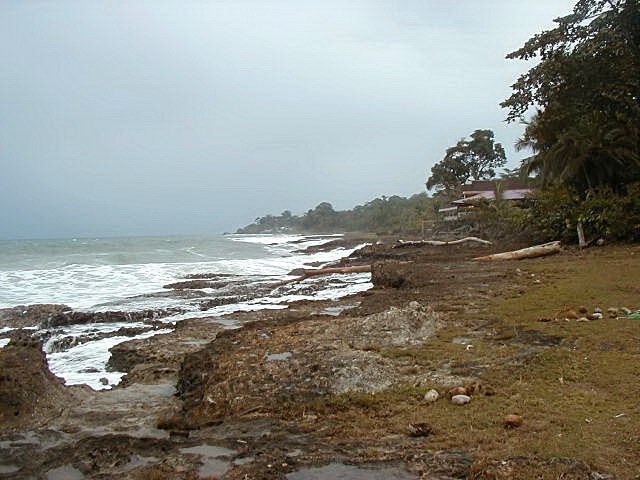
Playa Bonita feels like one of those rare places where time hasn’t just slowed down—it’s almost forgotten to move at all. Tucked along Costa Rica’s Caribbean coast near Limón, this stretch of sand exists where the jungle meets the sea, soft and golden underfoot, as if the earth itself sifted it smooth. There are no crowds here, no beachfront bars blaring music, no rows of sunbeds competing for space. Just the ocean, the sky, and a quiet so deep it’s broken only by the rustle of palm fronds and the occasional cry of a seabird.
This isn’t the kind of beach you see in travel brochures. It’s wild, but not in a harsh or unwelcoming way—more like a place that’s chosen to remain untamed, where solitude feels natural rather than lonely. The shoreline runs for kilometers, and even on the sunniest days, you can easily find a spot where the only footprints in the sand are your own. The waves here are gentler than those on the Pacific side, but they still carry the ocean’s quiet power, rolling in with a rhythm that feels ancient. The water is clear, with a faint green tint near the shore, where the sand gives way to small pebbles worn smooth by the tide.
The jungle presses right up to the beach, dense and alive, its edges blurred by vines and towering trees. Howler monkeys move through the canopy, their calls echoing like distant thunder, while sloths cling to branches, moving so slowly they seem part of the landscape. Birds flit between the leaves—toucans, parrots, and smaller species whose names you might not know but whose songs fill the air. Sometimes an iguana will lumber across the sand, or a crab will scuttle sideways toward the water, as if late for an appointment. The jungle here doesn’t just surround the beach; it feels like it’s holding its breath, waiting to reclaim the space if humans ever look away.
The history of Playa Bonita is woven into the broader story of Costa Rica’s Caribbean coast, a region that spent much of its past cut off from the rest of the country. For decades, Limón was isolated—no proper roads connected it to the capital, and the people who lived here, many of them Afro-Costa Rican, built their own communities, their own rhythms. Playa Bonita was known only to fishermen and a handful of travelers seeking solitude. Even now, with tourism growing in other parts of the country, this beach retains a sense of quiet mystery, as if it’s still keeping the secrets of those earlier times when few outsiders ventured this far.
There’s no grand architecture here, no resorts or restaurants trying to outdo each other in luxury. What little human presence exists feels temporary, almost accidental—small wooden huts where locals might sell fresh fruit or coconuts, their structures blending into the landscape rather than standing out. The road leading to the beach is little more than a dirt track, more suited to a four-wheel drive than a rental car. It’s the kind of place where you don’t come for amenities; you come because the absence of them makes the experience feel more real.
The best times to visit are at dawn or dusk. In the early morning, the ocean is still, its surface smooth as glass, disturbed only by the faintest ripples. The beach feels suspended in time, the waves lapping softly against the shore. By evening, the sky over Playa Bonita transforms into something almost unreal—a canvas of pinks, oranges, and purples that deepen as the sun sinks below the horizon. The colors linger long after the light fades, as if the day itself is reluctant to end.
This isn’t a place for those who need constant entertainment or the comforts of a resort. There are no showers, no beachside cafes, no vendors hawking souvenirs. If you plan to spend the day, you’ll need to bring your own water, food, and anything else you might need. But that’s part of what makes Playa Bonita special—it hasn’t been tamed for tourists. It’s a beach for people who don’t mind trading convenience for authenticity, who understand that some experiences are worth a little extra effort.
In recent years, Costa Rica’s Caribbean coast has started to attract more visitors, drawn by its reputation for untouched beauty. But Playa Bonita has remained largely untouched by that growth. Maybe it’s because the road here is rough, or because there’s nothing to do but sit and listen to the waves. Or maybe it’s because the people who do make the journey are the ones who don’t need much—just sand, sea, and the kind of quiet that’s hard to find anywhere else.
This isn’t a place for everyone. It’s for those who know how to slow down, how to appreciate the weight of silence, the way the light changes over the water, the feeling of being small in the face of something vast. It’s for people who don’t need a crowd to feel alive, who find meaning in the simple act of watching the tide come in. Playa Bonita doesn’t offer much, but what it does offer is rare: a chance to step outside of time, if only for a little while.