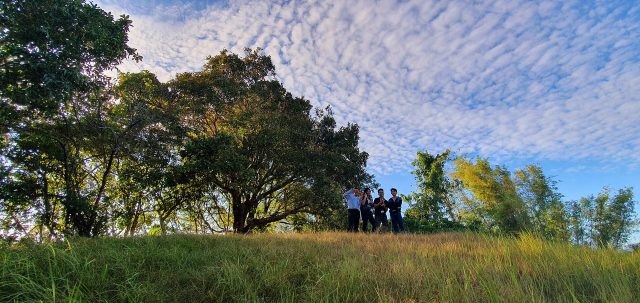
Miagao’s Tumaga Park is the kind of place that lingers in memory long after you’ve left. Tucked away in the quiet heart of this small Philippine town, it doesn’t announce itself with grand monuments or crowds of visitors. Instead, it offers something far more subtle: the unhurried rhythm of everyday life, the shade of ancient trees, and the quiet hum of a community that has claimed this space as its own.
The park’s history is woven into the fabric of Miagao itself. The town is best known for its UNESCO-listed Church of Santo Tomás de Villanueva, a masterpiece of Spanish colonial architecture, but Tumaga Park serves as a quiet counterpart to that grandeur. Centuries ago, this land was part of the town’s defenses, a strategic point where fortifications once stood against pirate raids during the colonial era. Little remains of those structures today, yet the park retains a sense of continuity, as if the past still lingers in the dappled light filtering through the leaves.
At its center, the park opens into a broad, grassy clearing framed by towering acacia and ficus trees. Their sprawling canopies create a natural shelter, offering respite from the midday heat. Benches dot the perimeter, and paved paths wind through the greenery, worn smooth by generations of footsteps. This is where locals come to unwind—parents watching their children play, students taking a break between classes, or elderly residents enjoying the cool morning air. There’s no agenda here, just the simple pleasure of being outdoors.
A modest fountain in the northern corner of the park draws the eye, not for its size or ornate design, but for the way it anchors the space. The water is clear, with a faint greenish tint, and the sound of it trickling over the stone adds to the park’s tranquil atmosphere. Nearby stands a bronze statue of a local figure, a man whose name is now known mostly to those who grew up in Miagao. The monument is understated, more a nod to the town’s collective memory than a grand tribute. It’s the kind of detail that might go unnoticed unless you pause to look.
What makes Tumaga Park special is how seamlessly it fits into the daily lives of those who live here. Mornings bring groups of older residents stretching or strolling along the paths, their movements slow and deliberate. By afternoon, the park fills with the chatter of students from nearby schools, grabbing a quick lunch or huddling in small groups to talk. As evening falls, families gather for picnics or simply to escape the day’s heat. On weekends, the park occasionally hosts small fairs or impromptu performances by local musicians, but these events feel organic, never forced.
The park’s design is unpretentious, prioritizing function over spectacle. There are no elaborate sculptures or manicured gardens, just well-tended lawns, neatly trimmed hedges, and bursts of color from flowers that bloom year-round. The paths are lined with plants that thrive in the tropical climate, their vibrant hues contrasting with the deep green of the trees. The rainy season transforms the park into a lush, almost overgrown paradise, the air thick with the scent of damp earth and blossoms.
For visitors, Tumaga Park offers a glimpse of the Philippines beyond the postcard-perfect beaches and tourist hotspots. There’s no fanfare here, no polished veneer—just the quiet authenticity of a place where people come to live, not to perform. You could spend an hour on a bench, watching the ebb and flow of town life, or wander the surrounding streets, where colonial-era houses stand as silent witnesses to history. If you’re lucky, you might stumble upon a local festival, when the park comes alive with music, dance, and laughter, a fleeting but unforgettable snapshot of community.
In recent years, the town has made efforts to maintain the park, though never at the expense of its character. There’s no attempt to modernize or sanitize the space; instead, the focus is on preserving what it has always been—a place of rest, reflection, and connection. That’s why locals keep returning. In a world that moves faster every day, Tumaga Park remains a steadfast refuge, a reminder of the value of slowing down.
If you find yourself in Miagao, don’t rush straight to the famous church. Take a detour to Tumaga Park first. Sit on a bench, listen to the rustle of leaves, and let the town’s rhythm wash over you. It’s in these unassuming corners that the real Philippines reveals itself—not in the grand gestures, but in the quiet moments where life unfolds at its own pace.