Belgorod’s Park of Remembrance is one of those quiet places where the past lingers in the air, not as a distant echo, but as something tangible, almost alive. It isn’t a park in the usual sense—no roller coasters, no food stalls, no crowds of tourists snapping photos. Instead, it’s a space where history is woven into the landscape itself, where every path, every tree, and every monument carries weight. The park was designed not just to honor those who fought and died during the Great Patriotic War, but to give visitors a place to reflect, to remember, and to feel the continuity between then and now.
The heart of the park is the Avenue of Glory, a long, straight promenade that stretches from the entrance to the memorial complex at its far end. Flanked by low granite stelae inscribed with the names of fallen soldiers, the avenue is lined with flowerbeds that bloom in waves from early spring to late autumn. Benches are scattered along the way, and on warm evenings, locals often sit here in silence, watching the sun dip below the horizon. There’s an unspoken understanding that this isn’t a place for loud conversations or laughter—just quiet contemplation. The names on the stelae belong to real people, many of them young, and the sheer number of them makes the scale of loss impossible to ignore.
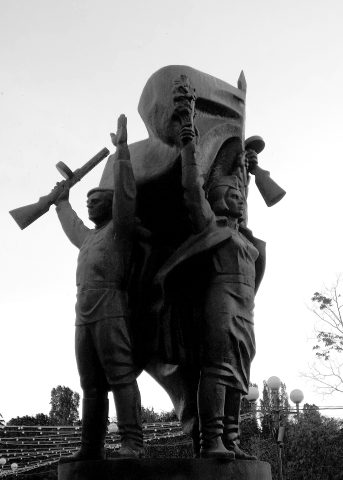
At the end of the avenue stands the memorial complex, a collection of structures and sculptures that together tell the story of the war and its aftermath. The centerpiece is the Eternal Flame, its flickering light reflected in the polished granite slabs surrounding it. Nearby, a bronze sculpture depicts a group of soldiers mid-charge, their faces set with determination. The figures are so lifelike that they seem frozen in motion, as if they might step off the pedestal at any moment. In the evening, the complex is softly lit, casting long shadows and turning the granite into a mirror for the flame. The effect is solemn, almost reverent, as if the place itself is holding its breath.
The park hasn’t always looked this way. In the years immediately following the war, this was just a small public garden with a few modest monuments—nowhere near enough to properly honor all those who had been lost. By the late 1970s, it was clear that Belgorod needed something more substantial, a place that could serve as both a memorial and a gathering spot for the living. Local architects took on the task, designing a space that would be dignified without being oppressive, a place where people could come not just to mourn, but to find a moment of peace. The result was a park that feels both timeless and deeply rooted in its city’s history.
One of the most striking things about the Park of Remembrance is how carefully it’s been planted. The trees here—oaks, maples, birches, and lindens—aren’t just decorative; they’re symbols, chosen for their resilience and their place in Russian culture. Some of them were planted in the first years after the war, and now their thick trunks and sprawling branches give the park a sense of permanence. In summer, the canopy is dense and green, filtering the sunlight into dappled patterns on the paths below. Come autumn, the leaves turn fiery shades of red and gold, transforming the avenues into something out of a painting. Winter brings its own kind of beauty, with frost clinging to the branches and snow dusting the granite and bronze, softening the edges of the memorial.
Beyond the memorial elements, the park also has spaces for lighter moments. Near the center, a small plaza with a fountain draws families on warm days. The fountain itself is simple, its design understated, but the sound of water adds a soothing rhythm to the air. Around it, playgrounds offer a place for children to run and play while parents relax on nearby benches. Occasionally, the plaza hosts small events tied to Victory Day or other commemorative dates, though these are always low-key, never overshadowing the park’s primary purpose.
For many in Belgorod, the Park of Remembrance is more than just a historical site—it’s part of daily life. School groups visit to learn about the city’s wartime history, while residents often bring guests here to show how Belgorod preserves its past. In recent years, the park has also become a popular spot for wedding photos, with couples posing against the backdrop of the memorial. It might seem unusual, but for many, these photos are a way of connecting their own future to the sacrifices of the past, a quiet acknowledgment that life goes on.
Winter doesn’t diminish the park’s appeal. If anything, the cold season gives it a different kind of beauty. Snow blankets the paths and sculptures, muffling sounds and turning the space into a hushed, almost otherworldly place. The Eternal Flame burns brighter against the white landscape, and during the New Year holidays, strings of lights are draped among the trees. Yet even with the festive decorations, the memorial retains its solemnity. Locals still come to lay flowers and wreaths, not just on Victory Day, but on other significant dates, like the anniversary of Belgorod’s liberation.
What makes the Park of Remembrance special isn’t just its monuments or its design, but the way it lives in the minds of those who visit. It’s a place where history isn’t just remembered—it’s felt. There are no grand speeches here, no forced solemnity. Instead, it’s a space where people can sit quietly, walk slowly, and let the weight of the past settle over them. The park may not be large, but its significance to Belgorod and its residents is immense. It’s a reminder that memory isn’t just about grand gestures; it’s about the small, everyday acts of respect that keep the past alive.