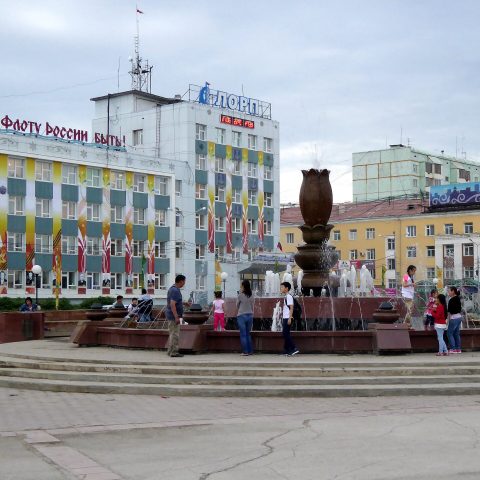
Gagarin Park in Yakutsk is one of those quiet corners where the city’s hustle fades into the background, replaced by the rustle of leaves and the steady flow of the Lena River. It’s not a vast expanse by urban standards, but in a place where winter stretches across most of the year, even a small patch of greenery feels like a gift. The park stretches along the riverbank, offering a place to sit by the water, watch the current, or wander down paths that bloom with wildflowers in summer and turn into snow-dusted trails in winter. It’s unassuming, yet precisely what the city needs—a space where nature and daily life intersect without pretension.
The park’s origins trace back to the Soviet era, when Yakutsk was expanding rapidly and public spaces became essential to urban life. It opened in the 1960s, a time of optimism and progress, and was named after Yuri Gagarin, the first man in space, a figure who embodied the era’s faith in the future. Back then, the park was a hub for community gatherings—festivals, open-air concerts, and celebrations that brought people together. Over the decades, it has quietly embedded itself into the city’s identity, a place where generations of Yakutsk residents have strolled, met, and made memories.
The park’s design is simple and practical, reflecting the utilitarian approach of its time. The main avenue leads to a bronze statue of Gagarin, installed in the 1980s. He stands tall, gazing into the distance as if still soaring above the city. Around the monument, flowerbeds bloom in summer, while in winter, strings of lights wrap around the base, casting a soft glow on the snow. Nearby, a small fountain trickles in the warmer months, offering a cool respite, though it freezes solid in winter, its ice forming delicate, temporary sculptures.
Beyond the central avenue, the park offers more than just a place to walk. There are playgrounds with swings and slides, filled with children’s laughter in summer and repurposed for sledding when the snow arrives. Outdoor exercise equipment dots the paths, used year-round by locals who aren’t deterred by the cold. In summer, the park hosts workshops, concerts by local musicians, and festivals celebrating Yakut culture, turning the space into a stage for community life.
One of the park’s most charming features is its open-air theater, a modest wooden stage with benches arranged in front. During the warmer months, it becomes a venue for plays, performances, and even outdoor movie screenings. In winter, the stage lies dormant, though it occasionally springs to life for holiday events, like New Year’s celebrations or gatherings on Defender of the Fatherland Day, where people huddle together with hot tea and songs to ward off the chill.
Despite its name, Gagarin Park doesn’t feel like a monument to grand ideals. It’s a place for ordinary moments—where a student might strum a guitar on a bench, a family takes an evening stroll, or an elderly couple sits by the river, watching the water flow. In summer, it’s alive with young people and the hum of conversation; in winter, it’s quieter, with parents pulling children on sleds or skating on the frozen pond. The park doesn’t try to be anything more than what it is: a slice of nature in the middle of the city, where life moves at its own pace.
In recent years, the park has seen subtle updates—new pathways, refurbished benches, and modern lighting that adds a cozy glow in the long winter evenings. But the essence remains unchanged. There are no extravagant fountains or exotic plants here, just the quiet comfort of trees, open space, and the Lena’s gentle presence. It’s the kind of place that doesn’t demand attention but offers something rare in cities: a sense of stillness, a breath of fresh air, and the feeling that time slows down, even if just for a little while.
Yakutsk is a city of extremes, where brutal winters give way to brief, intense summers. Gagarin Park mirrors these contrasts. In winter, it transforms into a snowy wonderland, with paths crunching underfoot and the occasional skier gliding through the trees. Come summer, it bursts into life—lush greenery, the scent of cut grass, and a breeze off the river that carries the faintest hint of warmth. The park doesn’t fight these shifts; it embraces them, becoming a different kind of refuge with each season.
It’s not the kind of place that makes it onto postcards or tourist itineraries. There are no crowds, no souvenir stalls, no guides herding visitors from one attraction to the next. Instead, there are trees bending under the weight of snow, the river’s steady murmur, and the quiet rhythm of people going about their day. Maybe that’s why Gagarin Park feels so enduring—it’s not trying to impress anyone. It’s just there, a steady presence in a city that’s always changing, offering a moment of calm to anyone who needs it. And perhaps that’s enough.