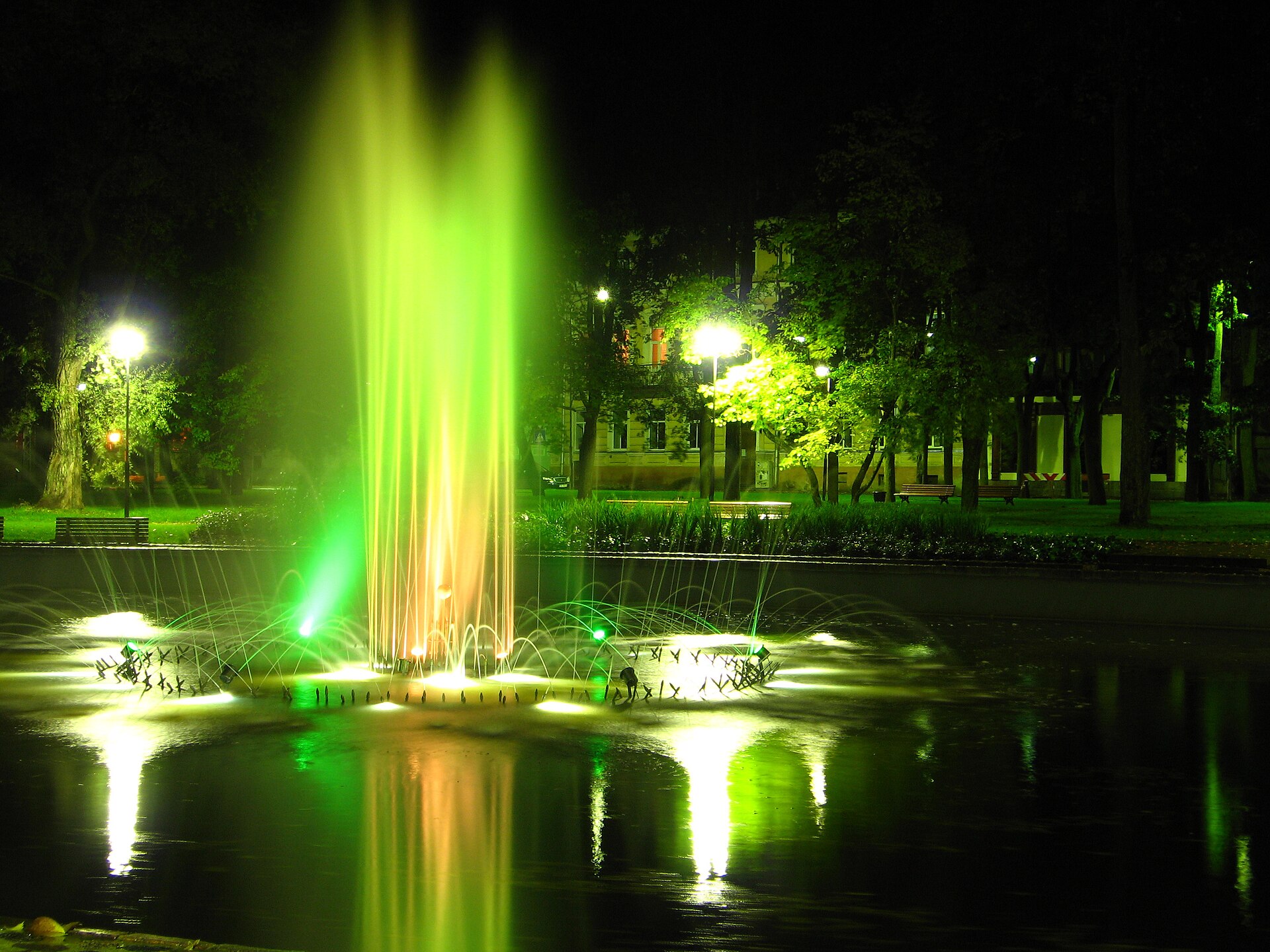
Daugavpils is a city where history lingers in unexpected corners, and one of those corners is Dubrovin Park. Tucked away from the bustle of the main streets, this green space feels like a quiet conversation between the past and the present. It’s not the kind of park where you’ll find manicured lawns or flashy attractions, but that’s part of its charm. Here, the trees grow as they please, the paths wind without urgency, and the air carries the scent of old wood and damp earth. It’s a place where locals come to escape, where children play without supervision, and where the city’s layers reveal themselves to those who take the time to look.
The park’s origins trace back to the late 19th century, when Daugavpils was still part of the Russian Empire and known by its Russian name, Dvinsk. It was established in 1870 by Pavel Dubrovin, a local merchant and philanthropist who wanted to create a public space for the city’s growing population. At the time, Daugavpils was an important industrial and military hub, and the park was meant to offer a respite from the noise and grime of factories and barracks. Dubrovin didn’t just donate the land—he funded the initial landscaping, planted trees, and even built a small wooden pavilion where musicians could perform for visitors. The park quickly became a favorite spot for strolls, picnics, and Sunday outings, a tradition that continues in some form today.
What makes Dubrovin Park unusual is how little it has changed over the decades. Unlike many urban parks that get redesigned every few years to keep up with trends, this one has retained much of its original character. The layout is still roughly the same as it was in Dubrovin’s time, with winding gravel paths that lead to quiet clearings and small ponds. Some of the trees planted in the 19th century are still standing, their trunks thick with age, their branches casting long shadows in the afternoon light. There’s a sense of permanence here, as if the park has simply decided to grow older alongside the city, untouched by the rush of modern life.
One of the most striking features of the park is the small hill at its center, crowned by a modest stone monument. This is the grave of Pavel Dubrovin himself, who was buried here in 1890. The monument is unassuming—just a simple cross and a plaque with his name—but it’s a reminder of the man who made the park possible. Over the years, the hill has become a kind of local landmark, a place where people sit to rest or where couples take photos. It’s not a grand memorial, but that only adds to its quiet dignity. The park feels like a gift that Dubrovin left behind, one that the city has chosen to preserve rather than modernize.
The architecture in and around the park is another layer of its story. The surrounding neighborhood is a mix of old wooden houses and Soviet-era apartment blocks, a contrast that speaks to Daugavpils’ complicated history. Some of the buildings near the park date back to the early 20th century, their facades weathered but still elegant. Others are more utilitarian, built during the Soviet period when the city’s population swelled and housing was needed quickly. The park itself has a few structures that hint at its past, like the remains of an old bandstand and a small brick building that once served as a tea house. These details aren’t immediately obvious, but they’re part of what makes the park feel lived-in, as if it’s been shaped by the people who’ve used it over the years.
For all its history, Dubrovin Park isn’t a museum. It’s a place where life happens in small, unremarkable ways. On any given day, you might see an elderly man feeding pigeons by the pond, a group of teenagers lounging on the grass with their phones, or a mother pushing a stroller along the shaded paths. In the summer, the park fills with the sound of children laughing and the occasional bark of a dog. In the winter, it’s quieter, the trees dusted with snow, the paths empty except for the occasional jogger. There’s no grand spectacle here, no must-see attractions—just the quiet rhythm of a neighborhood park that has outlasted empires and regimes.
The park’s location also tells a story. It sits on the edge of the city center, not far from the Daugava River, which has always been the lifeblood of Daugavpils. The river brought trade, industry, and people to the city, and the park was originally meant to be a green buffer between the urban core and the more residential areas. Today, that boundary is less defined, but the park still feels like a transition point—a place where the city’s hustle gives way to something slower and more contemplative. From the park, you can walk down to the river in about ten minutes, passing through streets that have seen wars, occupations, and economic booms and busts. The park is a small but enduring part of that larger narrative.
Dubrovin Park isn’t the kind of place that makes it onto postcards or travel brochures. It doesn’t have the grandeur of Riga’s parks or the fame of Latvia’s national reserves. But that’s precisely why it’s worth visiting. It’s a park for people who appreciate the unpolished, the overlooked, the places that exist not for tourists but for the city itself. Here, you won’t find guided tours or souvenir stands, just the quiet hum of everyday life. It’s a reminder that history isn’t always about monuments and museums—sometimes, it’s about the places where people have simply lived, loved, and left their mark in small, unassuming ways.
If you do visit, take your time. Walk the paths slowly, sit on one of the benches by the pond, and watch how the light filters through the trees. Listen to the sounds of the city fading into the background, replaced by the rustle of leaves and the distant chatter of children. In a place like this, the past isn’t something you read about in a book—it’s something you feel in the air, in the way the ground slopes gently toward the river, in the way the old trees stand as silent witnesses to the years that have passed. Dubrovin Park isn’t just a green space; it’s a piece of Daugavpils’ soul, one that has been quietly thriving for over a century.