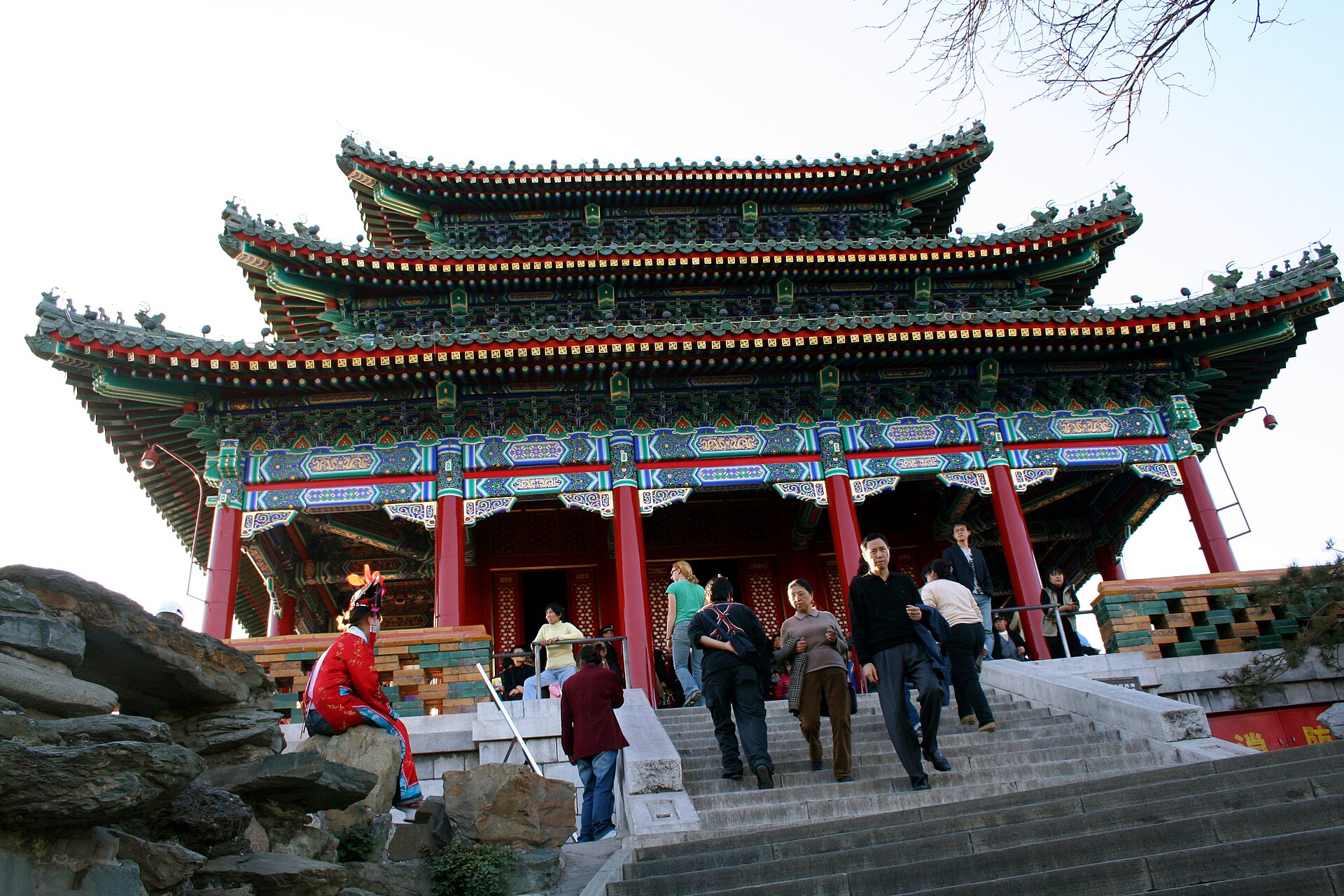
Jingshan Park sits just north of the Forbidden City, built from earth dug to create its moats in the 15th century. Originally called Copper Hill, later Longevity Hill, it was a place of significance for Ming and Qing emperors. Today, it remains a quiet counterpoint to Beijing’s pace.
The hill rises just over 40 meters. From the top, the Forbidden City’s golden roofs stretch below, while modern skyscrapers loom beyond its ancient walls. On clear days, the view feels like a map of the city’s layers—imperial, modern, unchanging.
Locals start their mornings here. Some practice tai chi among the trees, others play mahjong under their shade. Tourists climb for the view, but the park doesn’t exist just for them. It’s a place where Beijing’s daily life unfolds without ceremony.
The design is simple. Paths wind through groves of pine and cypress, some planted during the Ming Dynasty. Their gnarled trunks still stand, silent witnesses to centuries. At the summit, Wanchunting Pavilion’s curved roof offers the best vantage point. Emperors once watched the sunset from here. Now, photographers frame the same light on the Forbidden City’s rooftops.
History lingers in small details. In 1644, the last Ming emperor, Chongzhen, hanged himself from a tree on this hill as rebels took Beijing. A memorial stele at the base marks the spot, though the tree itself is long gone. The Qing Dynasty later claimed the park as a retreat, and after 1911, it opened to the public. The past isn’t announced here—it’s carried in the air, in the weight of footsteps on the paths.
Jingshan isn’t grand like the Summer Palace or meticulous like classical gardens. Its charm lies in its ordinariness. The wind moves through the trees, swings creak, conversations hum. In spring, peach blossoms scent the air. Autumn turns the maples red. Winter covers the hill in snow, where children play and adults walk slowly along frozen paths.
For Beijingers, the park holds personal memories. Some remember childhood visits, others first dates under the old trees. On weekends, families picnic, musicians play, artists sketch. Yet it never feels crowded. The space is large enough to find solitude, even in the middle of the city.
Stone steles dot the landscape, inscribed with calligraphy by emperors and scholars. The Shouhuang Stele, erected in the 18th century, wished the emperor longevity. Few know its exact meaning now, but it remains a curiosity, a tangible link to the past.
The park doesn’t feel like a museum. There are no barriers, no signs warning visitors to stay on the path. You can stop at a teahouse for jasmine tea, try a local snack, or sit on a bench and watch the light change. It asks only for your time and offers stillness in return.
During festivals, Jingshan comes alive. Lanterns glow at night, lion dances perform for Lunar New Year. Even then, quiet corners remain. You can always find a spot to stand and imagine those who walked these paths before—emperors, rebels, lovers, children—all looking out at the same view.