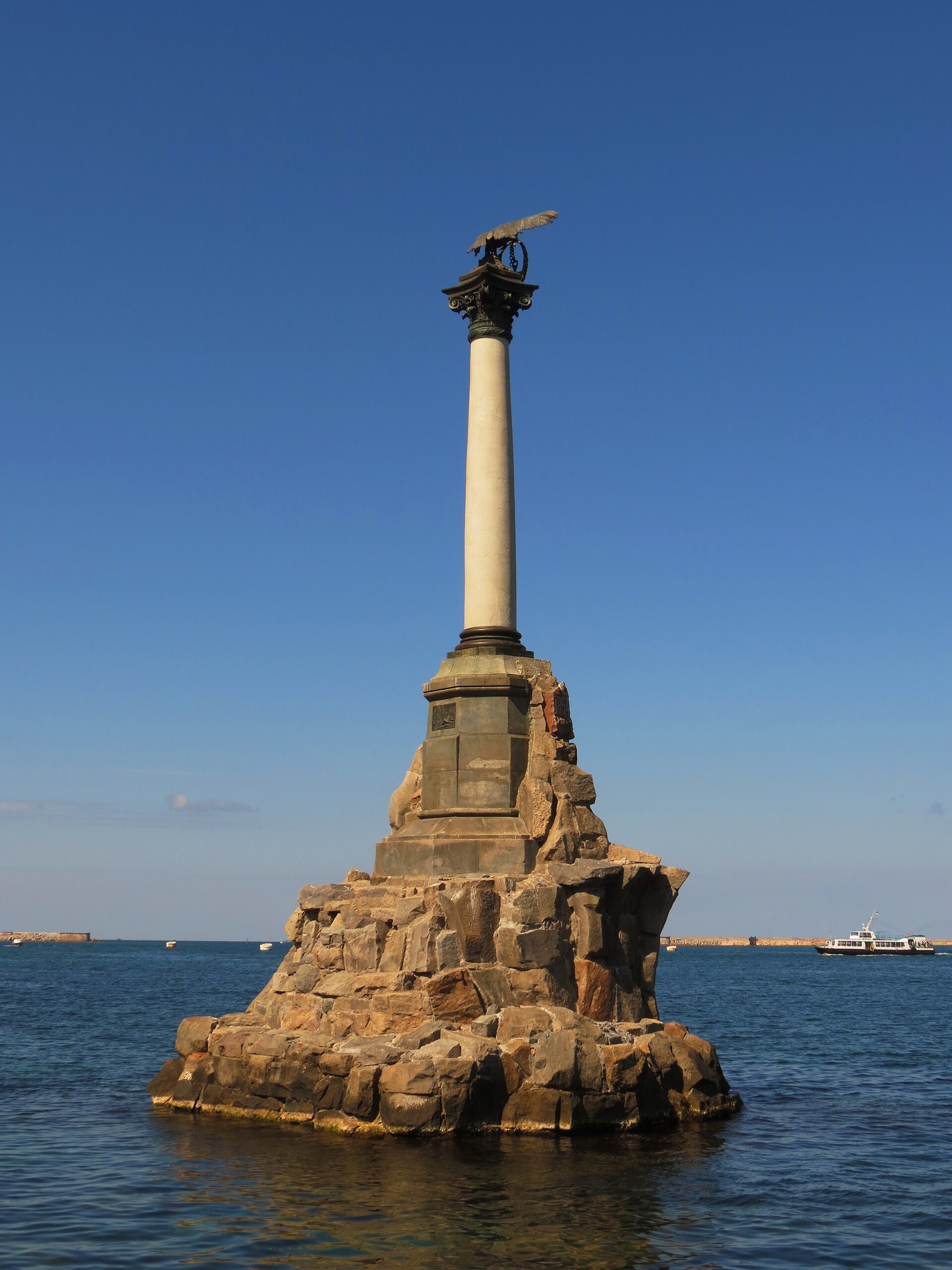
The Monument to the Scuttled Ships stands on a narrow promontory at the entrance to Balaklava Bay, a quiet sentinel overlooking the water. It was here, in 1854 during the Crimean War, that Russian sailors deliberately sank their own vessels to block the advance of the Anglo-French fleet. The act was one of desperation, a final attempt to defend Sevastopol when all other options had been exhausted. The ships went down not in battle, but by the hands of their own crews, their masts and rigging disappearing beneath the waves as the enemy watched from a distance. The gesture was futile in the end—the allies simply bypassed the obstruction—but it became one of the most haunting episodes of the war, a moment when strategy gave way to something closer to tragedy.
The monument itself is deceptively simple. A granite pedestal supports a slender column, crowned by a bronze eagle clutching a laurel wreath in its beak. The bird is poised, wings slightly spread, as if caught mid-flight, yet there’s a heaviness to it, as though the weight of memory has grounded it. At the base, anchors and chains are embedded in the stone, their rusted links a quiet echo of the ships that once lay beneath the surface. The design is restrained, almost austere, with none of the triumphalism one might expect from a war memorial. Instead, it feels like a gesture of remembrance, a way of acknowledging loss without glorifying it.
The monument was unveiled in 1905, half a century after the events it commemorates. Its creator, the sculptor Amandus Adamson, had originally envisioned something grander—a more elaborate composition with figures of sailors, perhaps even a reenactment of the scuttling itself. But in the end, simplicity won out. The eagle was chosen for its symbolism: in Russian military tradition, it represents strength and sovereignty, yet here it serves as a reminder of how fragile those things can be. The bird doesn’t soar; it clings to the column, as if aware that even the mightiest empires are built on moments of sacrifice.
Balaklava Bay has always been a place where history lingers. Long before the Crimean War, it was a crossroads for civilizations. Ancient Greeks and Genoese traders once anchored here, drawn by the natural shelter of its narrow, winding waters. By the 19th century, it had become a vital base for the Black Sea Fleet, its calm surface belying the strategic importance beneath. When war came, the bay was transformed into a battleground, its quiet depths turned into a graveyard for ships. Even now, fragments of those vessels remain on the seabed, their wooden ribs and iron fittings slowly dissolving into the silt. The water is clear enough in places to glimpse them, a ghostly presence just below the surface.
For all its historical weight, the monument is woven into the fabric of everyday life in Balaklava. Locals come here to walk along the embankment, to sit on the weathered stones and watch the fishing boats glide in and out of the harbor. Tourists pause to take photographs, though the best moments are the ones that don’t make it into frames—the way the light slants across the water at dusk, or the way the eagle’s shadow stretches across the pavement as the sun sinks behind the hills. There’s a stillness to the place, a sense that time moves differently here. On quiet evenings, when the wind dies down and the waves lap gently against the shore, it’s easy to imagine the distant echo of cannon fire, the shouts of sailors, the creaking of ships as they settled into their watery graves.
The monument doesn’t exist in isolation. It’s part of a larger story, one that unfolds across the Crimean Peninsula. Just a short distance away lies Malakhov Kurgan, the hill that saw some of the war’s fiercest fighting, its slopes still pockmarked with the scars of battle. In Sevastopol, the Panorama Museum recreates the siege in vivid, almost overwhelming detail, its circular canvas immersing visitors in the chaos of 19th-century warfare. But Balaklava feels different. There’s no grand narrative here, no attempt to package history into something neat and digestible. Instead, the past lingers in the details—the curve of the bay, the salt in the air, the way the light catches the eagle’s outstretched wings.
Even if military history isn’t your interest, the monument is worth visiting for the view alone. Balaklava Bay is one of those rare places where geography and history seem to align perfectly. The water is a deep, shifting blue, its surface rippling with currents that have carried ships for centuries. On clear days, it takes on a turquoise hue, so vivid it looks almost unreal. When storms roll in, the waves crash against the rocks with a force that shakes the ground, a reminder of how easily the sea can turn from ally to adversary. The bay is narrow, almost fjord-like, its entrance guarded by steep cliffs that have stood sentinel for millennia. It’s a place that invites contemplation, where the act of looking out at the water becomes a kind of meditation.
What makes the monument resonate isn’t just its design or its location, but the way it refuses to simplify history. There are no inscriptions here, no grand declarations about heroism or sacrifice. The story it tells is open-ended, a question rather than an answer. It doesn’t offer comfort or closure, only a quiet acknowledgment that some acts leave marks that never fully fade. That’s why people keep coming back—not to learn something new, but to feel something old. The monument doesn’t explain the past; it lets you stand in its shadow, close enough to sense its weight. And perhaps that’s enough.