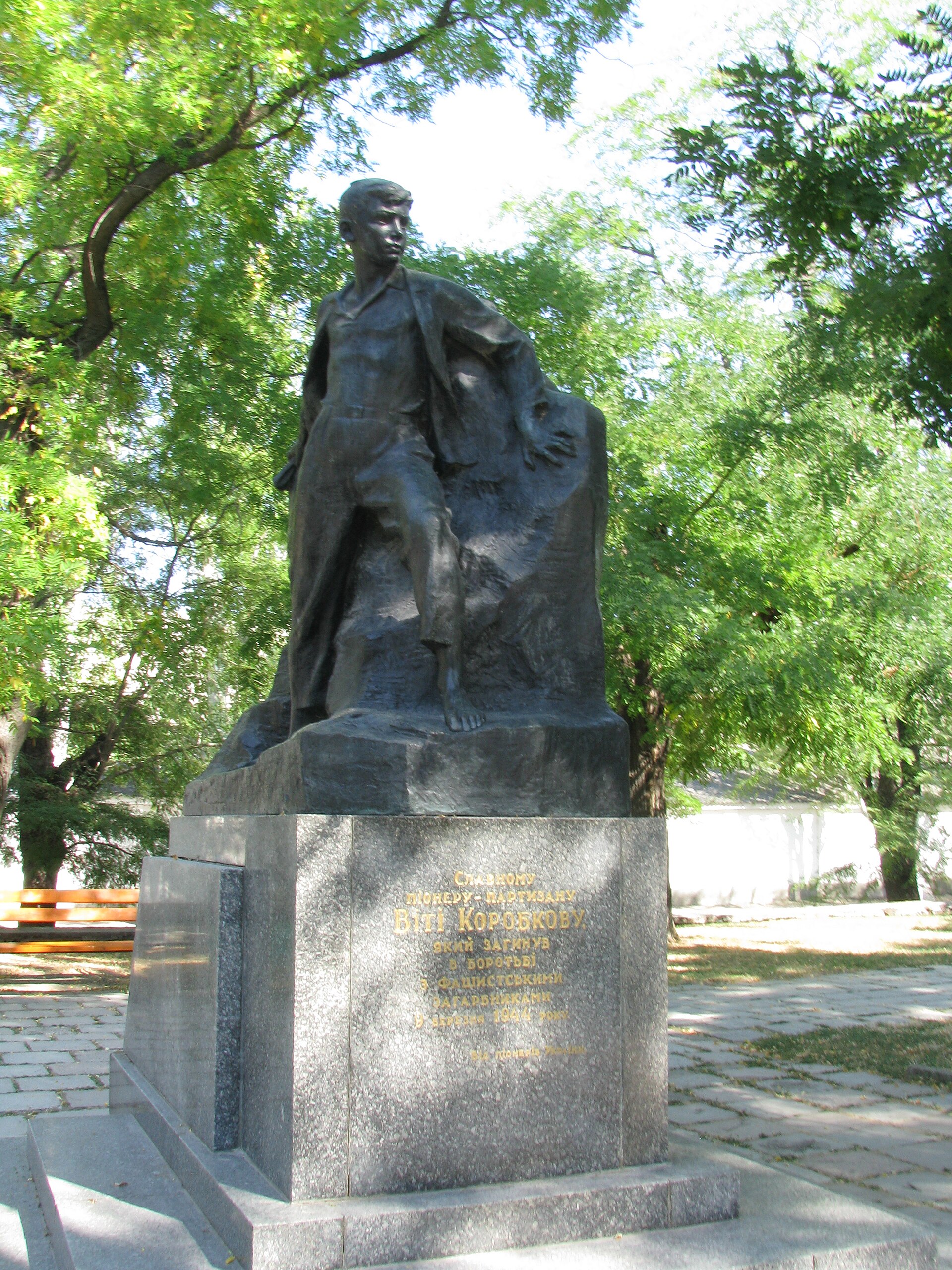
In the heart of Feodosia, a quiet coastal city where the Black Sea breeze carries whispers of history, there stands a monument that tells a story far more personal than most. It’s not a grand memorial to generals or battles, but a simple bronze figure of a boy, frozen in a moment that feels both ordinary and extraordinary. His name was Vitia Korobkov, and though he was just fourteen when the war came to his hometown, his life—and death—became a testament to the quiet courage of those who refused to look away from danger.
The statue captures Vitia mid-step, as if he might walk off his pedestal at any moment. In his hands, he holds a bucket and a fishing rod, the kind of things a boy his age might carry on a summer day. But there’s a weight to his posture, a tension in the way his fingers grip the bucket, as if he’s bracing himself. His gaze is fixed on something distant, his expression serious beyond his years. It’s the look of someone who has already seen too much. The war reached Feodosia in 1941, turning a peaceful port city into a battleground. While adults fought on the front lines, children like Vitia found their own ways to resist. He wasn’t a soldier, but he became a link in the chain of survival, helping local partisans by gathering information and delivering supplies. One winter, he hid a wounded Red Army soldier in a basement, risking everything to keep him alive. When the Nazis discovered his activities, they arrested him. Despite torture, he never betrayed his comrades. In December of that year, he was executed.
The monument was unveiled in 1964, part of the Soviet Union’s commemorations of the twentieth anniversary of victory in the war. Sculptor Lazar Vaisman chose not to depict Vitia as a hero in the traditional sense—no rifle, no defiant stance. Instead, he immortalized the boy in a moment of everyday resilience, his bucket and fishing rod transformed into symbols of something deeper. The bucket, once used to carry water for the partisans, now stands for the unseen labor of those who fought in small, unnoticed ways. The fishing rod, a reminder of the life that should have been, of lazy afternoons by the sea that were stolen by war. Vaisman’s work is understated, almost intimate, as if inviting viewers to step into Vitia’s world rather than stand in awe of it.
The location of the monument wasn’t chosen at random. It stands on what was once the outskirts of Feodosia, a working-class neighborhood where fishermen and dockworkers lived. During the war, this area was a hotspot for underground resistance, and it’s said that Vitia often passed through these streets on his missions. Today, the spot is quiet, shaded by trees and surrounded by low-rise buildings, but the weight of history lingers. The statue seems to watch over the neighborhood, a silent guardian of its past. For locals, it’s more than just a memorial; it’s a touchstone, a place where the war feels close in a way that textbooks can’t convey.
Feodosia’s residents have a deep, almost familial connection to the monument. Flowers appear at its base not just on Victory Day, but on other holidays too, as if Vitia were a neighbor rather than a historical figure. Schoolchildren visit for lessons on courage, their teachers pointing to the statue as proof that heroism isn’t always about grand gestures. Parents bring their own kids, lifting them up to touch the bronze bucket or pat the dog curled at Vitia’s feet. That dog is one of the monument’s most poignant details—a loyal companion who never left the boy’s side, even in the darkest times. There’s no official record of Vitia having a dog, but in the way these stories take root, it doesn’t matter. The dog feels real because the story does.
Architecturally, the monument is simple but striking. The low granite pedestal keeps the focus on Vitia, while the slight tilt of his head and the bend in his knees give the impression of movement, as if he’s about to step forward. Vaisman avoided the bombast that often defines war memorials, opting instead for a quiet honesty. There’s no glorification here, just the stark reality of a child caught in a war he never asked for. And yet, the statue doesn’t feel heavy or oppressive. There’s a warmth to it, a sense of resilience that lingers long after you’ve walked away. It’s as if Vitia’s defiance isn’t in his actions, but in his refusal to let the war erase the boy he was.
Over the years, the monument has become woven into the fabric of Feodosia’s daily life. Locals have their own traditions and superstitions tied to it. Some say rubbing the bronze bucket brings good luck, a promise that you’ll return to the city one day. The spot on the bucket is worn smooth from countless hands, a small testament to how many people have stood here, touching history. Others claim Vitia’s gaze is fixed on the sea, waiting for a father who never came home from the war. Whether these stories are true doesn’t really matter; they give the monument a life of its own, a sense that Vitia is still part of the city, still watching over it.
For visitors, the monument often comes as a surprise. Feodosia is a city of layers—ancient Genoese fortresses, bustling promenades, the salt-tinged air of the Black Sea. Amid all that, Vitia’s statue is a quiet interruption, a reminder that history isn’t just about empires and battles, but about people. Tourists who stumble upon it sometimes pause, struck by the contrast between the boy’s youth and the weight of his story. It’s a place that invites reflection, a moment to consider how fragile peace can be, and how easily it can be shattered.
For those who live in Feodosia, the monument is something more. It’s a connection to the past, a reminder of the generations who shaped the city before them. Feodosia has seen wars and occupations, destruction and rebirth, and Vitia’s story is just one thread in that larger tapestry. But it’s an important one, a reminder that courage isn’t always loud. Sometimes, it’s a boy with a bucket, doing what he can to help, even when the world around him is falling apart. In that way, the monument isn’t just about remembering the past—it’s about carrying its lessons into the future.