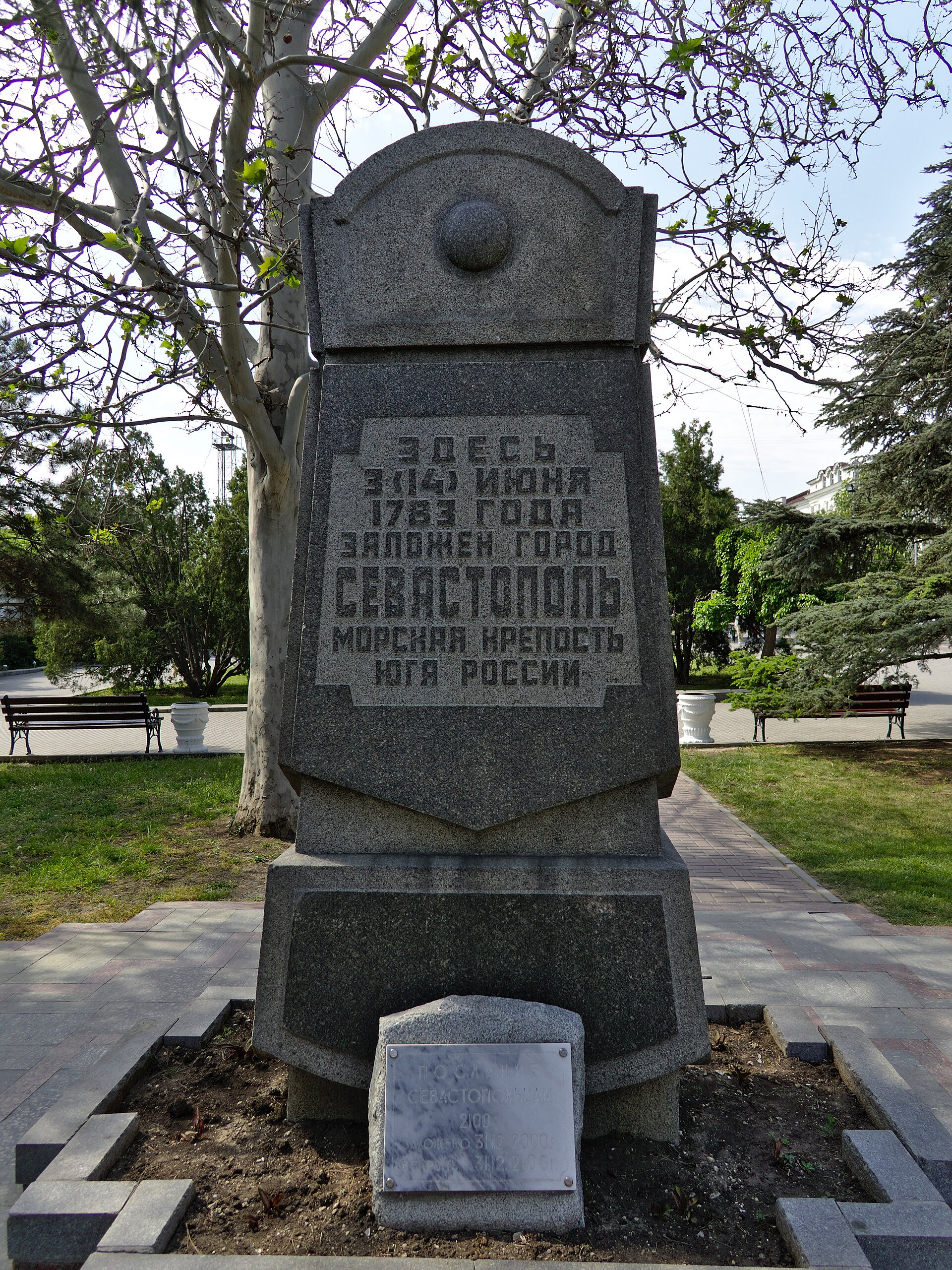
Sevastopol’s bicentennial monument isn’t just another statue in a city already crowded with memorials. It stands where the past and present quietly intersect, a place where the weight of history feels more tangible than anywhere else in the city. Erected in 1983 to mark two hundred years since Sevastopol’s founding, it wasn’t meant to be grand or imposing. Instead, it serves as a reminder of the city’s endurance—a place where the stories of sailors, soldiers, and ordinary citizens merge into something greater than the sum of its parts.
The monument itself is simple, almost austere. Two bronze figures—a sailor and a soldier—stand back-to-back on a granite pedestal. The sailor faces the sea, as if watching for ships that may never return, while the soldier looks inland, toward the battlefields where the city’s fate was decided time and again. Their poses are unassuming, yet there’s a quiet tension in the way they stand, as if ready to defend the city at a moment’s notice. This duality reflects Sevastopol’s identity: a place where the sea and the land, the military and the civilian, have always been inseparable.
What makes this monument unusual is how unobtrusive it is. Unlike many Soviet-era memorials, which often carried heavy ideological symbolism, this one feels personal. It doesn’t commemorate a single event or hero but rather the spirit of the city itself—resilient, unpretentious, and deeply rooted in its past. There’s no pomp or grandeur, just two figures standing in silent vigil. Perhaps that’s why it doesn’t feel out of place, even in a city where history is everywhere. It doesn’t demand attention, but it doesn’t fade into the background either.
The monument is located on Nakhimov Square, one of Sevastopol’s most historically charged spaces. This is where the city gathers for commemorations, where veterans meet on Victory Day, and where the echoes of the past are never far away. The square itself is surrounded by buildings that have witnessed everything from the Crimean War to the Siege of Sevastopol in World War II. There are no souvenir stands or tourist traps here, just the quiet presence of history. The monument fits seamlessly into this atmosphere, as if it has always been part of the city’s fabric.
From an architectural standpoint, the monument is unremarkable in the best sense of the word. Its creators, sculptor I.V. Makogon and architect A.S. Gladkov, worked within the traditions of Soviet monumental art, where meaning mattered more than form. The bronze figures are realistic but not overly detailed, their postures conveying strength without theatrics. The granite pedestal, solid and unadorned, reinforces the sense of permanence. The composition is balanced, almost static, but that stillness gives it a certain power. It doesn’t try to impress; it simply is.
For locals, the monument is just another part of the cityscape, something they pass by on their way to work or pause beside while waiting for a bus. Some bring their children here to explain why Sevastopol is different from other cities, why its streets feel heavier with memory. Tourists, especially those interested in naval history or World War II, often stop here too, though there’s little in the way of explanatory plaques. That might be for the best—it leaves room for interpretation. To some, it’s a tribute to military glory; to others, a reminder of the city’s ability to survive against the odds.
Remarkably, the monument has weathered the political and social upheavals that followed the Soviet Union’s collapse. While other memorials were vandalized or dismantled in the 1990s, this one remained untouched. Perhaps because it isn’t tied to any particular ideology, only to the city’s own story. Or maybe because there’s nothing provocative about it—just two figures standing in quiet dignity. Today, it still occupies the same spot, a silent witness to how Sevastopol has changed while somehow staying the same.
There are no barriers around the monument, no signs telling visitors to keep their distance. That’s typical of Sevastopol, a city that doesn’t put history behind glass. You can walk right up to it, run your fingers over the bronze, feel the roughness of the granite. Or you can stand a few steps away, watching how the light catches the figures at different times of day. The monument doesn’t offer answers, but it does invite reflection. How many people have passed by this spot over the years? How many lives have been shaped by this city? It doesn’t say, but it makes you wonder—and that might be its greatest strength.