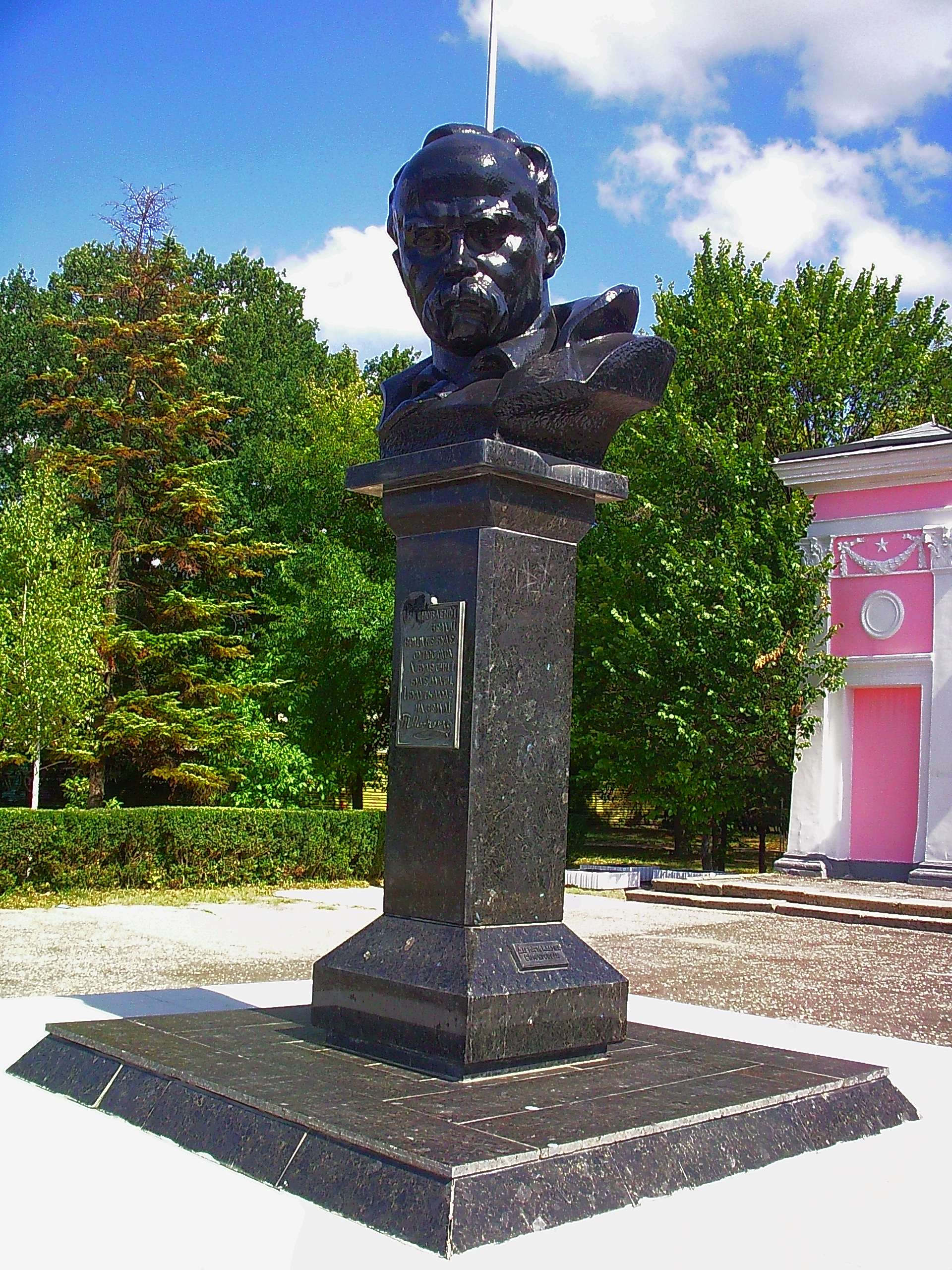
In the heart of Simferopol, where Sevastopolskaya Street meets Karl Marx Street, stands a monument to a man whose name has become synonymous not just with Ukrainian literature, but with the enduring struggle for freedom. Taras Shevchenko, poet, artist, and thinker, never set foot in Crimea, yet his connection to this land runs deeper than geography. Here, on a peninsula where cultures and destinies have intertwined for centuries, his figure takes on a special meaning—a bridge between peoples, a reminder that art and words can transcend borders.
The monument was unveiled in 1997, marking the 180th anniversary of Shevchenko’s birth. Created by Crimean sculptor Nikolai Morgun, known for his works honoring historical and cultural figures, the bronze statue rests on a low pedestal of red granite, its warm tones contrasting with the dark metal. Shevchenko is depicted in full length, clad in a long coat, a book in hand—not as a fiery revolutionary, but as a contemplative thinker. There’s no grandeur in his pose, just a quiet focus, as if he’s just stepped away from his verses and now gazes at the city that has embraced his memory.
The location was chosen with care. Karl Marx Street, once known as Ekaterininskaya, is one of Simferopol’s oldest thoroughfares, where the homes of nobles, merchants, and officials once stood. Nearby was the provincial printing house, where books in multiple languages, including Ukrainian, were published in the 19th century. It’s fitting, then, that Shevchenko—whose work was banned by tsarist censors—found a home here, a silent testament to the power of language and the resilience of art.
Though Shevchenko never lived in Crimea, his ties to the region are real. In the 1840s, while serving in the Orenburg Corps, he was sent on an expedition to the Aral Sea, passing through the Crimean steppes along the way. The vast landscapes, Tatar villages, and encounters with locals left a deep impression on him. Later, during his exile, he created a series of drawings inspired by Crimean scenery—harsh yet full of quiet strength. These works became part of his artistic legacy, forever linking his name to the peninsula.
Simferopol’s monument isn’t the only one dedicated to Shevchenko in Crimea. Another stands in Yalta, on the waterfront, erected in 2007. But the one in Simferopol feels different. It isn’t set on a tourist promenade; it’s part of the city’s daily rhythm, surrounded by shops, cafes, and the flow of passersby. There’s no pomp here, just the sense that Shevchenko belongs to this place, an unseen presence in its life. Locals have grown accustomed to the statue—some rush past on their way to work, others pause to lay flowers at its base, especially on the poet’s birthday or the anniversary of his death.
Over the years, the monument’s meaning has shifted. In Soviet times, Shevchenko was seen primarily as a revolutionary, a symbol of resistance against the tsarist regime. After the USSR’s collapse, the focus changed. Today, he’s often viewed as a unifying figure, a poet whose work belongs to multiple cultures. In Crimea, where people of different nationalities have long lived side by side, this matters. The statue at the intersection of two streets serves as a quiet reminder that history isn’t black and white, and that art can bring together even those who speak different languages.
Life around the monument carries on as usual. In summer, street musicians play nearby; in winter, snow caps the granite pedestal. Sometimes, school groups gather here, teachers recounting Shevchenko’s life, his verses, and why he’s called the Kobzar. As evening falls and the streetlights flicker on, the bronze figure casts a long shadow, as if the poet might step down at any moment, stroll through the familiar streets, browse a bookshop, or simply stand by the fountain, listening to the city’s hum.
The monument to Taras Shevchenko in Simferopol is more than just a sculpture—it’s a living piece of history. It doesn’t demand attention, nor does it fade into the background. It simply exists, a reminder that great figures don’t vanish without a trace, that their words and thoughts endure long after they’ve become bronze and stone. That’s the quiet power of such places: they don’t just tell a story—they make you part of it. And everyone who passes by, even for a moment, becomes a thread in that narrative.