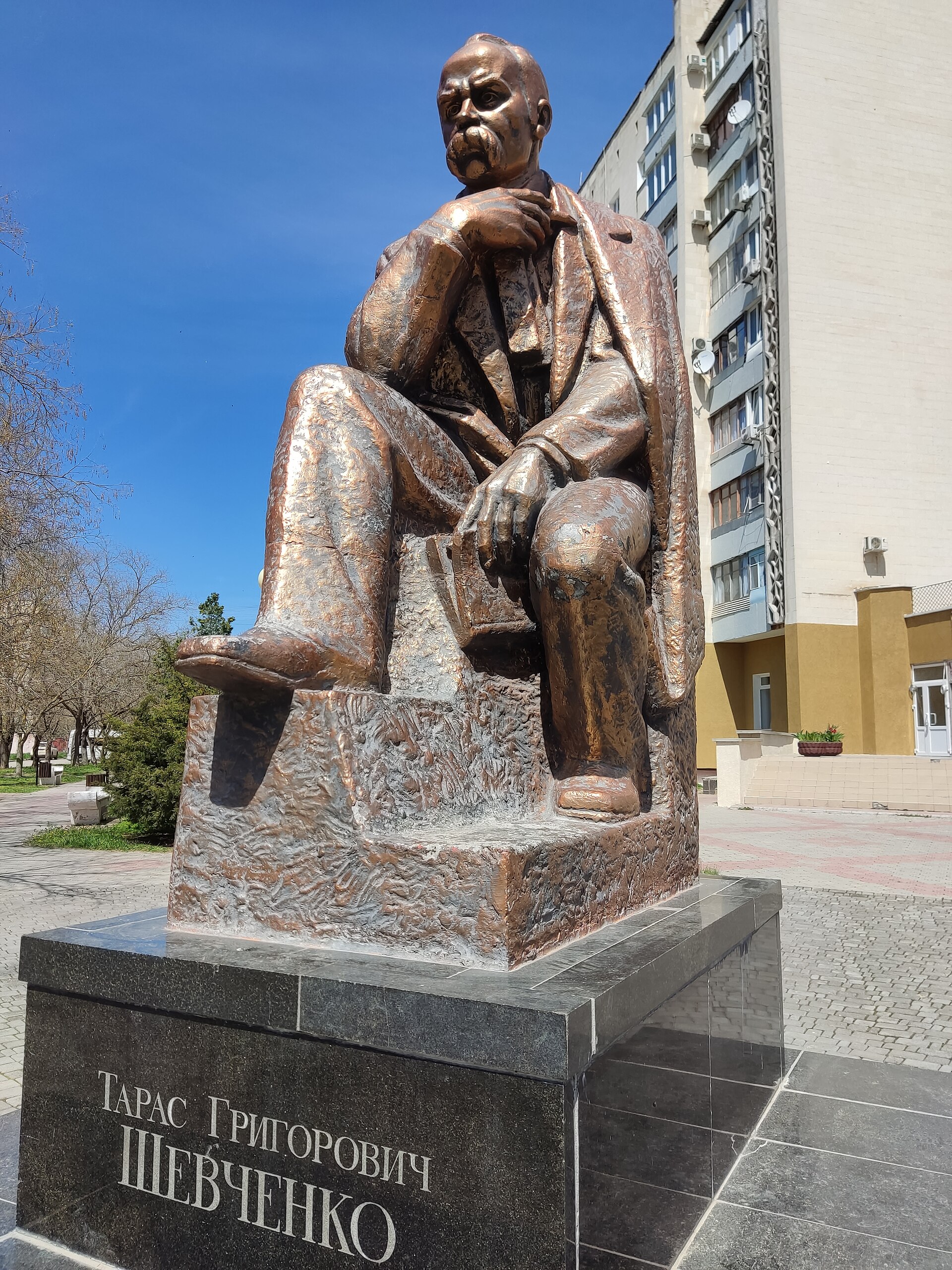
Yevpatoria’s monument to Taras Shevchenko stands quietly on Lenin Prospekt, a place where the city’s layered history feels especially tangible. This Crimean coastal town has long been a crossroads of cultures, a place where people from across the Russian Empire and later the Soviet Union came to rest, heal, or even settle. Shevchenko, whose name became synonymous with Ukrainian literature and the struggle for freedom, never actually visited Yevpatoria, yet his connection to Crimea runs deep. The peninsula inspired some of his most vivid poetry and sketches, and over time, monuments to the poet appeared in cities across the region, each reflecting a different facet of his legacy.
The bronze figure of Shevchenko here is unassuming, perched on a modest pedestal near the seafront. Unlike more imposing statues that dominate their surroundings, this one blends seamlessly into the cityscape. The poet is depicted not as a revolutionary or a fiery orator, but as a contemplative figure, a book in hand, lost in thought. The sculpture’s understated elegance mirrors Yevpatoria itself—a town where leisure and reflection have always coexisted. Behind the statue, the Black Sea stretches out, its ever-changing hues a reminder of the landscapes that once moved Shevchenko to write.
The monument was unveiled in 1982, part of a broader Soviet-era effort to honor Shevchenko as a cultural icon. Its creator, sculptor Vasily Borodai, was known for his work on historical and literary themes, and his interpretation of Shevchenko in Yevpatoria feels particularly intimate. While other Crimean cities have their own monuments to the poet, this one stands out for its quiet lyricism, as if capturing the very spirit of the town. There’s no grandiosity here, just a sense of quiet presence, as if Shevchenko himself might pause for a moment before continuing on his way.
For locals and visitors alike, the statue is more than just a landmark. In summer, tourists often gather around it for photographs, while in cooler months, school groups arrive for guided tours. The lack of barriers around the monument makes it feel approachable, almost like a familiar figure rather than a distant historical relic. This informality is part of what makes Yevpatoria special—a place where history isn’t locked behind glass but woven into the fabric of everyday life.
Yevpatoria has always been a town of contrasts, where ancient mosques stand alongside Orthodox churches, and the ruins of Greek settlements share space with Karaite kenassas. The Shevchenko monument fits naturally into this mosaic, a reminder that Crimea has long been a meeting point of cultures. Here, history isn’t divided into "ours" and "theirs" but exists as a shared narrative. Shevchenko, though Ukrainian by birth and identity, belongs to this broader story, his legacy intertwined with the peninsula’s own complex past.
Shevchenko’s ties to Crimea are well-documented. During his exile in the 1850s, he traveled to the peninsula several times, visiting places like Bakhchisarai and Yalta. His experiences there left a deep impression, inspiring poems and drawings that captured the stark beauty of the Crimean landscape—the endless steppe, the rugged mountains, the restless sea. These works often carried a sense of longing, a tension between freedom and confinement that mirrored his own life. It’s easy to see why monuments to him feel at home in Crimea; they seem to return him to the places that once stirred his imagination.
Today, the Shevchenko monument in Yevpatoria serves as more than just a tribute to a literary giant. It’s a quiet invitation to reflect on how art and history shape the places we inhabit. The town itself is a living archive, where every street and building tells a story. Shevchenko, though he never set foot in Yevpatoria, feels like a natural part of this narrative. His statue, facing the sea, becomes a bridge between past and present, a reminder that some legacies endure not because they’re forced into memory, but because they resonate with the spirit of a place. In Yevpatoria, where the sea meets the sky and the weight of history lingers in the air, Shevchenko’s presence feels inevitable, as if he had always belonged here.