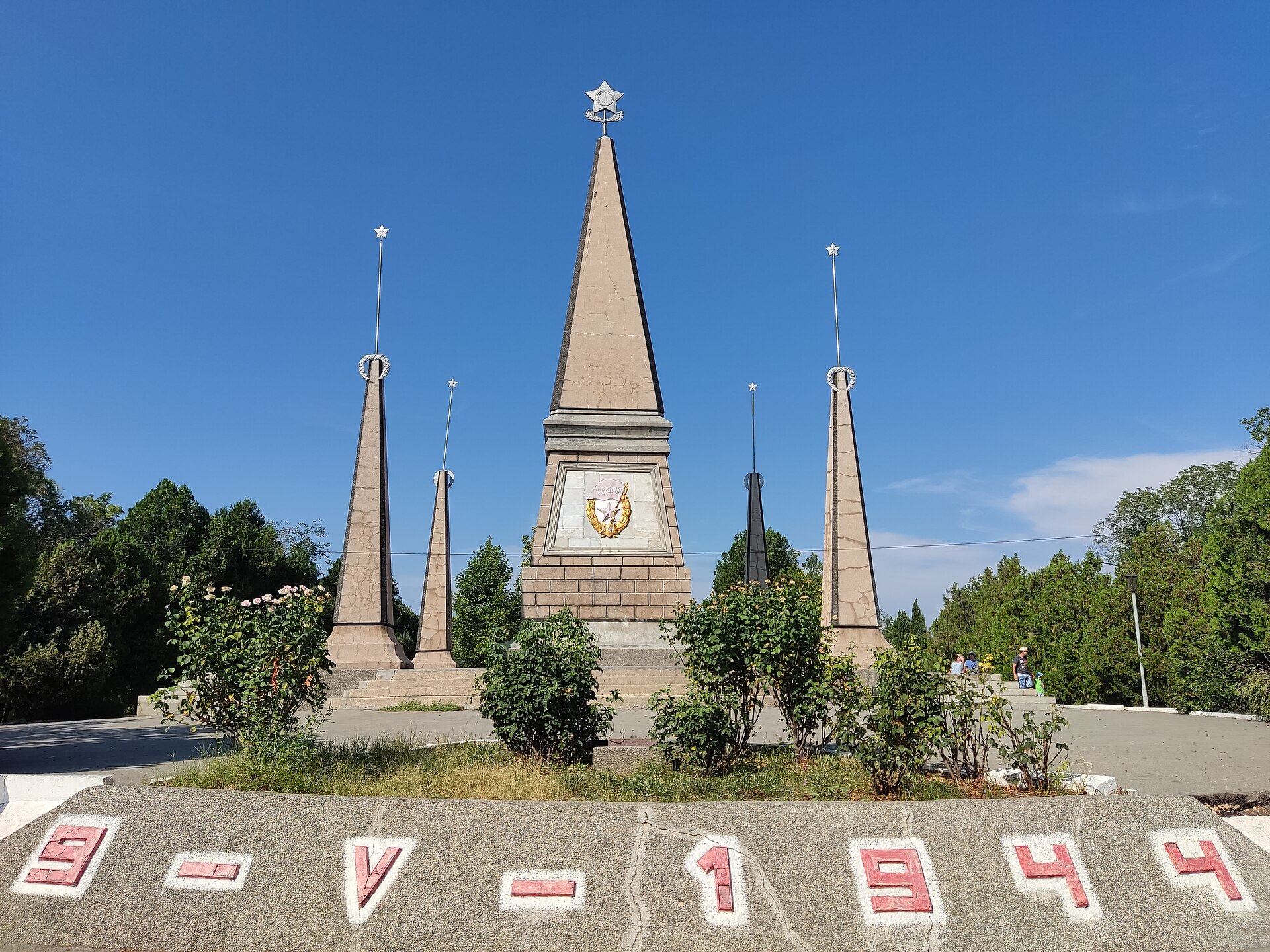
Perched on a hill overlooking Sevastopol and its bay, the Monument to the Glory of the 2nd Guards Army stands as a quiet witness to one of the most brutal chapters of the Second World War. The location was chosen deliberately—this was the ground where, in May 1944, fierce battles raged as Soviet forces fought to liberate Crimea from Nazi occupation. The 2nd Guards Army, to whom the monument is dedicated, played a decisive role in those final days, breaking through enemy defenses and turning the tide of the entire Crimean operation. The hill itself, part of the infamous Sapun Ridge, still bears the scars of war, with trenches and fortifications preserved as a stark reminder of the cost of victory.
The monument is a study in restrained power, its granite and bronze forms designed to convey both strength and solemnity. At its heart rises a towering stele, etched with the emblem of the Guards and an inscription honoring the soldiers’ sacrifice. Flanking it are figures of warriors, frozen mid-motion as if still locked in battle. There is no excess here, no unnecessary grandeur—just the raw weight of history pressing down on the viewer. The simplicity of the design forces you to confront the reality of what happened: the miles marched, the lives lost, the unyielding resolve of men who refused to retreat even in the face of certain death.
The story of the 2nd Guards Army is inseparable from Sevastopol’s own wartime narrative. Formed in late 1942 from units that had distinguished themselves in the Battle of Stalingrad, the army quickly became one of the Soviet Union’s most formidable fighting forces. By the spring of 1944, it had already seen some of the war’s bloodiest engagements—on the North Caucasus, the Kuban, and in the Donbas. When it reached Crimea, the soldiers faced a new kind of warfare: mountainous terrain, dense forests, and an enemy dug into heavily fortified positions. Yet they broke through, driving toward Sevastopol and tightening the noose around the German forces trapped on the peninsula.
Today, the monument serves as more than just a memorial. It is a place where history feels tangible, where the past lingers in the air. Veterans still come here, as do relatives of the fallen, schoolchildren on field trips, and visitors from across Russia. On Victory Day, the hillside fills with flowers and speeches, with stories of those who never made it home. The surrounding grounds are carefully maintained, with pathways winding through manicured lawns, but the real draw is the view. From the observation platform, you can see the city below—a place that was nearly leveled during the war but has since rebuilt itself, layer by layer.
The monument doesn’t exist in isolation. It is part of a larger memorial complex on Sapun Ridge, where the landscape itself tells the story of the battle. Nearby, you can walk through preserved trenches, examine the remains of bunkers, and stand where artillery once roared. The monument acts as a focal point for this open-air museum, a place where the abstract notion of sacrifice becomes concrete. Every hill, every gully here was paid for in blood, and the memorial ensures that those who fought are not forgotten.
For many in Sevastopol, this is more than just a historical site. It is a place of personal connection, where the past feels close enough to touch. Some come to search for names on the memorial plaques, tracing the stories of fathers, grandfathers, or distant relatives. Others simply stand in silence, listening to the wind rustling through the pines, as if the trees themselves are whispering the names of the fallen. There is no need for grand gestures here—just the quiet acknowledgment of what was lost and what was saved.
The monument is not a relic of the past but a living part of Sevastopol’s identity. It doesn’t demand attention with flashy displays or dramatic flourishes. Instead, it speaks in the language of memory, reminding visitors that the war was not just a series of dates and battles but a human tragedy that shaped the city’s very soul. The soldiers of the 2nd Guards Army didn’t fight for glory—they fought for home, for the people they loved, for the future of a country that would rise from the ruins. That is the story the monument tells, not with words, but with the weight of its presence.
In a city where history is never far from the surface, the Monument to the Glory of the 2nd Guards Army holds a special place. It is a bridge between generations, a place where the past and present intersect. You don’t need to be a historian to feel its significance—just stand there for a moment, look out over the bay, and listen. The wind, the trees, the distant hum of the city below all carry the same message: this is sacred ground. And it always will be.