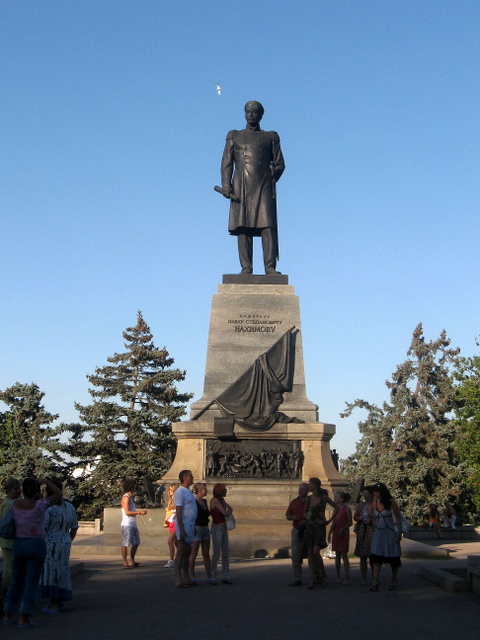
The monument to Admiral Pavel Nakhimov in Sevastopol is one of those rare landmarks that doesn’t just stand in a city but becomes part of its soul. It occupies a quiet corner of Nakhimov Square, where the rhythm of daily life—hurried footsteps, casual strollers, the occasional laughter of children—unfolds around it. The bronze figure of the admiral, captured mid-gesture with a telescope in hand, seems to watch over the city with a mix of resolve and quiet pride. Sevastopol is often seen as a sunny coastal retreat, its bays dotted with yachts and its streets lined with palm trees, but this monument is a reminder that its identity runs deeper. Here, history isn’t just remembered; it’s lived.
Nakhimov’s role in Sevastopol’s story is impossible to overstate. During the Crimean War, when the city was besieged by British, French, and Ottoman forces, he commanded the Russian fleet and garrison with a stubborn defiance that became legendary. For nearly a year, against overwhelming odds, the defenders held out, their resistance a testament to both Nakhimov’s leadership and the city’s unyielding spirit. His death in 1855, struck by a sniper’s bullet during the siege, marked a turning point in the war and left a wound in Sevastopol’s collective memory. The monument isn’t just a tribute to one man but to the thousands who fought alongside him, their names now woven into the city’s fabric.
The statue was unveiled in 1898, more than four decades after the war’s end. Sculptor Nikolai Lavretsky crafted it with a careful eye, not just for likeness but for the weight of Nakhimov’s legacy. The admiral stands in full naval uniform, his gaze fixed on the horizon as if still scanning the Black Sea, the waters that defined his life. The granite pedestal, sturdy and unadorned, is encircled by chains—a subtle nod to the maritime world he inhabited. Remarkably, the monument survived the Soviet era unscathed, a rarity for pre-revolutionary memorials. Perhaps even then, it was understood that some figures transcend politics, their stories too deeply embedded in the land to be erased.
The square itself has its own layers of history. Originally named after Catherine the Great, who founded Sevastopol in the late 18th century, it was later renamed in Nakhimov’s honor after the monument was installed. Over time, it became a focal point for the city’s public life. On Victory Day, Navy Day, and other national observances, the square fills with crowds, wreaths are laid at the base of the statue, and the air hums with the solemnity of remembrance. Yet it’s not just a place for formal ceremonies. Locals gather here year-round, whether to meet friends, take a shortcut through the city, or simply pause for a moment beneath the admiral’s watchful gaze.
For Sevastopol’s residents, the monument is more than a tourist attraction; it’s a touchstone. Veterans often stop by to pay their respects, their uniforms adorned with medals that tell their own stories of service. Schoolchildren visit on field trips, listening as teachers recount the siege and Nakhimov’s role in it. Even those who’ve lived in the city their entire lives sometimes linger here, as if the statue’s presence offers a quiet connection to the past. In a place where history is never far from the surface, the monument serves as a bridge between eras, a reminder that the city’s strength has always been as much about resilience as it is about beauty.
The architecture surrounding the square adds to its character. Nearby buildings, constructed in the late 19th and early 20th centuries, still bear the marks of Sevastopol’s golden age. The former Naval Assembly, where officers once gathered for meetings and social events, stands as a relic of the city’s military past. The Kista Hotel, still operating today, offers a glimpse into the elegance of pre-revolutionary hospitality. Together, these structures create an atmosphere that feels suspended in time, a contrast to the modern cafes and shops that have sprung up around them. Walking here, it’s easy to imagine Sevastopol as it once was—a bustling port city where military discipline and cultural vibrancy coexisted.
In recent years, Nakhimov Square has taken on a new role as a gathering place for younger generations. Concerts, festivals, and open-air markets now draw crowds, blending the square’s historical gravitas with a more contemporary energy. On summer evenings, the area comes alive with music, laughter, and the clinking of glasses from nearby cafes. The monument, once a silent sentinel, now presides over a space where the past and present intersect. It’s a place where a group of teenagers might snap selfies one moment and a veteran might pause to reflect the next, each finding their own meaning in its presence.
For first-time visitors, the monument can serve as a starting point for exploring Sevastopol. From here, it’s a short walk to the Primorsky Boulevard, where the Black Sea glitters under the sun, or to the city’s many museums and war memorials. The Crimean War’s legacy is visible at every turn—from the ruins of the Malakhov Kurgan to the quiet dignity of the Panorama Museum. But even if you never venture beyond the square, the monument offers a glimpse into what makes Sevastopol unique. It’s a city where history isn’t confined to textbooks; it’s etched into the streets, the buildings, and the very air.
More than just a statue, Nakhimov’s monument embodies the values that have shaped Sevastopol for centuries: courage, loyalty, and an unshakable bond with the sea. It stands as a testament to the city’s ability to endure, to rise from the ashes of war and reinvent itself without losing sight of its past. For those who call Sevastopol home, it’s a symbol of pride. For visitors, it’s an invitation to look beyond the postcard-perfect scenery and discover the stories that lie beneath. And for anyone who stands before it, it’s a quiet reminder that history isn’t just something we read about—it’s something we carry with us.