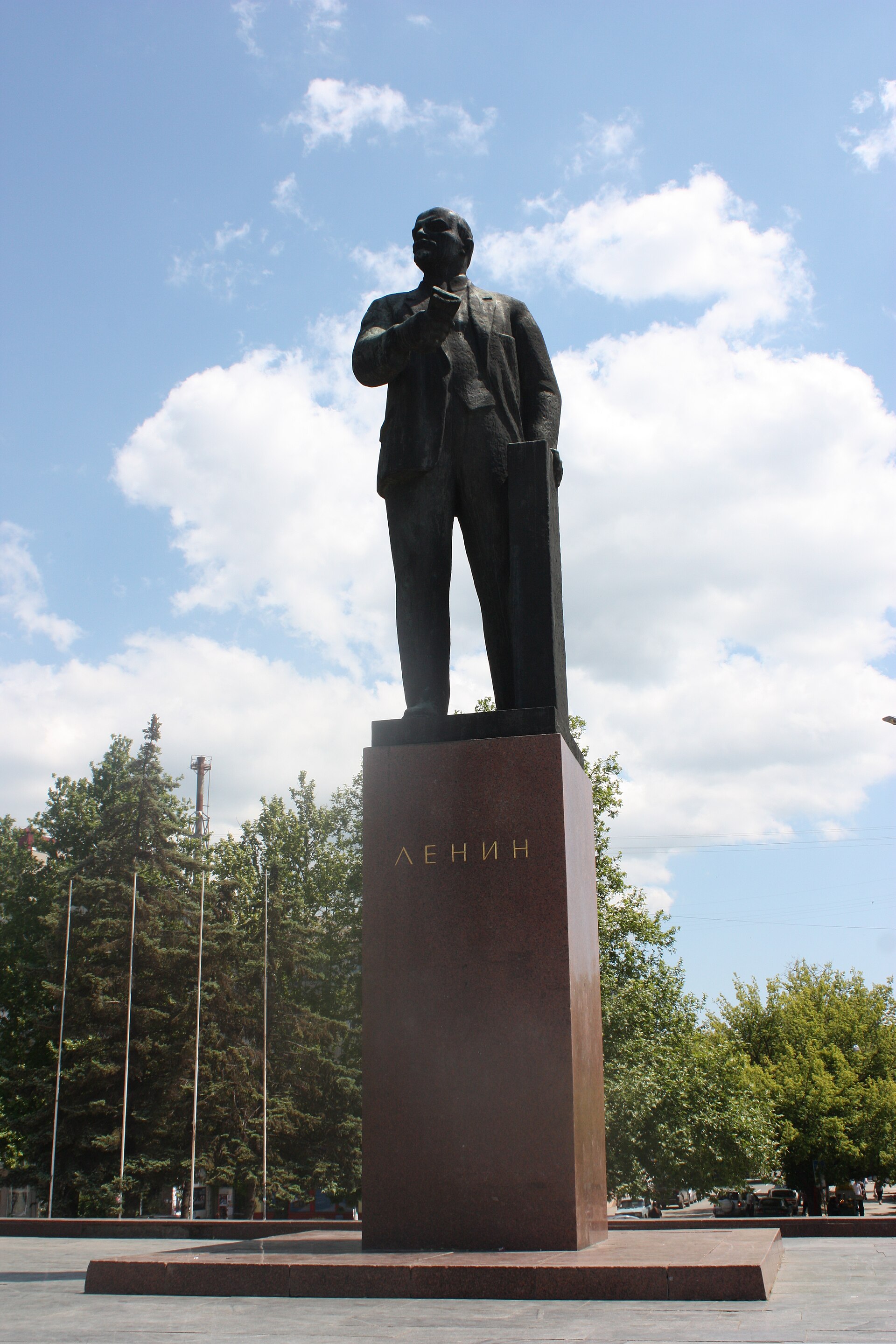
The Lenin Monument in Simferopol is one of those urban landmarks that doesn’t immediately demand attention but quietly becomes part of the city’s rhythm. Standing in Lenin Square at the heart of Simferopol, where the main streets converge, it’s a place where life unfolds in all its ordinary and extraordinary moments. For some, it’s just a bronze figure on a pedestal; for others, it’s a symbol of an era that shaped the course of history. Either way, the monument has long been woven into the fabric of the city, serving as a meeting point, a backdrop for photos, and a convenient starting point for exploring Simferopol.
The statue was unveiled in 1967 to mark the 50th anniversary of the October Revolution. Its creator, the Soviet sculptor Vasily Stamov, was known for his work across many cities of the former USSR. The figure of Lenin is rendered in the stylistic conventions of the time—depicted mid-gesture, with an outstretched arm as if addressing a crowd. The red granite pedestal gives the monument a sense of solidity, yet it doesn’t overwhelm the space around it. Instead, it blends into the square, becoming part of the city’s everyday scenery rather than a dominating presence.
Lenin Square itself is one of Simferopol’s oldest public spaces. In the 19th century, it was home to the Gostiny Dvor, a bustling trading hub where merchants and shoppers gathered. Over time, the square underwent several transformations, particularly during the Soviet era. Today, it’s a broad, open space with fountains, benches, and patches of greenery. Surrounded by administrative buildings, cafes, and shops, the square is always alive, especially on weekends when families, tourists, and locals come to stroll, relax, or simply watch the world go by.
The monument has not been without controversy. In the 1990s, as many cities across the former Soviet Union reconsidered their communist heritage, there were debates about whether the statue should be removed or relocated. In the end, it remained in place, and today it’s seen more as a historical artifact than an ideological statement. For most residents of Simferopol, it’s just another familiar element of the cityscape—neither a source of pride nor a cause for discomfort, but something that simply exists as part of the urban environment.
The architectural surroundings of the square add another layer of interest. Nearby stands the Council of Ministers building of the Republic of Crimea, constructed in the 1950s in the Stalinist Empire style. Its imposing columns and austere lines contrast with the more modern structures around it, yet together they create a distinct character for Simferopol’s city center. Other notable buildings from the Soviet era, like the House of Trade Unions and the Moskva Hotel, contribute to the area’s architectural identity, offering a glimpse into the city’s past.
For visitors, the Lenin Monument is less a must-see attraction and more a practical landmark. It’s a convenient starting point for exploring Simferopol, with the central market, Karl Marx Street’s pedestrian zone, and several museums all within easy reach. While the statue itself may not draw crowds for its artistic merit, it does attract those curious about the Soviet era or the evolution of urban spaces. Tourists often pause here for photos, not so much because of the monument’s significance but because it’s a tangible piece of history.
The square changes with the seasons. In summer, it’s lush and lively, with fountains in full flow and street musicians adding to the atmosphere. Autumn brings golden leaves and the scent of chestnuts, while winter sometimes sees the square transformed into a festive hub, complete with a Christmas tree and holiday markets. Come spring, the area awakens from its winter slumber, and even the bronze Lenin seems to take on a slightly warmer expression as life returns to the city.
Simferopol is a city with a complex history, and the Lenin Monument is just one of its many layers. It doesn’t tell the whole story of the past, but it serves as a reminder of how history accumulates, like sediment over time. The city is a mix of Soviet symbols, Tatar place names, pre-revolutionary buildings, and modern developments, all coexisting in the same space. In that sense, the monument is less a relic of ideology and more a reference point—a place to begin unraveling the many threads that have shaped Simferopol and continue to define it for those who call it home.