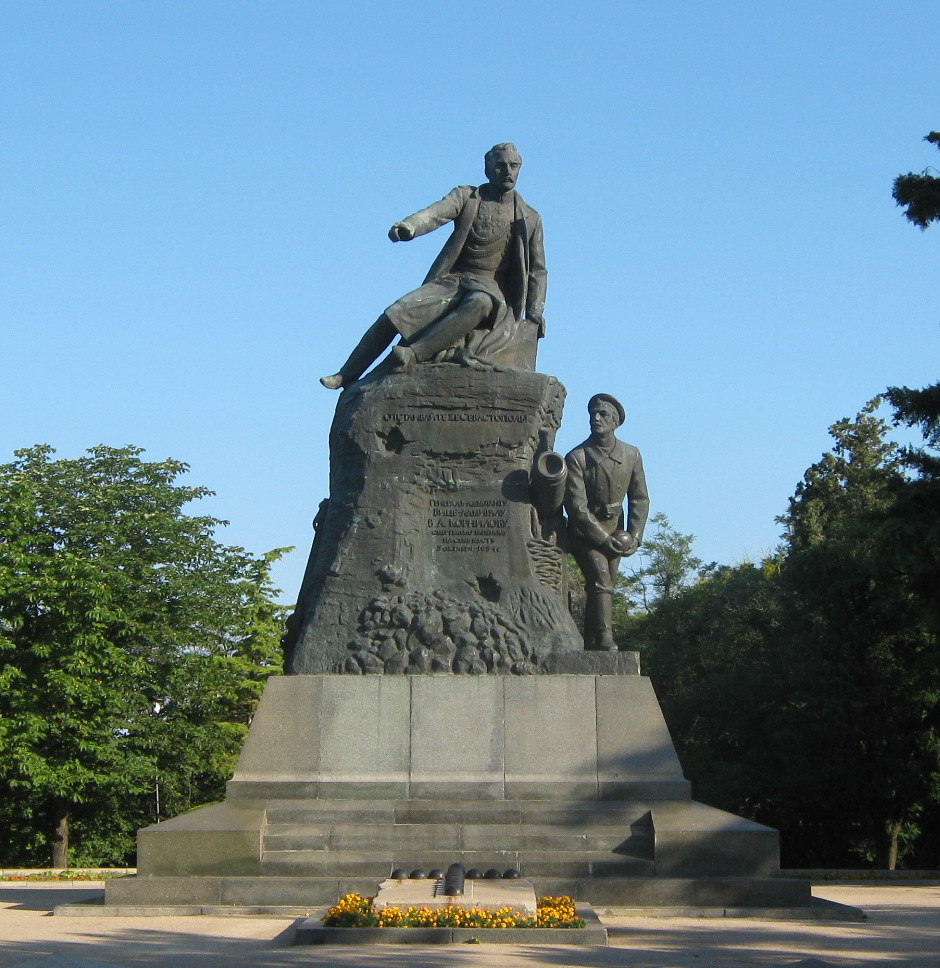
Malakhov Kurgan rises above Sevastopol like a silent witness to the city’s most turbulent chapters. This hill, overlooking the vast expanse of the bay, was once the heart of the Crimean War’s fiercest battles, where the fate of the city hung in the balance. Today, it remains a place where history feels tangible, where the earth still holds the echoes of cannon fire and the footsteps of those who fought here. At its summit stands the monument to Vice Admiral Vladimir Kornilov, a figure whose name is inseparable from the defense of Sevastopol and the resilience of its people.
Kornilov was more than a military leader—he was a symbol of defiance in the face of overwhelming odds. In October 1854, during one of the first major assaults on Malakhov Kurgan, he was mortally wounded while rallying his troops. His death marked a turning point in the siege, yet it also galvanized the city’s defenders, who fought on for nearly a year after losing their commander. The words attributed to him—*I am used to dying on my feet*—have since become a testament to his unwavering resolve. The monument, unveiled forty years later, captures that spirit not through grandeur, but through quiet dignity.
The statue itself is unassuming in its power. Sculpted by Ivan Schröder, Kornilov is depicted in full naval uniform, a spyglass in hand, as if surveying the bay one last time. There’s no theatrical pose, no exaggerated heroism—just a man who knew his duty and faced it without hesitation. The granite pedestal bears reliefs of the siege’s key moments, grounding the monument in the collective memory of the city’s struggle. The inscription is simple, almost understated, as if the weight of history needs no embellishment.
Malakhov Kurgan is more than just a memorial site; it’s an open-air museum where the past lingers in every detail. The earthworks, gun emplacements, and remnants of trenches still trace the contours of the 19th-century battlefield. Walking among them, it’s easy to imagine the chaos of war—the smoke, the shouts, the relentless pressure of an enemy that outnumbered the defenders at every turn. The monument to Kornilov fits seamlessly into this landscape, not as a detached tribute, but as a natural extension of the hill’s own story.
What makes this place remarkable is how it resists the passage of time. Unlike many historical sites that become sanitized for tourists, Malakhov Kurgan retains its raw, unpolished character. The wind carries the scent of the sea, the same wind that once carried the sounds of battle. The view of the bay, now dotted with ships and cranes, remains largely unchanged from the days when Kornilov stood here, watching for the enemy’s approach. It’s a rare kind of continuity, one that connects the present to the past without the need for elaborate explanations.
The monument has endured not just the ravages of war, but the shifting tides of history. In the Soviet era, many imperial-era memorials were dismantled or repurposed, yet Kornilov’s statue remained untouched. Perhaps because his legacy transcends political divides—his courage was not tied to a regime, but to something more enduring: the idea of standing firm when everything else is crumbling. That’s why visitors often linger here longer than at other sites. There’s no rush, no guided tour script to follow. Just the quiet understanding that some stories don’t need to be told in words.
Sevastopol itself is a city that has been rebuilt time and again, yet it has never lost its connection to its past. Malakhov Kurgan and the monument to Kornilov are not relics of a bygone era, but living parts of the city’s identity. They remind us that heroism isn’t confined to history books—it’s in the way a place carries its scars, in the way people still pause to remember. When you stand here, looking out over the bay, it’s impossible not to feel the weight of that history, not as something distant, but as something that still shapes the city today.
The hill is quiet now, the only sounds the cry of gulls and the rustle of leaves. But if you listen closely, you might hear something else—the faint echo of a command, the distant thunder of cannon fire. It’s not a ghost story, but a reminder that history isn’t just about what happened. It’s about what endures. And in Sevastopol, that endurance is written into the land itself.