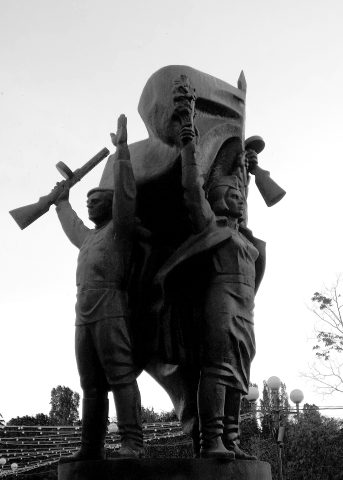
The monument to Prince Vladimir in Belgorod is more than just a statue—it’s a quiet reminder of the deep ties between this city and the early history of Rus. Standing on the high banks of the Seversky Donets River, it overlooks the water and the rolling landscape beyond, a place where the boundaries of the medieval Slavic world once met the open steppe. This was a land of shifting frontiers, where different cultures and peoples intersected for centuries. Prince Vladimir, who brought Christianity to Rus, embodies that era when these southern territories became part of a shared spiritual and political identity.
The sculpture itself follows the traditions of monumental art, depicting Vladimir in full stature, holding a cross in his right hand and a sword at his side. The cross represents his role in the Christianization of Rus, while the sword speaks to the military strength that secured these lands. His expression is calm, but there’s a quiet authority in his posture, as if he’s both a guardian and a guide. The statue rests on a tall pedestal of red granite, blending naturally with the surrounding terrain. At around fifteen meters in height, it’s one of the most striking landmarks in Belgorod, visible from a distance whether you’re approaching by road or along the river.
What sets this monument apart from others dedicated to Vladimir—like those in Moscow or Kyiv—is its setting. Unlike those in bustling city centers, Belgorod’s statue stands in a more contemplative space, surrounded by greenery and the slow curve of the river. There’s a sense of openness here, a place where history feels closer, less mediated by the noise of the city. Locals often come to walk along the riverbanks, especially in warmer months when the area becomes a favorite spot for picnics and quiet reflection. It’s not just a place to honor the past; it’s a space where the past and present coexist.
Belgorod’s connection to Prince Vladimir runs deeper than the monument itself. The city was founded in the late 16th century as a fortress to defend Russia’s southern borders, but its roots stretch back much further. Archaeological evidence suggests that settlements existed here as far back as the time of Kievan Rus, possibly along the very routes Vladimir and his retinue would have traveled as they expanded their influence southward. The monument serves as a bridge between those distant centuries and the modern city, a tangible link to the era when Christianity first took hold in these lands.
The design of the monument reinforces its symbolic weight. The pedestal is shaped like a stepped stylobate, lifting the figure of Vladimir above the surrounding landscape, as if elevating him both physically and spiritually. The statue faces east, a deliberate choice in Christian tradition, where the direction is associated with renewal, light, and the promise of dawn. At night, the monument is illuminated, its silhouette standing out against the dark sky, a beacon that can be seen from afar. It’s a detail that makes the statue feel alive, even in the quiet hours.
For Belgorod, the monument has become more than a historical tribute—it’s part of the city’s cultural fabric. On Orthodox holidays, particularly the Day of the Baptism of Rus on July 28, the area around the statue fills with worshippers paying their respects. At other times, it’s a peaceful spot where people come to walk, think, or simply enjoy the view. The monument doesn’t demand attention; it invites it, offering a moment of stillness in a world that rarely slows down.
The statue fits seamlessly into Belgorod’s landscape, standing near the city’s historic center where 19th-century buildings and old churches still line the streets. From the monument, it’s just a short walk to Sobornaya Square or Mikhail Shchepkin Street, making it easy to combine a visit with other sights. Nearby, the Victory Park and the diorama museum dedicated to the Battle of Kursk offer more layers of history, while the embankment along the Seversky Donets provides a scenic route for a leisurely stroll. The monument isn’t isolated; it’s part of a larger story that unfolds as you move through the city.
What makes this monument meaningful isn’t just its size or its artistry, but the way it connects people to something enduring. It stands at the edge of the city, where the built environment gives way to nature, and where the past meets the present. For Belgorod’s residents, it’s a familiar landmark, woven into the rhythm of daily life. For visitors, it’s a chance to step back and consider the foundations of Russian statehood and faith. There’s no grand narrative here, no forced significance—just the quiet presence of history, the river flowing by, and the sense that some things, like stone and memory, last.