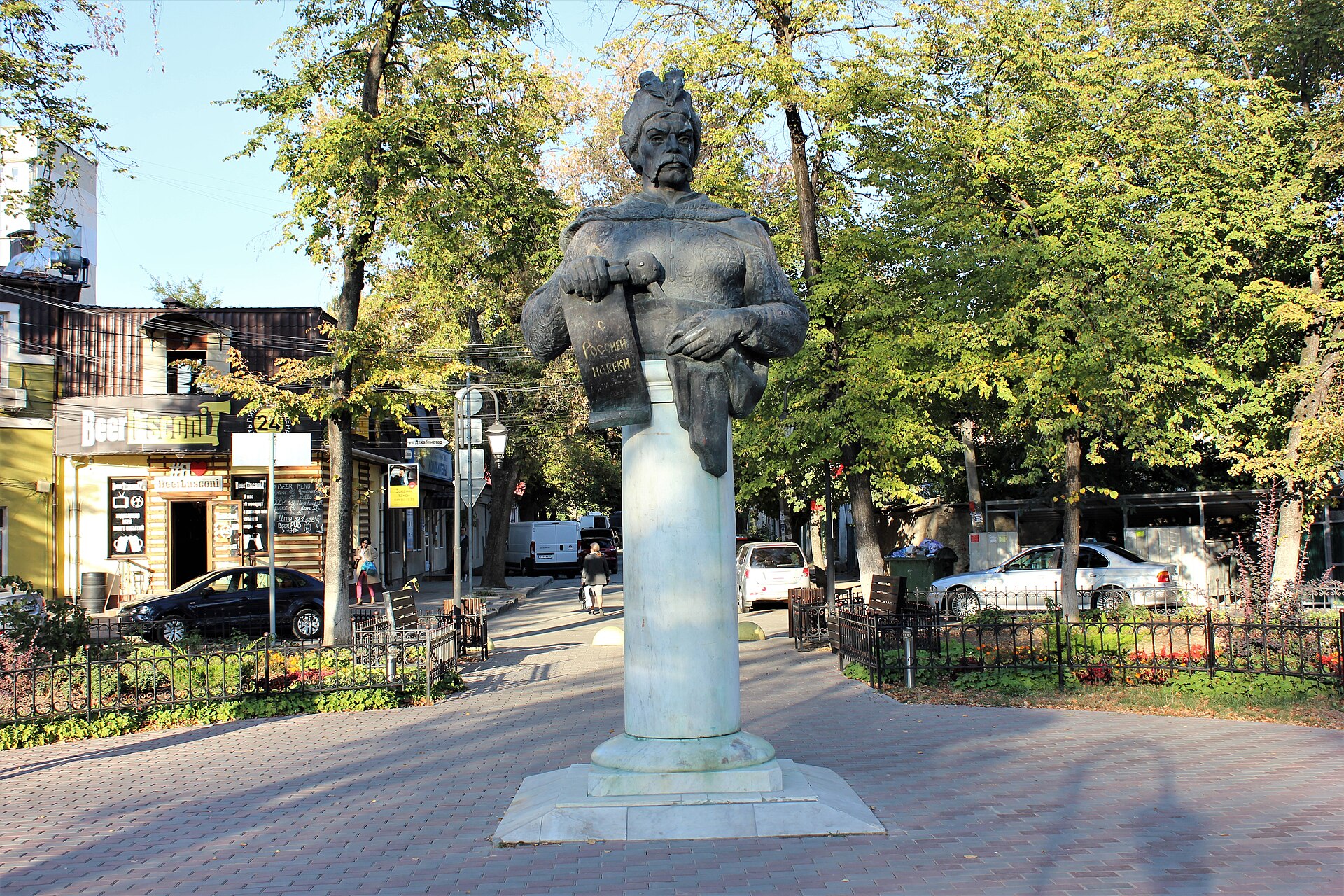
The monument to Bohdan Khmelnytsky in Simferopol is one of those quiet urban landmarks that doesn’t demand attention but reveals itself to those who know where to look. Tucked away on a small square where Kyivska Street meets Sevastopolska, it stands apart from the city’s busier tourist routes, yet firmly within the heart of the old town. Here, among low Soviet-era buildings and a handful of trees, the bronze figure of the hetman appears lost in thought, gazing at passersby with a faint air of detachment.
Bohdan Khmelnytsky, a name deeply tied to 17th-century Ukrainian history, holds a more symbolic than literal place in Simferopol. The monument was erected in 1954, shortly after Crimea became part of the Ukrainian SSR, as part of a broader political effort to strengthen ties between the regions. Created by Ukrainian sculptor Mykhailo Lysenko, the statue depicts Khmelnytsky in traditional Cossack attire, holding a mace and draped in a flowing cloak. The composition is dynamic but not confrontational—here, he is less a warrior than a statesman, contemplating the fate of the land.
The location was chosen deliberately. Kyivska Street, where the monument stands, has long been one of Simferopol’s main thoroughfares, connecting the city center with the train station and industrial outskirts. During the Soviet era, it became a symbolic link between republics, and placing Khmelnytsky’s figure here reinforced that idea. Today, the monument is seen more as a historical tribute than a political statement, though debates about its meaning occasionally resurface.
The setting is modest but typical of mid-20th-century Simferopol. The square is paved with tiles, surrounded by low trees and benches where locals often sit in warmer months. The granite pedestal is simple and unadorned, with an inscription in Ukrainian—a reminder of the era and the intentions behind its creation.
For most visitors, the monument isn’t a primary attraction. Simferopol moves at its own pace, and Khmelnytsky’s statue is just one of many points on its map. But for those interested in history, it offers a moment to reflect on the complex intersections of nations caught between empires. In Crimea, where cultures, languages, and religions have blended for centuries, even a small monument can tell a larger story.
Interestingly, Simferopol has another connection to Khmelnytsky—a street named after him in a different district. There’s nothing particularly notable about it, just a sign with the name. Yet together with the monument, it forms a subtle route, a way to trace how attitudes toward historical figures have shifted over time.
Today, the monument is more than a relic of the past; it’s part of the city’s fabric. It doesn’t draw crowds or demand admiration, but it remains a quiet fixture of Simferopol’s landscape. Around it, daily life unfolds—schoolchildren rushing to class, pensioners chatting on benches, locals hurrying about their day. In this ordinary rhythm, the bronze hetman feels almost alive, as if he exists outside of time, watching the city and the country change around him.