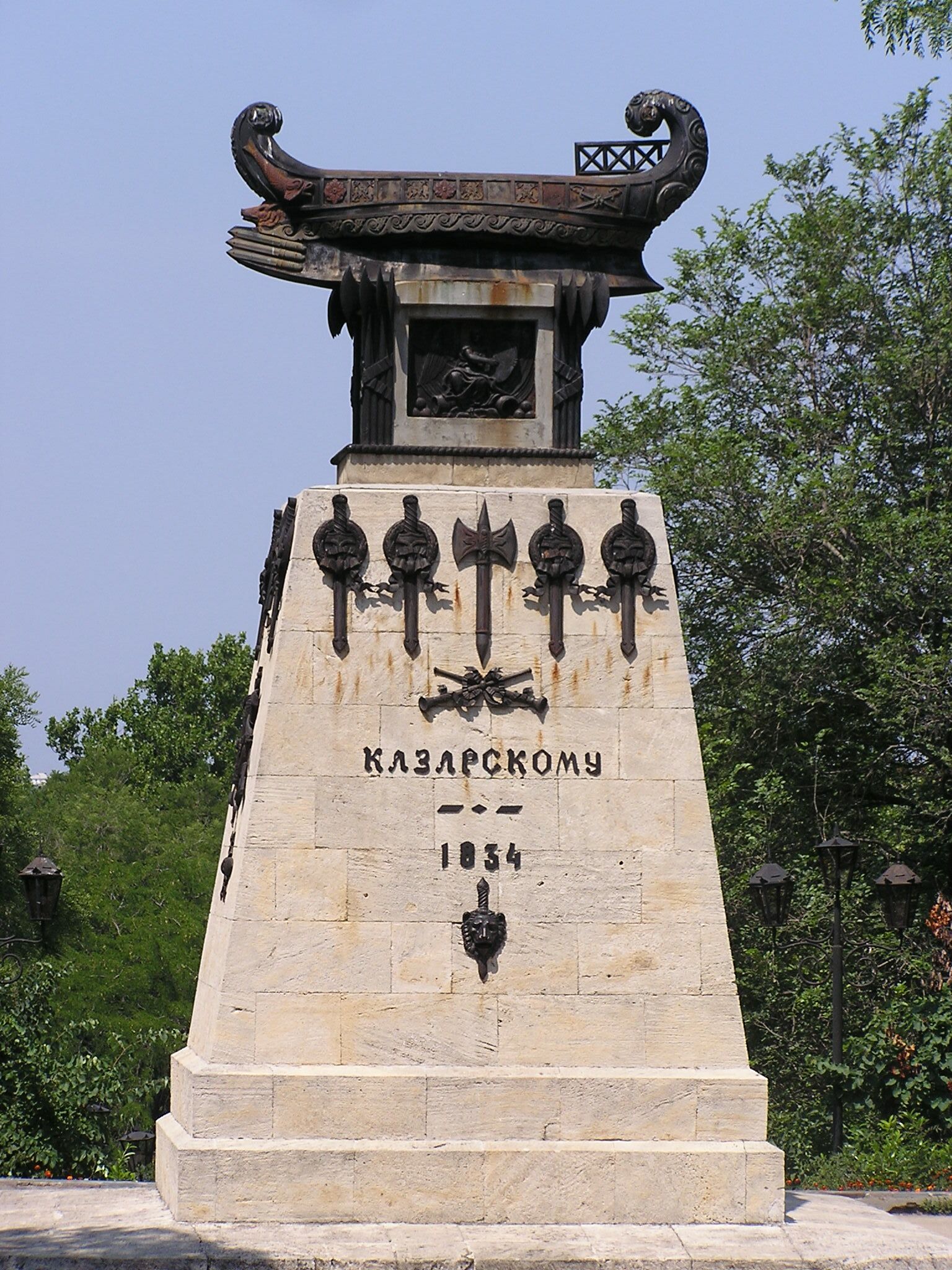
Standing quietly on Matrossky Boulevard in Sevastopol, the monument to Alexander Kazarsky is one of those places that doesn’t demand attention but slowly becomes part of the city’s rhythm. It’s not grand in scale, nor does it dominate the skyline like some of the more famous landmarks nearby. Instead, it occupies a modest space near Ushakov Square, where the bronze figure of a naval captain in mid-gesture seems to watch over the harbor with quiet resolve. The statue itself is unassuming—no dramatic poses or exaggerated details—yet the story behind it carries weight, a reminder of a moment when courage defied the odds.
Kazarsky’s name is tied to one of the most legendary episodes in the history of the Russian Black Sea Fleet. In 1829, during the Russo-Turkish War, he commanded the brig *Mercury*, a small ship that found itself alone against two far larger Turkish vessels. Outnumbered and outgunned, the *Mercury* had little chance of survival, yet Kazarsky chose to fight. Through a combination of tactical brilliance and sheer audacity, his crew managed to damage the enemy ships so severely that they were forced to retreat. The battle became a symbol of defiance, and Kazarsky himself was elevated to the status of a naval hero, his name synonymous with honor and resilience.
The monument was commissioned by Emperor Nicholas I in 1839, just a decade after the battle, as a deliberate act of remembrance. The sculptor, Ivan Martos, was already renowned for his neoclassical works, and he approached the task with the same measured dignity that defined the era. The statue captures Kazarsky in a moment of decision—one hand raised, the other resting on his sword—his expression stern but composed. The pedestal is adorned with bas-reliefs depicting scenes from the battle, while the inscription on the front simply reads *For Distinction*, a phrase that carries more meaning than any elaborate tribute could.
Over the years, the monument has settled into the fabric of Sevastopol. It stands on a slight rise, surrounded by old trees that cast shifting shadows over the bronze, as if the city itself is guarding it from neglect. The area around it is always alive with movement—tourists pausing for photographs, locals cutting through on their way to work, or groups of naval veterans gathering to pay their respects. On holidays, wreaths and flowers appear at the base, and for a moment, the statue seems to come alive, a silent witness to the city’s enduring connection to its past.
What makes this monument particularly interesting is how it transcends the story of one man. In the early 19th century, the Black Sea Fleet was still finding its footing, and victories like the *Mercury*’s were crucial in shaping its identity. Kazarsky’s defiance became a rallying point, a narrative of Russian naval prowess that was carefully cultivated by the imperial government. His image appeared in textbooks, his name was invoked in speeches, and the monument itself became part of a broader effort to instill a sense of national pride. Yet despite this official framing, the story never lost its raw, human core—a small ship refusing to surrender against impossible odds.
The design of the monument reflects the aesthetic ideals of its time. Martos worked in the late neoclassical style, which favored clean lines, symmetry, and a sense of restrained grandeur. The statue’s pose is deliberate, almost theatrical, but without the melodrama that later monuments might have employed. The bas-reliefs on the pedestal tell the story of the battle in a series of frozen moments, their details sharp enough to convey the chaos of combat without overwhelming the viewer. Even the setting—elevated slightly above the surrounding walkways, framed by flowerbeds in warmer months—gives the monument a sense of quiet authority.
Sevastopol is a city where history isn’t just preserved; it’s lived. The monument to Kazarsky is one of those places that helps bridge the gap between past and present. It’s not as imposing as the memorials on Sapun Mountain, nor as frequently visited as the Grafskaya Pier, but that’s part of its charm. There are no crowds here, no tour guides reciting rehearsed scripts. Just a statue that has stood in the same spot for nearly two centuries, and the occasional passerby who stops to read the inscription or simply reflect on what it means to face the impossible.
Remarkably, the monument has survived largely unchanged. Unlike many other statues that were torn down or repurposed during political upheavals, this one endured. Perhaps because its story was never tied to ideology—just a man, a ship, and a choice that resonated far beyond its time. In the Soviet era, it wasn’t demolished or reinterpreted; it remained as it was, a rare continuity in a city that has seen its share of turmoil. Today, it doesn’t feel like a relic. It feels like part of the city’s pulse, a quiet reminder that history isn’t just something you read about—it’s something you can stand next to and touch.
If you find yourself in Sevastopol, take a detour to Ushakov Square. The monument isn’t on the main tourist trail, and that’s a good thing. Here, you can stand in the shade of the trees, look up at Kazarsky’s bronze figure, and imagine the *Mercury* cutting through the waves, its crew knowing they were sailing toward a fight they couldn’t win—but choosing to fight anyway. Sevastopol is full of stories like this, but few are as straightforward, as human, as this one.