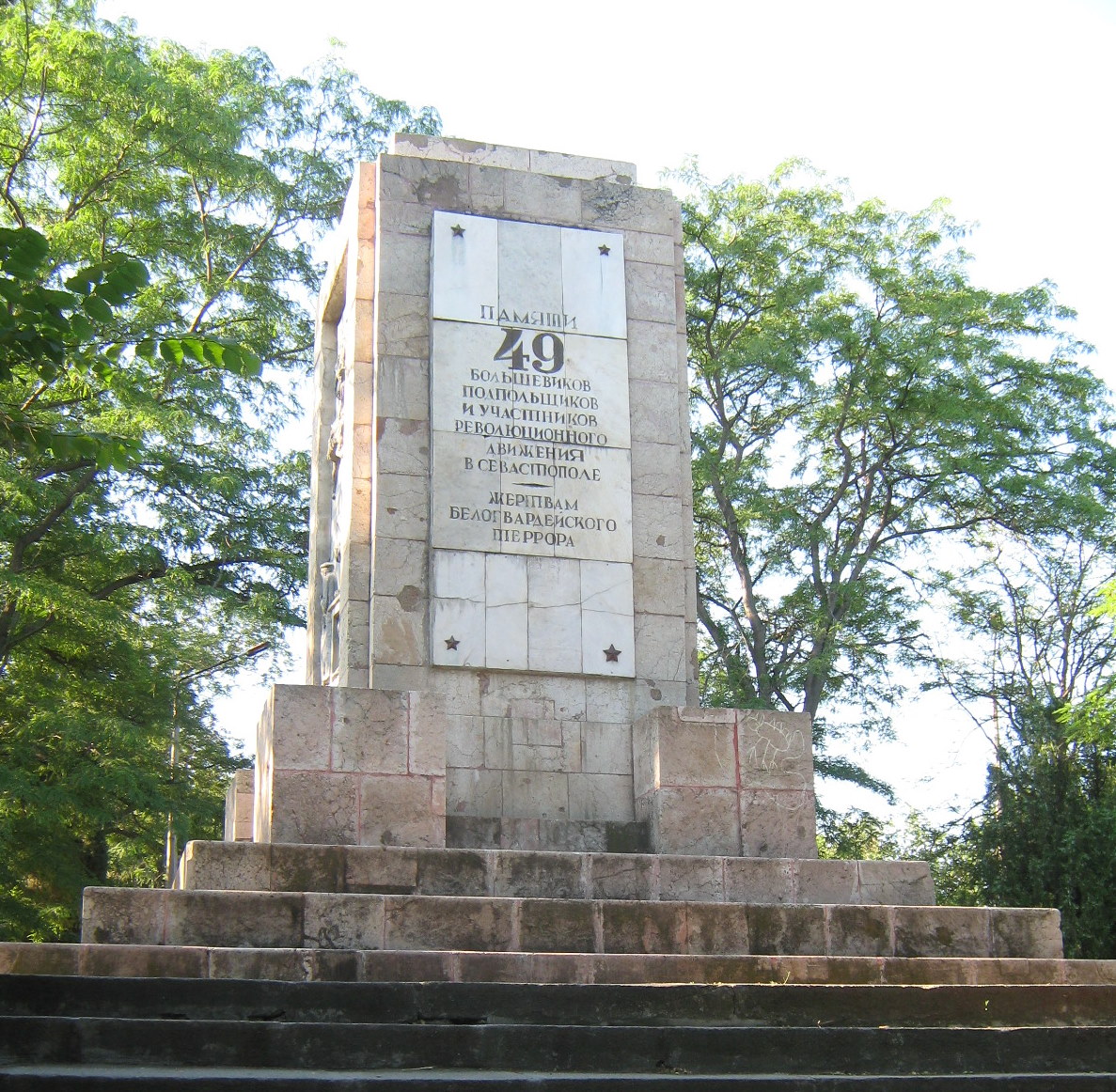
On a hill in Sevastopol, the Monument to the 49 Communards looks over the city and its bay. Here, history doesn’t just sit in books—it lingers in the wind and the salt air. In 1919, workers and sailors took control of Sevastopol for a few weeks during the Russian Civil War. The uprising was short, crushed by White Army forces, but the memory of it stuck. The monument itself went up in 1937, long after the events it marks, when the Soviet government was crafting its version of the past.
The bronze figures of workers and sailors stand with raised fists, their faces set in stern expressions. The design is pure 1930s Soviet monumental sculpture—granite pedestal, rigid lines, a sense of unshakable strength. The gestures are exaggerated, the faces determined, all meant to tell a story of heroism. But the real story was messier: confusion, division, violence. Today, the monument feels less like a political statement and more like a relic.
Kommunarsky Hill, where it stands, was chosen for its view. From here, you see the bay, the old neighborhoods, the waterfront. On clear days, the horizon stretches far beyond the city. The hill has always been part of Sevastopol’s landscape, a place where time feels heavy.
The 49 Communards were executed by White Army forces. Their remains were later reburied on this hill when Soviet rule returned to Crimea. The monument became a place of memory—not just for the dead, but for the ideals they fought for, however brief or flawed. People still come here to lay flowers or walk the paths. Memorial events happen on anniversaries, but the monument also invites quieter moments. How do we remember history? What gets left out?
Sevastopol is a city built on layers of the past. Every street, every stone carries traces of ancient settlements, sieges, wars. Kommunarsky Hill is one of those places where the weight of time is tangible. The area around the monument is peaceful—shaded paths, benches, a breeze cooler than in the streets below. A good spot to sit and think about how history unfolds.
The Monument to the 49 Communards doesn’t draw crowds like the Panorama of the Siege of Sevastopol or Grafskaya Pier. There are no guided tours or museum exhibits. Just silence, space, and the chance to stand where history happened. Sometimes, fresh flowers or notes appear at its base. Occasionally, new symbols or messages show up on the pedestal, reflecting how the past is never truly settled.
Opinions about the monument have shifted over the years. Some see it as an important symbol; others, as a relic. But it remains where it has always been, a quiet witness to Sevastopol’s relationship with its past. The city has always been shaped by history, and this hill is one of those places where that connection is strongest. For some, it’s a place of remembrance. For others, just a scenic overlook. For many, it’s a reminder of how complicated stories of people and nations can be.
The monument is part of Sevastopol’s identity. The city wouldn’t be the same without it.