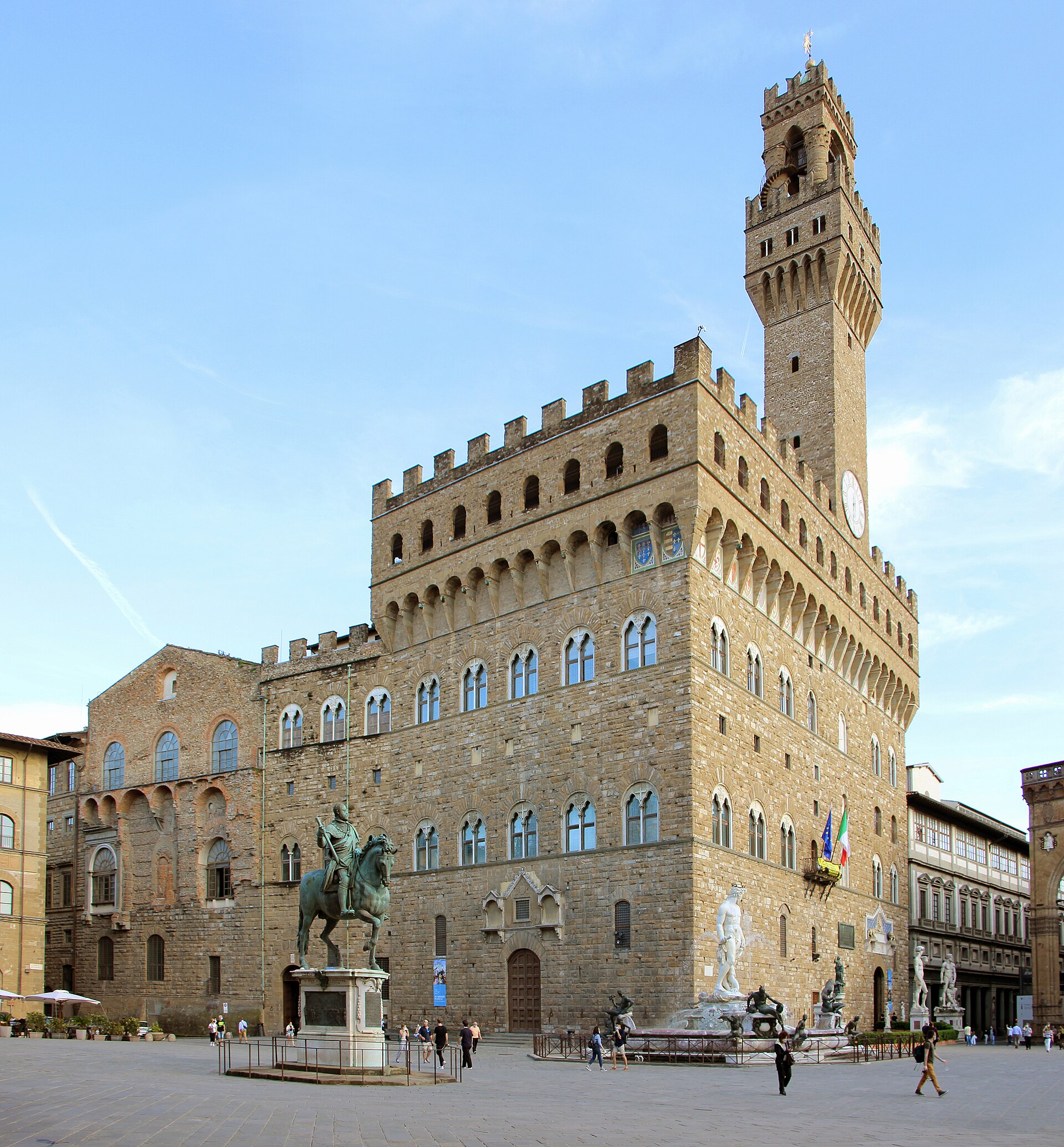
Palazzo Vecchio has stood at the heart of Florence for over seven centuries, a silent witness to the city’s rise and turmoil. Built in the early 1300s as the seat of the Florentine Republic’s government, its walls have absorbed the weight of power, intrigue, and artistic brilliance. Over time, it has been a fortress, a Medici palace, a prison, and now a museum—each era leaving its mark on the stone and frescoes within.
From the outside, the building looks like a medieval stronghold, its rough-hewn walls and crenellated towers designed to intimidate. The narrow windows and imposing bulk were meant to deter attackers, a reminder that Florence was a city that valued both beauty and strength. Yet step inside, and the contrast is striking. The austere exterior gives way to halls adorned with gold leaf, intricate frescoes, and masterpieces of the Renaissance. The tower, once a lookout post, now offers one of the best views over the city’s terracotta rooftops, where the Arno River winds through streets that have changed little since the days of Dante.
The palace’s interiors are a testament to Florence’s golden age. Giorgio Vasari’s frescoes cover ceilings in vivid detail, while sculptures by Donatello and paintings by Bronzino line the walls. The Salone dei Cinquecento, the grand hall where the republic’s councils once met, is particularly impressive. Its vast ceiling depicts scenes from the life of Cosimo I de’ Medici, while the walls are filled with allegories of virtue and victory. Among the treasures here is Donatello’s *Judith and Holofernes*, a bronze sculpture that once stood in the piazza outside, a symbol of the city’s defiance.
The Medici family transformed Palazzo Vecchio into a center of power and patronage. Cosimo I moved his court here from the Palazzo Medici, expanding the building and filling it with art that reflected his ambition. The palace became a stage for political theater, where alliances were forged and rivalries played out. Many of the works commissioned during this time remain in place, offering a glimpse into the tastes and aspirations of Florence’s most famous dynasty.
By the 19th century, the palace had taken on a new role as a symbol of Italian unification. The Tuscan parliament met here, and later, during Mussolini’s regime, the building was used for propaganda purposes. Today, it serves as a museum and a venue for exhibitions, its halls still echoing with the voices of those who shaped Florence’s destiny.
The palace holds secrets beneath its grand public spaces. Narrow spiral staircases lead to hidden chambers where treasures were once concealed, and in the cellars, the remains of an ancient Roman theater lie beneath the foundations. Climbing to the upper floors, visitors can look out over the city, where every street and square has its own story—some whispered in guidebooks, others lost to time.
The inner courtyard offers a quiet respite from the bustle of the piazza. A fountain trickles softly, and the cool stone walls provide relief from the Tuscan sun. Here, it’s easy to linger, tracing the details of the frescoes or imagining the debates that once filled these halls. The light shifts across the gilded ceilings, and for a moment, the past feels almost tangible—a place where history isn’t just remembered, but lived.