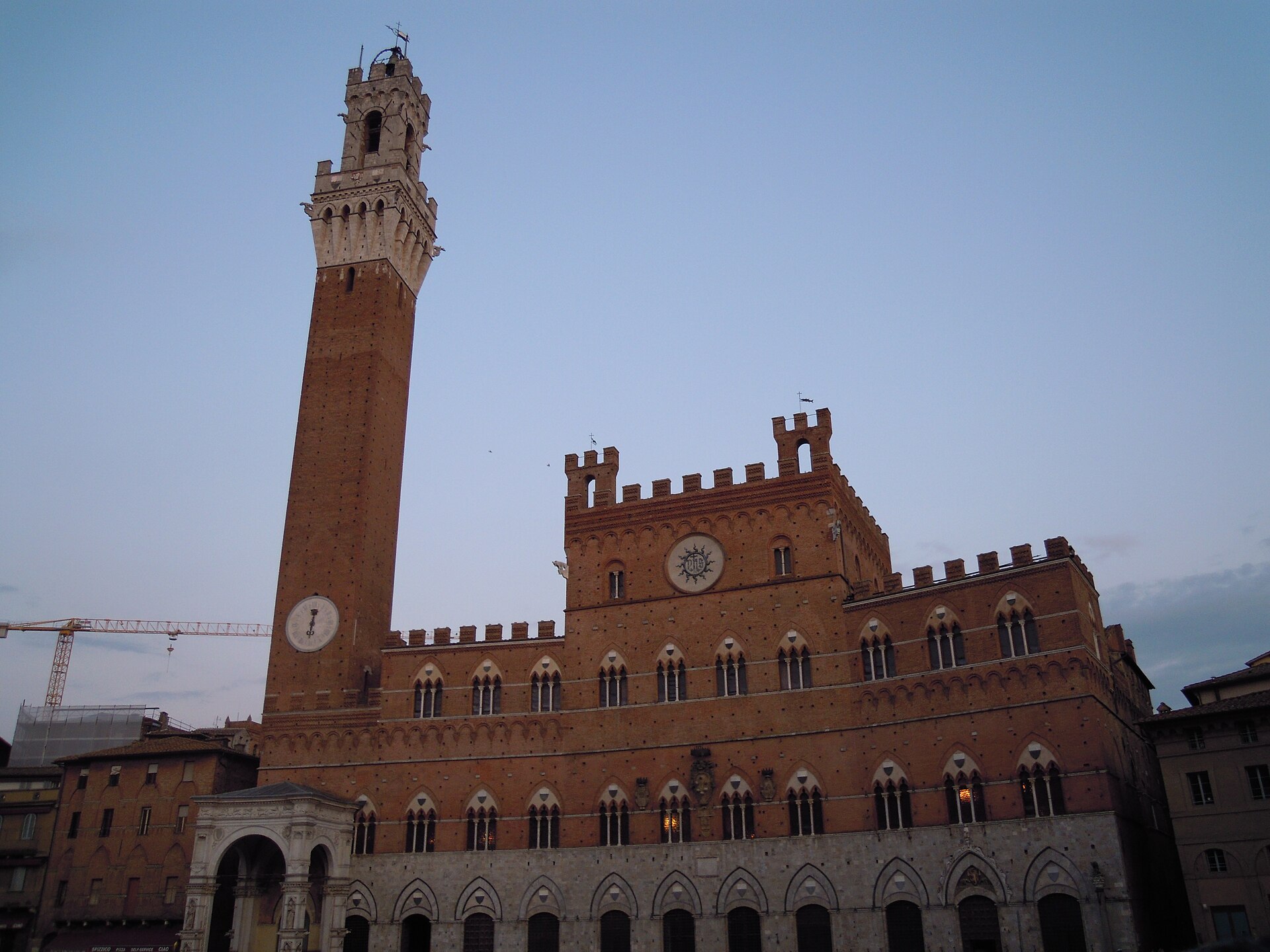
Palazzo Pubblico in Siena is one of those rare places where history isn’t just preserved in stone—it still breathes, shaping the city’s rhythm even today. Built in the early 14th century, this imposing structure became the symbol of the Sienese Republic, a medieval powerhouse that rivaled Florence for dominance in Tuscany. Its architecture reflects the era’s spirit: sturdy brick walls, clean lines, and the unmistakable silhouette of the Torre del Mangia, a crenellated tower that once served as both a defensive stronghold and a proud declaration of the city’s independence. Back then, Siena was a self-governing republic with its own currency, laws, and military, and the tower still stands as a reminder of that legacy, looming over Piazza del Campo like a silent guardian of the past.
Inside, the palace holds frescoes that read like an illustrated encyclopedia of medieval life. The most famous among them is Ambrogio Lorenzetti’s *Allegory of Good and Bad Government*, painted between 1338 and 1339. These murals weren’t just decoration for the Sala dei Nove, where the city’s ruling council met—they were a political manifesto. One wall depicts the rewards of just rule: fertile fields, bustling markets, and contented citizens going about their lives in safety. The opposite wall shows the chaos of tyranny—burning villages, deserted roads, and fear etched into every face. What makes Lorenzetti’s work extraordinary is its secular focus. At a time when most art revolved around religious themes, these frescoes were among the first in Europe to tackle politics and civic life head-on, offering a vision of how society *should* function.
The palace is inseparable from Piazza del Campo, one of Italy’s most celebrated squares. Every July, the piazza transforms into the stage for the Palio, Siena’s legendary bareback horse race, where the city’s contrade (districts) compete in a frenzied, high-stakes spectacle. But even on ordinary days, the square hums with life. Tourists linger by the Fonte Gaia, the ornate fountain that anchors the space, while locals sip espresso under the arcades or gather on the steps to chat. The Palazzo Pubblico remains the square’s focal point, just as it has for centuries, a constant presence amid the ebb and flow of daily life.
The interiors are as striking as the building’s exterior. The Sala del Mappamondo houses ancient maps that once guided Sienese leaders in their understanding of the world, including one of Europe’s earliest known cartographic representations from the 14th century. Other rooms display gifts to the city over the centuries—sculptures, paintings, and tapestries that tell their own stories. Among them is Simone Martini’s *Maestà*, a masterpiece of the Sienese school and a defining work of Gothic art. The painting’s delicate gold leaf and serene figures capture the spiritual and artistic ideals of the time, offering a quiet counterpoint to the palace’s more overtly political spaces.
Yet Palazzo Pubblico is more than a museum. It’s a living part of Siena’s civic life, where history and modernity coexist. Some rooms still serve official functions, and the city’s municipal offices occupy part of the building. While certain areas are only accessible during guided tours, even the courtyard feels like a bridge between past and present. Enclosed by arched walkways, it was once a hub for merchants and artisans, and today it occasionally hosts exhibitions or concerts. Standing there, it’s easy to imagine the voices that have echoed through these walls over the centuries—debates, deals, and decisions that shaped the city’s fate.
Siena itself is a city of contrasts. It’s a medieval time capsule with winding alleys and centuries-old traditions, but it’s also a vibrant university town where students fill the cafés and piazzas with youthful energy. Palazzo Pubblico embodies this duality. It stands at the intersection of old and new, a reminder that some places endure not by resisting change, but by adapting to it. The building has witnessed wars, plagues, and political upheavals, yet it remains a symbol of Siena’s resilience. That’s why people keep returning—not just to see history, but to feel its pulse, still beating strong after all these years.